Showing posts with label thinking. Show all posts

Friday, October 17, 2025

Patriotism vs. Nationalism

There is a lot of current conversation using the words patriotism and nationalism as though they were interchangeable phrases or concepts. Historically, they have not been interchangeable and I would argue they’re not today either. 


Patriotism and nationalism differ in the areas of unity vs. uniformity, reflection, and expectation around improvement. They both reflect a love of country and a pride in home and aspects of history. One is more willing to embrace truth-telling than the other. 


With regard to unity vs. uniformity, nationalism seeks the latter. Most nationalist movements have a concept of the “ideal” citizen in terms of race, religion, and/or political ideology. In the beginning of most nationalist movements, this is the “quiet” part. Leaders of the movement don’t necessarily specify these preferred expressions because they need everyone to be “all in” in order to achieve power. Eventually, though, the truth will out. Look to who speaks for the group most often and most publicly. Do not look for tokens, but for the most regular way of being. There are always early signs of the expectation of uniformity. 


Healthy patriotism seeks unity. This can be difficult to achieve because it involves listening, compromise, sharing of power and resources, and the pursuit of goals in common. An effort toward unity requires work that not everyone wants to do because it can be slow. Reciprocity and careful communication are required. Progress can be made. Within some of the greatest historical movements, there have always been tensions among leaders, but the change happened in the struggle for unity on the things that mattered most to the most. 


Patriotism allows and encourages reflection on history - celebrating victories and movements and learning from failures and losses. This reflection is not a blame game, but a chance to see the multi-sided truth of what happened, who was harmed, who benefitted, and how we got to where we are. This can be hard and, sometimes, painful work. Patriotism, as a deep love of country, sees it as necessary to continue to grow and to achieve the dreams of all who call a place home. 


Nationalism turns away from deep reflection. The narrow way of this mindset does not allow for the space to consider multiple viewpoints. In fact, integration of a variety of viewpoints would conflict with the preference for uniformity. Nationalism wants us all to accept the stated narrative, without consideration of additional information or experience. Even when a historical consideration is generally considered objectively harmful, the door to additional reflection is often shut to prevent “stirring up trouble” or bringing up things that are “over”. 


Finally, a patriot loves their country enough to be truthful about room for improvement. Accepting that the work will be on-going and sometimes tough, patriotism knows that the dreams continue and the effort to reach the mountaintop carries on. Patriotism can simultaneously recognize sacrifice and dedication AND expect moral deliberation and a pursuit of justice and liberty for all. No patriot would ever see these as mutually exclusive. 


Nationalism loves power. The strong fist, the weapon, the rules (written and unwritten) are the tools that keep those who would stray out of line with the vision of the future. Obedience has a high value and questions are viewed as the gateway to disobedience. In history, nationalist movements are known for having redefined common terms, for creating outgroups and scapegoats, and for shifting the settled laws and norms of the land, both inside and outside of legal channels. Viewed through the lens of history, nationalist movements often look like cults, but we rarely use that term because of the scope of their work in government(s). 


Patriotism and nationalism are not the same. They don’t have the same goals and they don’t show up in the world in the same way. There are many ways of defining them, but even if you use my basic definitions you should be able to tell them apart.


Here’s a story about my kid, both to illustrate a point and because I’m proud of him. My teen runs cross-country. In a recent race, he sacrificed the opportunity to improve his personal record or event experience to pace a teammate. This meant running with the teammate to help him qualify for state competition. The sacrifice meant having a full team to go to state competition and an improved time for the teammate, if a slower time in one race for my son. 


Patriotism is loving your team (country) enough to know that sometimes you will be called upon to sacrifice some for the good of the whole. It means wanting everyone to make it to the finish and to the next thing. It means telling the truth about what has to be done, what will work, what doesn’t work, and celebrating together. Both the individual AND the team matter. 


Patriotism wants us all to thrive as a team. Nationalism only wants certain of us on the podium. Don’t get them confused. 


Wednesday, November 30, 2016

Rend The Heavens: Advent Day 4

Due to having surgery this week, I'm starting a little behind on this daily devotional. I'll catch up days 1-3 at some point. See the prompts here.

Text: And he will send out his angels with a loud trumpet call, and they will gather his elect from the four winds, from one end of heaven to the other. Matthew 24:31

Prompt: SHUT UP

Yesterday, I had my uterus removed. After several years of pain and bleeding and messiness and discomfort and solutions that only created more problems, we did the thing that would make it all
stop. We removed the source of the problem. 

"Shut up" is the utterance we think of- possibly a little rude- when we want someone  or something to stop talking or making noise or creating a distraction. 

I wanted my uterus to shut up. It had served its purpose for me (growing two healthy babies) and now it was dysfunctional and its noisiness was disruptive and painful. 

Since I didn't often mention the pain I was experiencing and since I am only 35, people have asked if I was emotionally okay with having a hysterectomy. Was I grieving the removal of an organ that was ... was what? For me, being a woman was not tied to having a uterus, but I can see and perceive in the larger culture that ways of being are tightly defined, narrowly constrained, and the more clearly defined by parts and labels, the more comfortable most people are. 

However, comfort as a noun is not something to which Christians are called to aspire. We are called to comfort- the verb form. We are called to open our eyes, ears, minds, and hearts to God's work that is beyond definition and comprehension. We are led to "paths as yet untrodden and through perils unknown". Along the way, we are to comfort. Comforting others does not mean offering platitudes or promises that are hollow at best and lies at worst. 

Offering true comfort means shutting up and listening. Shutting up and showing up. Shutting up quietism and releasing the fire within our bones. 

I was not defined by my uterus and now I am not defined by not having one. On the day of the trumpet sound, I will not have to account for the parts I had or have. Instead, my words will be shut up as I account for my time. Will it turn out that I sought to be comforted or to comfort? 

Will it turn out that I shut up long enough, loudly enough to hear where I was called to be and to offer the comfort that can only come from God? 

Friday, October 28, 2016

When the Body of Christ is Fat

Bitmoji Julia enjoys tea
Within a very short amount of time, two people whom I love were called "fat ass". One of these slurs occurred in the church building and the other occurred in the same building and within the context of worship. Both incidents were the result of a person with already impaired judgment lashing out at the person who was in front of them, perceiving them to be unhelpful or denying aid or service. Regardless of the "why", the reality is that the name was uncalled for, hurtful, and aimed to be a deep cut.

The reality is that a person who is under the influence of legal or illegal substances and often displays impaired judgment can still tell that body shaming- comments about shape, appearance, or size- is a way to lash out at someone who is frustrating you. That means those words and that way of using them are deeply rooted in our culture. An additional truth is that when we, as a congregation, attempted to console and listen to those who had been hurt in this encounter, I don't know that we said anything about the slur "fat ass" being wrong. "You shouldn't have to hear that" or "I'm sorry that happened" is not the same as "That was a crappy thing to hear, especially since it's untrue."

Bitmoji Julia doesn't care for this.
I've turned these events over and over in my mind. I have an unformed set of theological thoughts roiling around in there and I can't seem to make them beautiful, but I can sense their truth. The church is not good at talking about body image- especially as it relates to size. Even as we come to understand race, culture, sex, gender expression, attraction, and even mental health as things that are innate, but not necessarily immutable- we have not applied that learning or that spiritual growth to body size and shape. Even in the life of a congregation, we reflect the cultural idea that a bigger body is related to immorality. Despite a wealth of scientific information related to body size and shape as inherited, that BMI is not worth the metal to make the calipers, that a sedentary life is the biggest health risk, and that diets rarely produce long-term, lasting results... despite all of this, the church still jumps on the bandwagon of good/bad food choices, silence in the face of fat and/or thin shaming, privatizing size (it's all your fault), and ignoring the call to physically move.

The church is the place where we are supposed to reveal an inclusive welcome, open arms, and a reflection that all people are children of God. What happens when we don't include size- fatness and thinness- in that conversation? When our scripture readings are about banqueting, feasting, rich wines and marrow, open tables, hospitality, and eating in community, how often do we subvert that welcome and the joy of creation by creating binaries about what we should and shouldn't eat, can and can't wear, do and don't look?

Bitmoji Julia feels this more than real Julia
Lest you think that I have no idea what I am talking about, I know my own weight so well that I know if I am down just 2 pounds. I wrestle with my own body image, including how much of it there is. I would be tempted to respond being called "fat ass" with saying, "You probably need your eyes checked because that's not all that's fat." Of course, I acknowledge that while I have high BMI (worth nothing!), I am on the smaller side of being overweight. My weight also doesn't conflict with what I enjoy doing- outdoors or otherwise and yet I am hyper-aware of it. When I think of the gifts I can give to God, I would quickly name my brain or my ears or my hands and feet- as though these exist on their own, instead of within the sanctified casing of the rest of my body.

I appeal to you therefore, brothers, by the mercies of God, to present your bodies as a living sacrifice, holy and acceptable to God, which is your spiritual worship. Romans 12:1

Bitmoji Julia tells it on the mountain
Then God said, “Let us [shape soil] in our image, after our likeness. And let them have dominion over the fish of the sea and over the birds of the heavens and over the livestock and over all the earth and over every creeping thing that creeps on the earth.” So God created [humans in the  Divine] image, in the image of God [they were created]; male and female he created them. Genesis 1:26-27

So, whether you eat or drink, or whatever you do, do all to the glory of God.1 Corinthians 10:31


So, what do we do with this? How do we move to make sure that body shaming is not part of church culture and that health, wellness appreciation, and confidence in God's creation is? 

1. Do not make food "good" or "bad". All food is a political choice. When we decide what to eat or what to provide, we are deciding where to put our money, our community resources and time, our energy, and our support (expressed and unexpressed). Think about what you want to communicate about how you perceive God in farming, ranching, research, community life, and vocation through the food you provide or consume- both as individuals and as a congregation. 

2. Fat people know they are fat. They probably know better than you what they weigh, their measurements, and where they can find clothes and where they can't. Do not participate in shaming by ignoring or by patronizing. Also, do not assume they have no idea how to make correct food choices or exercise habits. Don't moralize size. 

3. Consider what it means that a sedentary life is more dangerous than being overweight or obese. Who do you know who might need a walking partner who is understanding and willing to go slow? Who might need a friend to come by a couple times a week for a low-impact exercise video? Who else might need to know that they aren't alone in having Type 2 Diabetes? Could you rideshare to the hospital's T2 class or organize a presentation with a nurse at the church for the community? 

4.  Do not assume that all health issues are related to weight or that weight is automatically related to stress. Sometimes yes, but sometimes no. Are you the doctor of everybody? 

5. When someone struggles because of their size (thinness or fatness), do not pretend that their body is not a real thing. Being rejected from an exit row seat because one needs a seat belt extender isn't actually an FAA regulation and it is pretty insulting. Acknowledge that this is a hurtful thing and be willing to listen to what it stirs up in the person. When someone is called a "fat ass", listen to that story. Maybe it hurt them, maybe they dismiss it. Acknowledge that this is about an attempt to embarrass them about their body- a reality of their world and how they are created. 

6. Do not participate in body shaming of any type (yourself or others), including when it happens to people you don't particularly like. Loving your neighbor means critiquing their behavior with an eye toward repentance or metanoia (turning around), not being cruel about something that is part of how God has made them. 

7. The Body of Christ is the body of Christ. Sometimes it has a soft, squidgy tummy or flappy upper arms or large strong thighs or round face. The fat body of Christ can still come to your house and do a load of laundry when you are flattened by chemotherapy. The underweight body of Christ can still bring a pizza to a family after an adoption. The roly-poly body can collect your cups after communion with Spirit-filled smile and the body that cannot keep up with its metabolic disorder can still read the gospel during Bible study. The Body of Christ is the body of Christ.

What would it look like for the church to embody this? 


Tuesday, October 4, 2016

Litany for Loosing

This was written for a prayer service in Anchorage, Alaska in response to a significant rise in reported homicides and other personal crimes. It has a partner in the Litany for Binding.

Holy God of all creation, you are always moving toward resurrection, restoration, and reformation. With the help of the Holy Spirit, we are open to this work.

We truly welcome this.

God of love and light, you have provided us with diversity in race, creed, sexuality, experience, gender, and spiritual gifts- all of which can be used for healing and peace. With the help of the Holy Spirit, we are open to this work.

We truly welcome this.

God of peace and hope, open our eyes and ears to see and hear stories of pain and promise that we might hold space for one another and move toward reconciliation. With the help of the Holy Spirit, we are open to this work.

We truly welcome this.

God of consolation and mercy, those who grieve need accompaniment not only in the hours after death, but in the weeks, months, and years ahead. With the help of the Holy Spirit, we are open to this work.

We truly welcome this.

God of justice and peace, help us to value the vocations of all who live within our city, peace officers and fire fighters, teachers and municipal employees, tourists and residents. With the help of the Holy Spirit, we are open to this work.

We truly welcome this.

God of the living Word, grant us the courage and will to challenge complacency, resignation, and resistance against change and community. With the help of the Holy Spirit, we are open to this work.

We truly welcome this.


Holy God, you are the ground and source of our very being. You have revealed your faithfulness through keeping your covenants, sending your prophets, and through the birth, life, and resurrection of Jesus, your Son and our Savior. Knowing that you cause all things to work for good, we dare to ask that we would see that in Anchorage here and now. We ask to be part of how you heal and restore this city. We ask for change and we seek to accept how it convicts and transforms each of us in its wake. Stir up your Holy Spirit in us and send your peace to us and through us into the world. We ask all this in Christ’s name… [and all God’s children said]… Amen.

Tuesday, September 6, 2016

ING #1

HEARING

I've been trying to catch up on my podcasts since I didn't listen to nearly any during the month of June. That means I'm months behind in Stuff You Missed In History Class, This American Life, Slate, and many others. I'm interested in adding another book podcast to my feed, but I don't know if that's wise financially. (The podcast is free, but... books.) Not all the podcasts are child-friendly and since a lot of my time in the car (otherwise known as podcast time) is with kids, some things have to wait. 

I also have three new audiobooks waiting. 

SEEING

I'm seeing fall. Of course, that means winter is, at best, 2-3 weeks away (hello, Alaska!). The yellow birch is gorgeous, though. 


MAKING

I have a lot of crocheting projects anywhere from just started to almost finished. And it's almost hat making season! 

DREAMING

I'm going to start a second blog (because I'm so good at this one). The second one will be focused on book reviews only. I'd like to have a concentrated place for that work and more discipline about that part of my writing life. Stay tuned!

PLANNING

I have some travel for work coming up in October. Need to get a lot of things in motion for that. 

LISTENING

There's a lot of pain in the world right now. I'm listening to stories, sitting with information, and letting go of what's not mine to hold. 

WATCHING

I'm watching my To Be Read pile get out of control. 

READING

In some shape, form, or fashion, I'm reading Firecracker Boys, Trouble I Seen, HillBilly Elegy, The Shelf, Why Be Happy... and Adnan's Story. Send snacks!

(Please don't ask me what I have pre-ordered that's coming out in the next couple weeks. Forget the snacks; I need a lifeboat, a au pair, and a backup reader!)

 EATING


I don't always snack, but when I do... I eat the best gummies in the world! 

GOING

All over town... soon to the hospital to visit a parishioner after her surgery for a broken ankle. 

THINKING

I am 100% ready for the election to be over. I am tired of the "commentary", the "quotes", the "research", the "journalism", and the complete lack of real conversation about what's actually happening in the world in the lives of real people (not people who are good for photo ops). 

FEELING

I feel saddened and frustrated that two people I care about have been called "fat ass" by strangers recently. In particular, I consider that they were probably told by well-meaning people, possibly including me, that the insult was unnecessary and mean, but did we say it was untrue? Did we counter with a different truth about their bodies and how their bodies are used in God's kin-dom? I believe in health at any and every size, but I am not sure that I communicated that well in a time when people may have been shamed or hurt about their bodies and their receipt in community. 

LEARNING 

I am learning to be clearer about boundaries, especially what's my job and what isn't. I think about what is mine to fix and what isn't. What's your shit to own and what isn't. 

LOVING

I love that it is finally cold enough for me to sleep well. This probably means that my husband is going to want to close the windows soon. Noooooooo!

Tuesday, August 2, 2016

Fairy Tale Ending

The BlogHer August prompts are about fairy tales.

Do you believe it's possible for some people to get that fairy tale ending of happily ever after?

I think it depends on what we think happily ever after looks like. I read a lot of romance novels and the community of romance readers is very big on what we call the HEA (happily ever after). In fact, if there is a not a clear resolution of conflict and at least the implication that the main characters are going to live together in love and harmony, then we're fairly quick to reject it as romance. 

However, HEA covers a multitude of dishes, vacation squabbles, differences of opinion, socks forgotten on the stairs, burned dinner, and general frustration. The implication is that love will cover all these things- if indeed any of these things occur. Many contemporary (setting and writing) romances deal with a variety of more complex issues: learning difficulties, mismatched personalities, chronic illness, children who are more than genial plot devices, temptations, anxiety, and other real life/world issues. 

The next station on that train of thought for me is that if HEA was enough, the gospels would be the end of our written scripture. They would end with an empty tomb, encounters with the risen Christ, and then we would fade to the sunset. Ta-da! And Peter and James and John and Thomas and Mary Magdalene and Johanna and the other Mary all lived happily ever after. 

Except that Acts tells us otherwise. And our experience of church tells us the same. 

There is an HEA of resurrection, promise, and presence, but there is also work. Riding off into the sunset with the risen Jesus only leads to the sunrise and the one after that and the one after that. As it turns out, the fairy tale ending is just the end of the recitation. It's the commencement of the work of living out the togetherness that was the joy of the story. 

So do I believe that it is possible for some people to get that fairy tale ending of happily ever after? 

I do. I really do. But I think the ending is only the beginning- the beginning of the work of the new life, the new love, and the new reality that has been made in the HEA. 

Tuesday, July 5, 2016

Corpus Christi

Thirty-five days ago, I left Poland. It has not yet left me and I don't really expect that it will. I am still sorting through what I saw, felt, heard, and experienced. Some of these things may take years to put together and some I may have already forgotten. Only God knows how these things will finally take shape or root within me.

There is one experience that I actually continue to think about almost daily. Going in, I thought about this with almost anthropological interest, but very little emotional attachment. Yet, now, I think of it constantly. When I think of this situation, I feel grief and frustration, sadness and hurt, impassioned and, yet, paralyzed.

By Manederequesens (Own work) [CC BY-SA 4.0], via Wikimedia Commons
On Thursday, May 26th, Roman Catholic Poles, along with Roman Catholics around the world, celebrated the Feast of Corpus Christi. In Krakow, the Friend of Calvin who came to visit me and I were interested to see the observance of this feast. It is a national holiday in Poland with many shops and places closed for observance. There is a procession from Wawel Castle to Krakow's Main Square and St. Mary's Basilica.

The procession involves a priest carrying the Host, the consecrated bread of communion, in a monstrance under a canopy, which is itself carried by deacons. Behind the priest is a procession of hundreds, if not a thousand, people. There were soldiers, nuns (so many nuns), monks, priests, bishops, first communicants, town elders, town leaders, church leaders, Roman Catholic bishops and archdeacons, and probably several groups that I missed or don't know how to classify.

Krakow's Main Square, one of the largest in Europe, was filled with people who were not in the procession, but who came to see it, to honor the Host, to hear the sermon (presumably about Holy Communion and the presence of Christ. It was in Polish), and to receive communion. People stood(!) on pavement and cobblestones to listen. There were young men in dress shirts, ties, and dark slacks, wearing portable speakers to broadcast the sermon all around the square so that all could hear.

As the sermon concluded, the priest carrying the host (at the very front of the procession), began to move again- toward the Basilica and the altar. As the monstrance passed, people knelt. Some bowed deeply, but others fully knelt on the cold stones, crossing themselves. Some wept and stayed down. Others stood again after the Host had gone by. These people were acknowledging what they believe is the Presence of Christ, the Real Presence, in the wafer framed in the monstrance. (See the pic above for an example of an empty monstrance.)

I was pulled along in the crowd until I realized I was very close to where communion was going to be celebrated. Suddenly I realized that not only was I not in the right frame of mind to observe this, but that there were people behind me who would like to be closer. So I moved through the tightly packed crowd back to the more open air of the square, toward the clock where my friend and I hurriedly gestured that we would meet.
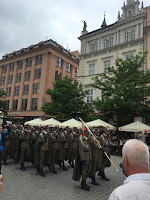
In chatting, we decided to go for a coffee, but when we sat down at a table in the square, I ordered bison grass vodka and apple juice. In a rare moment of actually feeling my feelings at the time they were occurring, I realized that I was mad. By this time in my trip, I had toured Jewish history sites in Warsaw. Friend of Calvin and I had gone to Auschwitz and Birkenau just two days before Corpus Christi. In all my reading, I knew that Poland (not alone in this) has not ever dealt fully with its anti-Jewish history (or present). Due to Germany's attack on Poland, most Poles felt/feel that they were more sinned against than sinning in World War II (and preceding), despite the complicity of Polish men and women in turning in their Jewish, homosexual, Roma, and "political" neighbors. Poland does not acknowledge complicity in the Holocaust, despite making money through "dark tourism"- the thousands of people who travel to see the concentration and death camps each year.

Additionally, Poland is currently struggling with government leaders (and communities) who want to keep their borders closed and reject immigrants. Anti-Jewish activities have seen a rise in the past few years, as well as anti-immigrant displays and commentary. All of this knowledge, of this awareness, of all the grief, came swirling into a head as I poured cold vodka down my throat and thought about the procession I had just seen.

People had reverently, tenderly, carefully acknowledged the presence of Christ in pressed bread, but would they do the same to their neighbor? Had they done the same in 1942 or 1968 (Polish Jewish Exclusion) or today? The Feast of Corpus Christ is nearly 1000 years old. This means that Poles (and others) likely observed this same procession in the German occupation. There were probably soldiers and others who knelt, receiving the body of Christ in their mouth, and then rose to go back to the hideous work of the war and its atrocities.

Christ is as present in the host, in the bread and wine, as he is in the person next to us. Furthermore, He is as present therein as he is IN us as we do anything in his name.

The truth is that most people willfully ignored what was happening around them or followed orders because they either believed what they had been told or shut their minds to the cognitive dissonance of the words of their faith and the words of their political leaders

We want to believe that we would be different. That we ARE different.

At least, I assume we do.

Most of us, though, still kneel reverently at the altar and, with Christ's body still in ours, make excuses for why we do what we do, say what we say, think what we think. It happens all the time.

How do we change that? What are the words, the steps, the turning that need to be done?

If Christ's presence in communion does anything, it gives us the strength to make that change. The power is actually IN us when we commune. We just have to be willing to join into the work, to participate in the change, to bear the cross of truth and to lift it high.

It seems likely that a very, very, very tiny percentage of people present in Krakow on 26 May 2016 were also present in that same procession in, say, 1943. Yet, the repercussions of the actions against Jewish neighbors and others, before and after, still reverberate through that country. And the repercussions of what I witnessed and felt on that day still reverberate through me.


Tuesday, March 8, 2016

Selfie Snobs

The other day I saw this meme on Facebook and it was liked by several people I respect. The poster (who I doubt was the original poster) was not someone I knew, but a pseudonym (I assume and hope) that asserted that this person enjoys being the grouch in a congregation. That's too bad. Something about this particular picture/meme set my teeth on edge. It's not because I love selfies or even that I take very many. This has the tinge of annoyance that implies that people who do something differently than you are wrong, even if what they are doing is not inherently wrong. 
For much of human history, the people who were preserved in art had money. You had to have plenty of money to have your image carved in stone. You had to have the connections to commission a likeness and the implied power to keep the artist working. Even if a particular artist was creating an image that involved, say, a biblical persona, he (or she) might model the scene with a likeness of a local leader or wealthy person. 

Eventually art became even more of a sponsored medium and artists used less wealthy people for models. Nevertheless, people in lower classes or possessing less wealth might be posed in painting or reliefs, but certainly never expected to own one. Self portraits were still for the upper-classes. 

When photography came into vogue, it was partially disdained because of its equalizing effect. Capturing slave and empress alike, it meant that people for whom a family portrait had previously been out of reach could now have one- a prized possession. As the technology marched on, more and more of the "mundane" side of life became captured. If one can sit through family film strips or videos, one would see birthday parties and dinners being served. I remember my dad borrowing a video camera to make a movie for my grandparents and in the video we showed the areas in which
Van Gogh's Selfie with Bandaged Ear
we liked to play. I sat on a rock and recited the books of the Hebrew Bible. This is not the stuff of museums, but it is the stuff of life.

So back to selfies, it's not necessarily narcissism. Unless one believes that is the natural state of art de-evolution from only the upper crust having access. The selfie is a way that people show where they were present, whose company they were enjoying, and what they saw. Not every selfie is a work of art and some may inherently be in poor taste (which is just a risk one runs with art, in general).

Regardless, we must be aware of how we talk about selfies and those who take them. In disdaining the self-portraiture of the masses, as it were, one may sound less like a grouch and more like a snob. Sneering and contempt have no place in a congregation, whether one is a grouch or not.
  

Wednesday, November 11, 2015

Not Exactly Rarin' To Go

Prompt: What is the hardest part of a big project: getting the energy to begin, finding the time to work on it, or feeling down that it's over?


I can never get started. 

It's not because I like putting things off. It is actually because of my fear of failing. As long as I haven't started, the project is not a failure. 

I started to write "perfect", but I don't actually expect perfection of myself. That's not attainable. I do, however, have a standard for myself that probably looks like perfection to some people. I tend to operate with the personal expectation of a high level of competency, creativity, and clarity. I feel it very deeply when I fail on one of those. 

Thus, it is often easier not to start something because I can't flop on what I don't leap for. 

What a horrible sentence

It is the time of year when all my spare thoughts are about my Christmas Eve sermon. What can I say to communicate the power, mystery, and deep love of the Incarnation? How can I keep myself out of it, but make it personal enough that the majority of those hearing it believe it was meant for them? 

I almost write the thing on 12/23. On two years, I wrote it before then only because I had other people involved in the sermon. 

I was late on a play this year because I wanted it to be just right. I'd planned out most of it my head, but I dragged writing that first page. I knew once I started, I'd be okay. However, I couldn't commit to being open to the Spirit, writing, editing, and moving forward in the way I imagine normal (read:most) people do. 

I waited. Until it was embarrassing. 

I wish I had a clever ending for this post, but the truth is this: I'm just glad that I started it. 

Tuesday, June 9, 2015

Future Tense

I'm currently at the Collegeville Institute in Minnesota for a writing workshop week.

We are using building that once was called the Ecumenical Institute, where work to unite churches and faithful people was done with earnestness and great hope.

Today is also the Feast Day for St. Columba, among others, who helped to bring the Christian faith and establish its roots in Scotland (and elsewhere in Britain). I have been to Iona Abbey, one of the monasteries associated with Columba. The pictures here are from Iona.

Listening to crickets chirping, loons calling, and seeing an actual sunset out my window (doesn't happen in AK this time of year), I am thinking of those whose faithfulness makes our lives possible.

God's provision for the future through the faithful is moving and provocative. What am I doing on a daily or even semi-regular basis that God may use to improve lives in the future? The reality is I may never know. But I remain committed to sharing the gospel, to seeking Christ in my neighbor, and pursuing the well-being of all. In that action is a life and in that life there is all the future that will be- ever in God's hands.


Tuesday, March 11, 2014

Purple

Since it's still pretty gray here, I searched through some old photos for inspiration for the Lenten photo a day word: purple.

This is from a walk I took by myself around the outskirts of Bath, England. It was late September, very warm, and sunny. I skirted a cow pasture on an old path, on a hill above the town. I found an old graveyard, a blackberry patch, and a canal.

This picture of flowers blooming out of a wall is the essence of purple- a regal growth of life in the midst of stones.

There's something to that.


Thursday, February 13, 2014

External Motivation

I recently got a Fitbit- a pretty fancy pedometer.

I got it in part because other efforts toward health and activity have not been successful. Fitbit gives me little encouragements toward daily and weekly goals (and beyond).

This morning I woke to an email congratulating me on having earned a 50 mile badge. Since starting with the Fitbit on 2/3, I've walked 50 miles while wearing it. That's essentially 5 miles a day.

On the one hand, I'm thrilled that this is working for me like nothing else ever has.

On the other hand, I feel embarrassed to need the adult version of a sticker chart to encourage me to healthy habits.

In discussing this with some others today, they mentioned that they too really thrive on little boosts of encouragement and affirmation.

Do we do enough of this in general for the people around us? I mean, genuinely affirm who they are, their efforts, and their progress?

The other thing I think about is this: what would a Fitbit for spiritual health look like?


Thursday, August 23, 2012

Gotta Serve Somebody

This week's reading from Joshua includes the famous verse:

 "Now if you are unwilling to serve the Lord, choose this day whom you will serve, whether the gods your ancestors served in the region beyond the River or the gods of the Amories in whose land you are living; but as for me and my household, well will serve the Lord." (Joshua 24:15) 

When I think of this verse, I consider the truth that we're never really choosing if we are going to have a god, we're constantly choosing what we will worship as god. Will we choose the God of creation, who has chosen us, or we will choose any number of lesser gods- whose glittering promises of health, wealth, and power are played like siren calls from all corners of the world? 

Whom will we serve? 

I keep hearing the words of the prophet, Bob Dylan, singing, "You gotta serve somebody..." It's not that we've gotta, it's that we're gonna... so whom will you choose? 

"Gotta Serve Somebody"

You may be an ambassador to England or France
You may like to gamble, you might like to dance
You may be the heavyweight champion of the world
You may be a socialite with a long string of pearls.

But you're gonna have to serve somebody, yes indeed
You're gonna have to serve somebody,
It may be the devil or it may be the Lord
But you're gonna have to serve somebody.

Might be a rock'n' roll adict prancing on the stage
Might have money and drugs at your commands, women in a cage
You may be a business man or some high degree thief
They may call you Doctor or they may call you Chief.

But you're gonna have to serve somebody, yes indeed
You're gonna have to serve somebody,
Well, it may be the devil or it may be the Lord
But you're gonna have to serve somebody.

You may be a state trooper, you might be an young turk
You may be the head of some big TV network
You may be rich or poor, you may be blind or lame
You may be living in another country under another name.

But you're gonna have to serve somebody, yes 
You're gonna have to serve somebody,
Well, it may be the devil or it may be the Lord
But you're gonna have to serve somebody.

You may be a construction worker working on a home
You may be living in a mansion or you might live in a dome
You might own guns and you might even own tanks
You might be somebody's landlord you might even own banks.

But you're gonna have to serve somebody, yes 
You're gonna have to serve somebody,
Well, it may be the devil or it may be the Lord
But you're gonna have to serve somebody.

You may be a preacher with your spiritual pride
You may be a city councilman taking bribes on the side
You may be working in a barbershop, you may know how to cut hair
You may be somebody's mistress, may be somebody's heir.

But you're gonna have to serve somebody, yes 
You're gonna have to serve somebody,
Well, it may be the devil or it may be the Lord
But you're gonna have to serve somebody.

Might like to wear cotton, might like to wear silk
Might like to drink whiskey, might like to drink milk
You might like to eat caviar, you might like to eat bread
You may be sleeping on the floor, sleeping in a king-sized bed.

But you're gonna have to serve somebody, yes indeed
You're gonna have to serve somebody,
It may be the devil or it may be the Lord
But you're gonna have to serve somebody.

You may call me Terry, you may call me Jimmy
You may call me Bobby, you may call me Zimmy
You may call me R.J., you may call me Ray
You may call me anything but no matter what you say.

You're gonna have to serve somebody, yes indeed
You're gonna have to serve somebody,
Well, it may be the devil or it may be the Lord
But you're gonna have to serve somebody.


Tuesday, May 22, 2012

50 Essential Passages: Thinking about Hagar (#12)

I realize that I will never finish this series if I expect every entry to cover all the thoughts I have on a passage. So, I am striving for reflection and completion.

Passage 12: Genesis 21:8-21


 The child grew, and was weaned; and Abraham made a great feast on the day that Isaac was weaned. 9But Sarah saw the son of Hagar the Egyptian, whom she had borne to Abraham, playing with her son Isaac.*10So she said to Abraham, ‘Cast out this slave woman with her son; for the son of this slave woman shall not inherit along with my son Isaac.’11The matter was very distressing to Abraham on account of his son.12But God said to Abraham, ‘Do not be distressed because of the boy and because of your slave woman; whatever Sarah says to you, do as she tells you, for it is through Isaac that offspring shall be named after you. 13As for the son of the slave woman, I will make a nation of him also, because he is your offspring.’ 14So Abraham rose early in the morning, and took bread and a skin of water, and gave it to Hagar, putting it on her shoulder, along with the child, and sent her away. And she departed, and wandered about in the wilderness of Beer-sheba.15 When the water in the skin was gone, she cast the child under one of the bushes. 16Then she went and sat down opposite him a good way off, about the distance of a bowshot; for she said, ‘Do not let me look on the death of the child.’ And as she sat opposite him, she lifted up her voice and wept. 17And God heard the voice of the boy; and the angel of God called to Hagar from heaven, and said to her, ‘What troubles you, Hagar? Do not be afraid; for God has heard the voice of the boy where he is. 18Come, lift up the boy and hold him fast with your hand, for I will make a great nation of him.’ 19Then God opened her eyes, and she saw a well of water. She went, and filled the skin with water, and gave the boy a drink.20 God was with the boy, and he grew up; he lived in the wilderness, and became an expert with the bow. 21He lived in the wilderness of Paran; and his mother got a wife for him from the land of Egypt.

     We live in a world of connections, wherein we can so easily be in touch with anyone whom we have ever met. Yet we still pass many people, content to stay mutual strangers. Despite our vast repositories of information and contacts, it is likely that you do not know what happened to the sister of the young man that your cousin dated in high school. You probably do not know the story of the mother of the man whom your parent did not marry. The saga of third cousin of the neighbor who moved away ten years ago is lost to you and to yours.
     So be it. 
     We cannot know everything. We cannot know everyone. We can, however, remember that their stories, even unknown, touch up against our own through God. We think frequently about how God is shaping us, about God’s promises to those in our particular faith community and to us, about God’s work in what is our known world. What about God’s work that goes on, unbeknownst to us?
     Did Isaac ever wonder what happened to the dark-eyed teenager he remembered so faintly from his childhood? Did Ishmael ever speak of his half-brother whom he enjoyed making laugh? Did Abraham tell Isaac of his folly? Did Hagar tell her son of Abraham and of Sarah and of her broken heart? Did both boys grow up, knowing of God’s promises to their parents and their role in fulfilling them? And, if they knew, did they imagine God making the same promise with regard to each of them?
     Isaac and Ishmael are both signs of God’s providence and commitment. In human history, they represent two significant personal, political, and religious streams whose currents have significantly shaped the sands and rocks of time. If Isaac had known that Ishmael was also the start of a great nation, what might he have done differently? If Ishmael heard of the twin promises, did it soothe the ache of rejection or fire up his frustrations at his father and at Isaac?
     God’s promise to Hagar is a powerful and significant promise. Offered to a woman in the worst of circumstances, watching her child die, it is not a hurried consolation prize, but a powerful offer of hope and future. While Ishmael may have been second place in some households, in the eyes of his creator, he still mattered- as the offspring of Abraham and as the offspring of Hagar.
      All of creation, including all people, receives this promise of hope and a future. God considers each person worthy of shaping, of wholeness, and of salvation. We are called into seeing that worthiness in one another. Furthermore, we are called into working together toward the fulfillment of those promises. We do not always know the stories of the people around us, but we can know the promises that have been made to them. We should expect that God is with them. We cannot pretend their stories do not matter.

Through the Door Into Something New

Text: John 1:29-42 The season of Epiphany, which we are in right now, can get a little lost in the church year. Coming between Christmas and...