Showing posts with label Children of God. Show all posts

Sunday, July 19, 2020

Undivided Heart

Teach me your way, O Lord, and I will walk in your truth;
 give me an undivided heart to revere your name
. - Psalm 86:11


What does it mean to have an undivided heart? Specifically, the psalmist requests an undivided heart for the purposes of revering, holding in awe and respect, God's name. A heart that is focused on keeping God's name holy is truly an undivided heart. 


In the Large Catechism, Martin Luther writes, "Anything on which your heart relies and depends, I say, that is really your God... Idolatry does not consist merely of erecting an image and praying to it, but it is primarily a matter of the heart, which fixes its gaze upon other things and seeks help and consolation from creatures, saints, or devils. It neither cares for God nor expects good things from him sufficiently to trust that he wants to help, nor does it believe that whatever good it encounters comes from God." (Book of Concord, 386f) 


Our hearts are divided if we believe that God takes care of the next life, but not this one. Our hearts are divided if we say we are God's people, but we speak ill of others or feign ignorance about the oppression and pain of the world. Our hearts are divided when we worship God with our words, but our daily actions are focused on success, status, and stuff. Our hearts are divided when we take all the credit for what we have and what we do and do not offer praise and gratitude to the One who created everything and is at ceaseless work in the world. 


When we ask God, through this psalm and our prayers, for an undivided heart, we must accept the changes that will bring. As our heart finds a permanent anchor in God's presence and power, there will be a shift in our priorities. We will find ourselves aligned with God's will and God's way. When we try to go our own way, we will experience the pain of division once more. 


How can we know what is God's will? We look to Jesus. In today's parable, the gospel writer expects those hearing the parable to align themselves with the disciples and, therefore, also with the workers in the master's household. That means us. We do not concern ourselves with determining who is going to hell and who isn't. We know a weed when we see it, but our work is to tend to the wheat. Our task, the task of hearts aligned with God, is to take care of the soil, the wheat itself, and the surrounding field so that God's hope, God's love, God's mercy, God's justice matures and increases its yield. The harvest and the destruction of the weeds are God's own work of God's own creation, while we are hired hands for that work in the same creation. 


I don't like to speak for this long in metaphors. I understand the desire to have a parable simplified and the desire to have the pastor clarify, once and for all, weeds do this, wheat does this. Be wheat. End of sermon. 


That's not how parables work. Additionally, if I do that, then you know that my heart is divided. It means I care more about you and your comfort than I do about God's expectations of me and the holy discomfort the Word stirs for all of us. When preachers make things too easy and too comfortable too often, we are making an idol of you liking us and our preaching. When I'm unfolding pieces, but leaving you to complete some of the puzzle, we are both respecting that God's word is a little bit mysterious, a little bit disquieting, and something from which we wrestle a blessing, like Jacob. 


In that light, back to the undivided heart. But, pastor, I can hear someone saying: what about my family, what about my job, what about my friends, what about things I have to do for the community? 


Friends, God has given you all those things. God’s love has been poured out for all, from the beginning of creation, through the incarnation and resurrection of Jesus Christ, through to the Spirit’s presence today. If you find a division between how your care for your family or how you act in community roles and what you believe God wants of you, then you are truly experiencing a divided heart. The forces that oppose God often try to mask things like co-dependency, suffering, and complications as love by saying that life is hard, but God is with us. Life can be difficult and God is with us, but suffering and pain are not inevitable. Our attempts to control others, to relieve them of the burdens of their bad choices, to make people like us, to demand respect- all energies that go to this kind of thing and related situations are part of having a divided heart. 


When we ask God for an undivided heart, a unified hope, a clarified awareness and trust in God's power, the other realities of our life will fall in line. That doesn't mean ranching will suddenly become easier or our family member with addiction will suddenly be well. What our undivided heart will do is help us to live peaceably in the midst of life's complications. 


Once upon a time, I was in Fairbanks, Alaska for a pastor's conference. It was early November, but I'd ridden up with a friend. One of my friends flew to Fairbanks and rented a car, but it did not have winter tires. She missed the turn to the retreat center and found herself down a hill that she didn't have the tread or engine power to get back up to the main road. She called our group for help and three of us went out in a car to get her. Since she was down the hill, we couldn't see her headlights and she wasn't exactly sure where she was. As we drove back and forth, one of the other pastors got agitated. "What if we can't find her?" she said. "Will she have to be out here all night?" 


"We will find her," assured the other person in our search party. 


We got out on the side of the road and called for her, while our lost friend was on the phone. She told us she could hear our voices, but couldn't see any street signs where she was. We told her to stay put and that we would walk down to her. 


Again, the other woman in the search party was distressed, "What if we can't get her car out of there?" 


I hadn't said too much at this point, because I had fairly recently joined a 12-step group. My new work through the group had made me very aware of my own anxiety and my desire to try to solve problems quickly, in effort to get people to like me and to be considered proficient and useful. So, in our search for our friend, I had called her, but mostly stayed quiet because I was paying attention to details and to my own reactions. 


When the leader of our rescue party said again, "What if we can't find her?" I finally looked at her and said, "We can do anything for 12 hours that would appall us if we had to keep it up for a lifetime." 


The other woman gave me the most horrified look and said, "A lifetime? What are you talking about?" 


She had to think I was high as a kite and who could blame her? My words weren't soothing. To her, they didn't seem to take the problem seriously at all. For me, they were very serious. We would figure out a solution, eventually, but our anxiety wouldn't control the situation, it was only controlling us. I did have the good sense not to say that or to say the dreaded and unhelpful "calm down". 


We rescued our friend. As we did so, I walked around the community we were in and then figured out how to drive the car out and back to the retreat center. I was the last one to attempt to drive the car out because each of the others attempted to get it up the hill. While they tried, I checked out our surroundings and discerned what I thought might be a back way, which turned out to be correct. 


I always hesitate to use an example like this because I know you often remember the story and not the point I am hoping you will take away. The point I want to make here isn't that you should stay calm in a crisis or that God will always provide a way or even that 12-step programs are useful. Those are good points for another day. 


My point is this: that is a time in my life that I can point to having an undivided heart. I knew, intellectually and spiritually, that God's desire for me was for health, well-being, and wholeness. I knew that some of the pain in my life was of my own doing and some was from others because I had let them take up space that wasn't theirs to take. This unity in my heart, my hope for healing, my experience of God's nearness helped me to know that a stressful experience wasn't going to last forever. By focusing on the only forever I knew, God and God's love, I didn't give the stress of the situation any more power than it needed to try to solve the problem. 


Not all situations are this easy. Not all people are going to be working with us on a team. Not everyone will respond kindly when we explain that we are trying to consider God's will for ourselves, our family, our jobs, our role as citizens, and our faithful actions. An undivided heart, though, will guide us in perceiving God's nearness. It will prevent us from making idols of our heritage, our denomination, our political affiliation, what we see on social media, what we read in the paper, what our friend groups expect of us, and so on. An undivided heart, a heart that desires to be aligned with God's will and way, finds peace in unusual places and hope in unusual times because God's love surrounds and carries it. 


Let us ask God for undivided hearts, hearts that are prepared as good soil to be nourished by God's word and that are strengthened to be workers for Christ’s sake in the world. Let us ask God for undivided hearts that will work with one another and with unexpected allies to end oppression, to bring justice, and to be part of establishing God's true peace. Let us ask God for undivided hearts that worship and trust in God alone, more than our own understanding or habits. 


And if we are not ready yet for undivided hearts, then let us ask God for the courage to desire them. 


Amen. 


Friday, January 4, 2019

Revelation Read-Along: Day 18

Reading: Revelation 14

Advent Theme: Absence

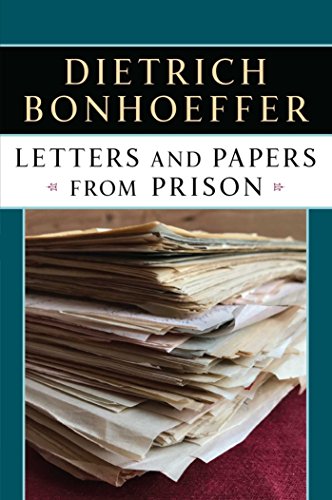
I am still reading Letters and Papers from Prison by Dietrich Bonhoeffer. I began reading it in 2005. I am, perhaps, a quarter finished with it. In my view, this is the most significant theological work of the 20thcentury. According to him, these are the things Bonhoeffer wrote after he truly understood the cost of discipleship. None of us truly comprehend that cost until we realize that we are paying it. 

Very early in Letters is this passage:

…God is teaching us that we must live as humans who can get along very well without God. The God who is with us is the God who forsakes us. The God who makes us live in this world without using God as a working hypothesis is the god before whom we are standing. Before God and with God we live without God. God allows Himself to be edged out of the world and on to the cross. God is weak and powerless in the world, and that is exactly the way, the only way, in which God can be with us and help us. Matthew 8:17 (he took up our infirmities, and bore the burden of our sins) makes it crystal clear that it is not by his omnipotence that Christ helps us, but by his weakness and suffering.

This is the decisive difference between Christianity and all religions. Man's religiosity makes him look in his distress to the power of God in the world; he uses God as a deus ex machina. The Bible, however, directs us to the powerlessness and suffering of God; only a suffering God can help. To this extent we may say that the process we have described by which the world came of age was an abandonment of the false conception of God, and a clearing of the decks for the God of the Bible, who conquers power and space in the world by his weakness…
 
After I read this for the first time, I closed the book and didn’t open it again for five months. I could not stop thinking about this phrase, “Before God and with God we live without God.” What did it mean for one of the most faithful people I can think of- one whose heart for serving others did not let him stay safe but to throw himself into the mess of trying to overthrow Hitler- what does it mean that he believes in an active and compassionate God who does not give us an adequate framework for living? 

This is what comes to mind when I read Revelation 14. I think of all the people who have told me that their religious practice is “private”. What they believe or how they imitate Christ is an interior practice, not meant for discussion, reflection, or for display in public. It is true, however, that everything we do reveals to the people around us what we believe. To follow Jesus, to truly be a disciple, to show that one’s heart is at rest in the one true God means paying attention to the details. It means spiritually reflecting on one’s habits, purchases, hobbies, time spent, time wasted, words said, words unsaid, generosity shown, generosity withheld. What we do and what we leave undone is what makes the mark on us- revealing to all who will see it where our loyalties lie.

Which brings me back to Bonhoeffer’s cryptic writing. There are parts of the Bible that are just mysterious. They are neither road map nor pointillist painting. They are written for a people that we are not. The Spirit is present in these words, but She may not be speaking a language we understand. Before God and with God, we admit that we do not always comprehend the words of God and then we go on. Frankly, my dear, we have enough to work on with what we do understand.

Potential Takeaway: Throughout history, faithful people have had to make difficult decisions and felt as though God was silent as they struggled. They were never alone. It is a painful part of being human that we are not always as fully connected with our Creator as we could or should be. It is not a matter of letting go and letting God, but rather trusting that God is present, is acting, and will make all things new. Our consolation in this is that when we feel this way, we are not the first to do so, nor the last. 

Holy God, in the beginning, the Spirit brought creation and order out of chaos. Your creation has never known a time when You were absent, when your love was not intimately present. Strengthen me to trust you ever more deeply and yet to live out my faith more boldly and bravely- showing your truth to all whom I encounter. Amen. 

Thursday, January 3, 2019

Revelation Read-Along: Day 17

The series took a hiatus while I gave time and energy to be with a grieving family and a dying saint. I appreciate your patience. 


Reading: Revelation 13

Advent Theme: Simplicity

Jesus said, “Let the little children come to me, and do not hinder them. For the kingdom of heaven belongs to such as these.” (Matthew 19:14) I think about that verse when I read Revelation 13. So much has been made about this chapter, gallons of ink spilled on it alone, that it can be hard to read it with new eyes. Thus, think about how you might explain this to a child. If we cannot explain the scripture to a child, then either our interpretation is off-base or Jesus was wrong. Which one of those two would you like to pick? (I do realize that creating a binary there isn’t necessarily helpful, but please let it stand for this post.)

Let’s approach chapter 13 as though we were going to explain it to a 9-year-old. We have a different relationship with dragons now, but imagine if you didn’t have books and movies about dragons. Imagine the rulers of the world used the images of power and fire, like a dragon, to make people scared. How would you feel if you saw shields with dragons or red flags, like dragon fire, carried on long poles as an army rode by?

Then what would it be like if your friends and their families all said, “We have to follow the emperor. He is looking for all the people who don’t decorate their house with dragons. If you don’t sing the dragon song, he will send the army to kill you.”

Your family and you believe that a house should only have words from God in it and no pictures. Your family will not get on their knees when the emperor’s dragon flag goes by. Your parents say that you are not allowed to sing the dragon song- not at home, not on the playground, not if you’re by yourself. They say that the emperor says he is God, but you know that he is not. Your friends aren’t allowed to play with you anymore because their families are scared and they believe in the emperor, or at least in the emperor’s power.

Sometimes the emperor makes things that seem good happen. His army triumphs over invaders. He allows extra grain to come into the market. He slows down the sacrificing of people in the Coliseum since it is for his entertainment that this happens.

When your parents talk about the emperor with their friend, the ones they know from house church, they use a code. In this code, a different number represents each letter of the alphabet. They use the numbers in conversation so that no one will overhear them speaking ill of the emperor.

What do you do, oh, proverbial 9-year-old?  

This is the essence of chapter 13. It is revealing the symbolism of Rome and the emperor as a cult. Like most cults, this one demands the worship and devotion of those who wish to benefit from the cult’s power and resources. As the cult grows in power, those who are uncomfortable or even fully dissenting will have to work harder and harder to resist and to survive.

Gematria is the system of determining the numerical value of letters. Jewish people at the time of John’s writing would have been familiar with this system and it has counterparts in Greek, as well as in other languages around the world. The name “Nero Caesar” has a numerical value of 666 in Hebrew. In textual variants, the number is sometimes 616, but that also becomes “Nero Caesar” in Greek or Latin. The famous number is just a coded way of talking about the emperor. “I’m thinking of a number. It’s for someone’s name. Can you guess who?” 

The other significance of 666 is in relationship to the use of the number seven (7) throughout Revelation. John uses 7 as a number of completion and perfection. Six falls short of seven. It can never be the perfect number. The use of 6 in relation to the beast and the dragon is to remind the readers, once again, that the empire is NOT the same as God’s kingdom.

Potential Takeaway: John’s readers are shown through more symbols (apocalyptic literature for the win!) that what the world offers cannot reach what God freely gives. We often mix up those two systems, believing that we can easily acquire worldly stature, but we will have to work hard for heavenly grace. Grace is grace. It is free and is truly appreciated when we realize what it cost God to give it (becoming human and suffering our rejection in the flesh). As we grow in appreciation of grace, we will then be led to respond to it by correct worship, caring for others, and stewarding the world that God made. 


Gracious and generous God, Your power is so much greater than anything the world can show us. Yet we remain bombarded with the signs of earthly status and success. Guide me into faithful worship in thought, word, and deed- that I might resist that which fades and find strength and hope in what is eternal. Amen. 

Tuesday, December 18, 2018

Revelation Read-Along: Day 15

Reading: Revelation 12:7-18

Advent Theme: Adversity

An interpretation and re-telling of Rev. 12:7-18, Revised Julia Version

And then fighting began in the spiritual realm, near God’s throne. Michael, who is a leader among the angels, and the other angels fought against the Satan, the adversary of God’s will. The spiritual forces that oppose God’s will battled mightily, but they were defeated and they could not last near the throne of God. To be clear, the Satan is the same one who is sometimes called the Devil or by other names. The Satan works to deceive the world and there are spiritual forces- on many levels- that are willing to try to work against God’s purposes. At the end of the battle, the Satan and his minions fled back to the earth, to try to make trouble there.  

Then John heard a booming voice in heaven, stating clearly:

“It is the right time. Here are the saving power and everlasting leadership of our one true God. Here is the authority of his Anointed One, the Messiah. For the one who tries to make trouble for our friends, the saints, has been defeated. Oh, that sly one tried to present a case for how they were weak in faith, but they persisted!

The saints of God won by a three-fold victory. First and foremost, Jesus claimed them through his own blood. Secondly, their testimony was certain- identifying themselves with Christ. Lastly, they both lived and died in Jesus Christ. 

It’s too bad for those who will not do those things. The Satan is loose on the earth and is angry because he knows his is a losing battle.”

So, when the Satan realized his heavenly visa had been revoked, he stirred up trouble on earth. Eagles took away the woman whom Satan harassed so that she could rest in safety in a place apart from fear and pain. He still tried to whisper lies to her, lies that he sent in a variety of ways. Yet, God’s creation would not let the lies stand. The very soil and water of the earth witnessed to the power and majesty of God’s creative love and mercy. The lies of the Satan could not stand.

The Satan was mad. Stomping off, the Satan- the spiritual adversary of the Christ followers- vowed to make life hard for all who seek to live a life of faith and hope.

The Satan made a stand at the edge of the abyss and waited to for willing accomplices, with whom to wreak havoc.

Potential Takeaway: There are spiritual and earthly forces that oppose God’s will. The internal force of sin is a manifestation of the human desire for control and our struggle to understand that only God is God. And that God is good. A very real part of the life of faith is renouncing the forces outside and within us that seek to oppose God’s will for life and wholeness. 

Holy and mighty God, Your word is love and your gospel is peace. Yet the forces that oppose You do so with such violence that it can be difficult to walk a path of justice and peace-making. Guide me in following You, identifying Your work and word, and living into Your truth alone. Amen. 

Friday, December 7, 2018

Revelation Read-Along: Day 7

Reading: Revelation 6

Advent Theme: Hope

I can see from my blog stats that as the Revelation readings get more complicated, the number of daily readers has begun to drop off. Of course, that could also be related to the fact that it is a very full time of year and, in the northern hemisphere, it is darker for more of the day. Darkness itself is a time of rest and renewal, not an absence of light but an opportunity to perceive light in a different way. Part of my love of reading Revelation is that it is of a piece of the life-long work of trying to perceive light in different ways.

In chapter 6, we read about the opening of the seven seals. The seals will have parallels in the seven trumpets and the seven bowls. In terms of scriptural numerology, seven often appears to represent completeness. The original creation was described as happening in seven days and the making of all things new, a recreation, receives a kind mirror treatment.

As the seals are opened, we see the “four horsemen of the apocalypse” as they are often called. Interestingly, if we look closely at the images, the horsemen don’t necessarily come as a set of four, but instead as one and three. Christ is associated with the color white in Revelation. Use of the verb “conquer” is also almost always associated with those who persevere in faith. Therefore, the first horseman- the rider on the white horse- seems to be a metaphor for the gospel or the Spirit or even the Living Word, Christ’s own self, going into the world.

The riders that follow are war and violence (red horse), economic disaster and poverty (black horse), and death (pale horse). The implication could be that these follow behind the spread of the gospel, attempting to subvert its good work and to upend trust in the promises of Christ. The additional seals reveal the faithful who continue to pray and worship in the midst of the chaos, as well as the fear and cowardice of powers and principalities of the world as it was.

Trying to draw specifics out of this chapter is like trying to find the hidden image in a Magic Eye picture or a stereogram. Some people can do it, but most people can’t and it is only frustrating to try. In fact, I would tend to be suspicious of anyone who says they know how and when these things will happen since Jesus himself specifically indicates that no one knows except the Father (Matthew 24:36). 

Potential takeaways: Occam’s Razor is a philosophical principle which states that the answer that requires the least speculation is usually correct. The famous example is usually that if you hear hoofbeats, think horse before you think zebra. The Occam’s Razor of the human condition is that war, famine, and death are usually the result of world leaders and economic machines wanting power and control. To look at these things and to try to parse them for indications of matching John’s revelation is to hear hoofbeats and think, “Oh, boy! Zebras!” The purpose of apocalyptic literature is to stir our imagination. John’s purpose in using the genre is to stir our imagination and use that energy to drive us into proper worship in community and faithful discipleship in daily life. 

Holy God, when the activities of the world overwhelm me, I ask that You would guide my thoughts and concerns to a place of rest in You. Grant me the will and the ability to live a faithful life, in the midst of turmoil, and to resist being overcome by the forces that oppose Your true will for wholeness and restoration. In Christ’s name, Amen. 

Sunday, December 2, 2018

Psalm 25, Revisited


In Hebrew, Psalm 25 is an acrostic psalm. The beginning of each sentence forms the alef-bet down the page. 

I have re-written Psalm 25, in Revised Julia Edition, to be an acrostic of the English alphabet. 


All of my being belongs to you, O Lord, 
Because of this truth, I trust in You alone. Consent not that the forces that oppose You to triumph in my life.
Do not allow any of Your faithful people to become discouraged or embarrassed because of their hope in you. 
Educate me in Your ways, O Lord. Teach me the feel of Your road. 
First things first, and that must always be You. 
God of all things, You alone offer true wholeness and peace: salvation.            
Happy is the one who learns this and waits for You. 
I beg you to continue in mercy and everlasting compassion, O Lord,  
Just as you did for Sarah, Ruth, and Hannah. 
Keep no mementos of my sins- against You or others.
Let Your own eyes of love be the lens through which You see me. 
Majesty is revealed through constancy and goodness, which certainly describes the Lord. 
Neglecting no one, the Lord offers guidance in faithful discipleship.
O God, those who are willing to listen will hear and receive Your guidance,
Patiently, the Lord corrects and guides the faithful to a holy life. 
Questioners find a way of surety and eternal mercy when they follow the Lord. 
Remember, O Lord, Your Divine reputation and forgive me all my many sins. 
Since we fear, love, and trust the Lord, we will not be without direction or help. 
Those who listen to God will find the justice, life-fullness, and family they desire. 
Ultimately, the Lord does not abandon those who want to be God’s people. 
Victory over sin and death belong to the Lord, who includes even me in that triumph. 
When You think of me, O God, pour out the healing you know I need in my whole being.
X-ray those who hate me, see their insides, and protect me from what may truly harm me. 
Yes, I seek a life of wholeness and self-control as I wait for you. 
Zion, the original people of Your heart, awaits Your redemption. Hasten to them, O God. 

Friday, October 27, 2017

Human Being

I have been thinking about getting a new tattoo for over a year. For a while, I thought
about the phrase I read in a book by Augusten Burroughs: “Harder is just harder”. I felt comforted at the idea that harder isn’t impossible, it’s just harder. However, the right time and place for that tat never materialized.
That idea faded when I came upon another phrase: fida et audax- faithful and bold. I loved the idea of this motto and it made me feel strong and courageous to imagine it on my wrist or on an ankle. This was my plan until about 3 weeks ago.
A variety of life events came to a culmination and I found that I was exhausted, frustrated, and tense. Overwhelmed by all things that seemed insurmountable, I marinated in the idea that in this intense time, I couldn’t “do” very much. All I could do was be.
Be.
I’m not very good at being. I am good at doing. I am good at thinking. I am okay at feeling, but I tend to put that aside for what I think I should do.
I went to visit a friend in New York. She was with me in 2005 when I got my first tattoo. Getting my second with her was a natural choice, but as I thought about what I wanted, I realized that I couldn’t get fida. That was about doing. It was about actions, resistance, and persistence. Those things are very important to me, but if I was getting a permanent reminder... I don’t need one for how to do, I need one for how to be.
Then I knew... I would get sola gratia- grace alone. One of the rallying cries of the reformations of the 16th century, this phrase grounds me not in my own doing, but in God’s doing. In light of God’s doing, my response is to be. Being beloved. Being saved. Being healed. Being welcomed. Being held. By grace alone. Not by my doing, my thinking, or my successes or failures.
By grace. Alone.
So now it is permanently inked into my wrist. It is a reminder that what I am, first and last, is God’s. Thus, whether I am trying the hard thing, the bold thing, the faithful thing... there is always time to still myself. To know I am loved. To be washed again in grace alone.

Thursday, June 22, 2017

What Kind of Stranger Are You?

"What kind of stranger are you?"

The small black girl paused in her climb up the playground equipment and asked me that question. She was speeding around the playground with my white daughter and another little black girl. The three preschool age girls united in laughter, daredevilry, and energy were challenging each other to scrambling up, over, and under everything in sight. 

I tried to be inconspicuous as a spotter as they climbed on the equipment, trying to eye all of them equally for potential falls. Halfway through scaling the wooden framework, one of the little girls turned and looked at me. 

"Is that your daughter?"

"Yes."

"Can we play with her?"

"Sure!"

"Are you a stranger?"

"Um, yes, I am a stranger to you, but not to her." 

"What kind of stranger are you?"

I froze for a moment, cutting my eyes away from hers. For a kindergarten aged black girl in Anchorage, Alaska, what kind of stranger am I? What kind of stranger am I to her mom or dad, her older brother, her next door neighbor, her teachers, her cousin, her pastor or community leader? 

"Well," I said carefully. "I am the kind of stranger who you can ask for help if you are hurt or lost or scared. But you should not go anywhere with me or take anything from me. I am the kind of stranger who will be kind to you, but I still want you to know that not all strangers are the same." 

There's no way to explain to any child that strangers are not always the danger. That sometimes the danger is in your house or your school or the people in positions to protect you. I didn't say that I am a stranger who has fought for things for all Alaskans- like Medicaid expansion, more Medicare doctors, community policing, and more detox beds in the Anchorage Bowl. I didn't tell her that I'm the kind of stranger who wrestles with privilege and frustration and anger. I didn't tell her that I'm the kind of stranger who has a #BlackLivesMatter pin stuck into my bright pink pussy hat and I mean both symbols wholeheartedly. 

As far as she knows, I'm the kind of stranger who watches out for all the kids on the playground. I'm the kind of stranger who will push her on the swing. I'm the kind of stranger whose daughter will refer to other girls whose names she does not know as "my sister". (I don't actually know why she does this, but V told me once that all girls are her sisters. I didn't argue.) I'm the kind of stranger who will pretend to be a tickle monster under the slide, but will only tickle hands and arms of children to whom I am not related. I am the kind of stranger who will offer a bandaid for a scrape, but not a snack because I don't want children I don't know to be in the habit of taking food from people they don't know outside of an organized setting or a grownup's permission. 

I'm the kind of stranger who is not close to being perfect or even that good, but I'm strange enough to keep persisting in being better. 

What kind of stranger are you? 

Thursday, March 9, 2017

Childlike Vs. Childish

Last night, I was asked an excellent question. We read and meditated on this passage from Paul’s writing:

For we know only in part, and we prophesy only in part; but when the complete comes, the partial will come to an end. When I was a child, I spoke like a child, I thought like a child, I reasoned like a child; when I became an adult, I put an end to childish ways. For now we see in a mirror, dimly, but then we will see face to face. Now I know only in part; then I will know fully, even as I have been fully known. 1 Corinthians 13:9-12

Someone asked, “Why does that passage talk about children like that if Jesus said we have faith like a child?”

People were bringing even infants to him that he might touch them; and when the disciples saw it, they sternly ordered them not to do it.  But Jesus called for them and said, “Let the little children come to me, and do not stop them; for it is to such as these that the kingdom of God belongs. Truly I tell you, whoever does not receive the kingdom of God as a little child will never enter it.” Luke 18:15-17 

At that time the disciples came to Jesus and asked, “Who is the greatest in the kingdom of heaven?” He called a child, whom he put among them, and said, “Truly I tell you, unless you change and become like children, you will never enter the kingdom of heaven. Whoever becomes humble like this child is the greatest in the kingdom of heaven. Whoever welcomes one such child in my name welcomes me. Matthew 18:1-5

Great question! Why do we have a passage from the apostle Paul that seems to specifically contradict a teaching that we have from Jesus?

The first thing to remember is that Paul did not have written gospels to read, as far as we know. He taught from his memorization of what was handed down to him and from the leading of the Holy Spirit. The gospels are written accounts that are crafted, by inspiration, with literary skills like foreshadowing, plot, and theme.

Paul has his own rhetorical flourishes and themes. Where these things seem to contradict one another, we must always follow the guiding of Jesus. However, it is worth a closer look to see if a contradiction is truly present.

When Jesus speaks to his disciples regarding children and faith, it is important to remember that he commends a child-like faith, but not a childish faith. In this time period, children were blessings, but also non-entities. Families had many children in hopes that some would live and would be useful to the family business or farm. One hoped for the dowries that might come with daughters-in-law and worried about the dowries to provide for one’s own daughters. Children were not only not heard, but also barely seen.

Yet, outside of the legal realities, children were certainly valued. God describes the Divine nature as being like one who lifts an infant to the cheek (Hosea 11:4). And in Luke 11, Jesus acknowledges that parents want good things for their children. So, we can ascertain that children in a healthy family system were loved. Children in this circumstance have an awareness of their value. They ask questions, play without fear, and freely give and receive affection.

This is the childlike faith that Jesus holds out as an example to the disciples. In the gospels, people and created beings who are in the margins, which included children, perceive who Jesus is as the Christ. They do not fear him in this role, but are drawn to him. As the One who contains the Eternal Word that is Love, Jesus could certainly see and sense the fear, guilt, shame, and worry of adults. He saw them with love and commended them to a faith of healthy security, trust, and openness- like that of the children who sought out their Savior.

Paul, instead, is writing to the Corinthians who have habits that exemplify childish behavior. They do not share. They engage in grouping up and keeping some people out of the group. They make bad choices and defy others to correct them. They tell Paul, “You are not the boss of us.”

Paul’s great argument toward the behavior that comes with love- being loved and showing love- is a direct hit against childishness and a push toward childlike faith. Be adults, he is arguing. Stop with petty jealousies and score keeping. Don’t show off. Don’t be rude. Stop pretending you have a secret club in Jesus’ name- that’s offensive. God is the boss of you and God sees what you’re doing. And God knows you can do better!

Paul is exactly speaking against the kind of childish behavior for which loving parents correct their children, so that they will learn to leave those things behind. Regrettably, as with the Corinthians, many of us do not leave that behavior behind and adopt a more adult way of reasoning and showing love to our neighbors. However, God was not done with the church at Corinth, which is why Paul kept writing them, and God is not done with us. The Spirit still moves.


So, when we compare these two passages, it is a difference between embracing a childlike faith and rejecting childishness in faith (and faith community). This was an excellent question and an excellent thing for us to work toward on our way to Easter resurrection celebration.

Friday, May 13, 2016

God on the Go Kits

Like many congregations, we have lots of members who travel during the summertime. They may spend three months fishing or camping or traveling or hiking or playing. Given Alaska's long daylight hours, making it back into town on Sunday morning or even Sunday night doesn't always happen.
One could rail against that or one can ask for guidance in the Spirit for how to keep community and communion alive in these months of family and personal sabbath in the woods and wilderness. (Still, if you're in town, come on down!)

Inspired by Take Out Church, I made "God on the Go" kits for the faithful Alaskan family with kids. The kits and all their contents fit into the 64 ounce Ziplock containers with the lid snapping snugly. This should keep things watertight and just-right-sized for throwing in a duffle bag, backpack or suitcase. Or pushing under the seat of the camper. Or having at the foot of a sleeping bag.

I have included below the list of items inside and the explanation for each. This is exactly the information that each family receives in their kit. I plan to take one with me when we travel as a family and I hope others will also delight in this spiritual growth experience in their children and as a family.


GOD ON THE GO!

So let’s do it—full of belief, confident that we’re presentable inside and out. Let’s keep a firm grip on the promises that keep us going. He always keeps his word.
Let’s see how inventive we can be in encouraging love and helping out, not avoiding worshiping together as some do but spurring each other on, especially as we see the big Day approaching.

- Hebrews 10:25, The Message translation


What’s in the box?

A Flat Jesus                           
Baptism Bubbles                           
Holy Communion guide
Holy Communion instructions                  
1 Sharpie                  
1 Beach ball
1 “tablet” of paper         
Colored pencils + pencil sharpener                 
Stickers
Blessing chalk                           
Feelings play doh                           
Candle
Heavenly Sunshine songbook          
VBS reminder card
Bible apps/Music/Bible recommendations


1. Flat Jesus- Color your Flat Jesus. Take pictures of Him or with Him on your travels. Use the hashtag #GodontheGo if you share your pictures on Facebook or Twitter and link Lutheran Church of Hope or @hopelutheranak. Talk about how Jesus is always with you.

2. Baptism Bubbles- Remember your baptism(s) on occasion by blowing bubbles at each other. Talk about baptism both as a kind of washing and a welcoming. When the bubbles pop, think about how our sins (little or big things that we do that might hurt others or ourselves) are forgiven by God and can be forgiven by others. Sometimes bubbles leave residue, like sins have consequences. However, no matter what they do not last forever and they cannot separate us from God’s love.

3. Holy Communion guide- There’s a hand drawn sheet that talks about what we believe about Holy Communion. You might read through it a couple times or talk about Jesus eating with his friends. It’s important on occasion to talk about how your food gets to you (how God gets the food to you)… all the way from the seed (or the salmon roe) to your table. We are all connected.

4. Holy Communion instructions- These are here. At least once a month during your travels, take a little time as a family (2, 3, 4, 10). Get a plate and a cup (special or not) and a few crackers or a piece of bread and some grape juice or wine. (My parents let us have a sip of wine as a part of home communion as a kid.) Talk about Jesus being with his friends. Think of the words of communion and the words “For you”. Offer the elements to each other with that phrase. Pray together. Light your candle for this ritual and talk about what it felt like afterwards.

5 and 6. Sharpie and Beachball- Inflate your beach ball on occasion and write things for which you are thankful on it. Make this a habit- every 2-3 days- big fish, fun bonfire, visit from Grandma, trip to the zoo, clear sky… write them on the ball. If you meet up with family or friends as part of your adventures, have them sign the ball. Deflate it when the ink is dry and put it back in your kit. At the end of the summer, you’ll have a tangible reminder of all your thanksgivings of the summer. We can all bring our balls at the end of August and share our thanksgivings!

7. Paper, pencils, sharpener, and stickers- Use for praying in color (drawing a picture as part of praying or making a list), drawing pictures, writing lists or playing games.

8. Feelings Play-Doh- When someone needs a timeout, they may also need the feelings playdoh. They can use the dough to sculpt out their frustrations or pound them flat. Using something tactile in a timeout may seem like allowing playtime, but for younger kids- having to stay in one place with low stimulation- can really help. If the dough sits on the table, it sits. Sometimes grownups may need it too. You can use this in a conversation about choices or consequences as well.

9. Candle- The candle is for your communion, baptism, or forgiveness rituals. The congregation is also going to light a candle every Sunday morning to help them remember to pray for Pastor Julia on her sabbatical. You could do the same.

10. Blessing Chalk Use chalk to make a little washable graffiti where it’s safe and acceptable. A prayer for the boat or the car, on the side walk, at the park, etc. Bless your activities and the people involved.

11. VBS reminder card, Songbook, and suggestion sheet. I hope this is self-explanatory. :) 


Bible Apps for Kids (some are free, some are not, most are also available on Android based devices)

The Beginner’s Bible (iPad) by Zondervan
Adventure Bible Lite (or complete) (iPad) by Zondervan
Jesus Calling for Kids (iPhone) by HarperCollins ($9.99)
Smart Kids: Underground Mysteries (iPhone) by Barcelone Multimedia

(You may find others that are suitable for your family. These are just a couple recommendations. You might want to consider downloading a Bible app or devotional app for yourself.)

Recommended Children’s Bibles

Whirl Story Bible (available online or from LCOH)
Spark Story Bible
The Beginner’s Bible for Toddlers
Sprout Bible (WaterBrook Press)
Seedling Bible (WaterBrook Press)


Remember that a children’s Bible (like Whirl or Spark) is written at about a 3rd grade reading and comprehension level. If that’s not where your child is, you may wish to get a Bible aimed for younger readers. The best Bible to get is the one you will read! :)

Recommended translations for adults (if you’re curious):

New Revised Standard Version [NRSV] (most authentic academic translation)
Common English Version [CEV] (readable)
The Message translation (extremely readable paraphrase from direct translation)
New International Version [NIV] (readable)

****A “Study Bible” has footnotes to help you understand translation decisions and historical information. A “Devotional Bible” may have the same things, but will also have insets or guidance for how to pray about or interpret certain passages. Bibles marketed at specific genders, races, denominations, or age groups are exactly what they sound like. Be aware that everyone has a reason for what they’re writing or selling (even Pastor Julia).

Music:


We have enclosed a Heavenly Sunshine songbook in your kit. If you aren’t sure of the tunes, try YouTube. Look for kids singing the song. You may also consider buying “Wee Sing Bible Songs” or another children’s hymn album. Remember the Vacation Bible School songs will be Christmas carols.


Sunday, November 15, 2015

Lord's Prayer (For Kids)

God, our father in heaven, Your name is special. The whole world wants your good works. Let them happen here, just like they do in heaven. Give us today exactly what we need- not too much and not too little. Forgive us where we've messed up and Help us forgive the people who've hurt us- our bodies or our feelings. Remind us that you are always with us especially when we are afraid. The entire universe, all the power, and the most glory go to you, because you are the only God. Amen

Sunday, November 8, 2015

Worship Assistant: Google

An elderly woman and her son have attended church where I serve for a few weeks. They always leave very quickly, such that I've never really be able to meet them. She comes up for communion with the help of someone in the congregation, but he stays behind in the pew.

She receives the bread and doesn't eat it. A couple weeks ago, the congregation member who had helped come up waved me over and asked to give her a blessing. The older woman said her name, which I thought was French. Conjugating quickly in my head, I said, "Dieu vous donne la paix." She smiled gently at me and I felt successful.

This week, at the beginning of the service, they were back. I looked at the younger man and asked "En francais?" He said, "No, she speaks German."

That explained two weeks of blank looks!

"Guten Morgen!" I quickly offered. The congregation chuckled.

During the passing of the peace, I went back to him and asked about communion. Knowing I hadn't been speaking the right language, I asked him about the bread issue. He confided that she actually struggled with Alzheimer's, so she wasn't entirely sure what was happening. "Thank you for tolerating her," he concluded.

"Oh, no," I protested. "We aren't tolerating anyone. It's an open table for everybody, no matter what they understand. Besides, no matter what she forgets, God remembers her."

His face reddened and his eyes watered as he thanked me. I felt intensely emotional.

During the offering, I used my cell phone to Google how to say some kind of blessing. The words for "The body of Christ broken for you" were beyond my pronunciation. The smile she gave told me she'd understood what I'd gotten out.

During the last hymn, I googled "German English Bible". Word project.org offered me the page you see here in a side-by-side translation. I knew if I could find that, I could find the Aaronic blessing from Numbers 6 and offer at least a line of it.

I think it's really important for anyone visiting a church to hear a least one line in their own language. No church is likely able to offer a complete translation of anything to a new visitor. If you don't usually have non-English speaking visitors, you may not even have materials available in another language. Nevertheless, it is hospitable, kind, and generous to offer something in a language that a visitor or newer member can understand. Particularly in the case of older people or people who have difficulty processing information, words in a childhood language or song may be the most comforting thing they could hear. I've greeted people in French (correctly) and offered the Holy Communion dialogue in American Sign Language before.

At the end of the service, I spread wide my right arm and clearly announced, "Der HERR segne dich und behüte dich." Before the sound had fully died, the face of the woman at the back of the church was transformed. She lit up and grinned so broadly I could see her teeth. She heard. She understood. She felt the blessing.

I offered the full blessing- intercession, request, and promise- in English.

I will always remember how Google, my worship assistant, actually allowed me to see the blessing of Aaron take root in a woman who just wanted to feel- even briefly- welcome and at home.

The Walkup Song of the Lord

Synod Sermon – Pentecost 19, Lectionary 27, Year A Isaiah 5:1-7; Psalm 80:7-15; Philippians 3:4b-14; Matthew 21:33-46 D ear Friends in Chris...