Since there already exists a body of writing to explain the action at the churchwide assembly, I'd like to offer a brief explanation about the polity of the ELCA.

Decisions made at the churchwide level rise up from congregations through synods to the floor of the churchwide assembly (CWA) every three years. If you look here, you can see how many resolutions and memorials were brought forward to be decided at the CWA. Due to the co-equal nature of the expressions, the churchwide office takes direction from congregations and synods, which serve as the springboard for the prophetic action of the more visible arm of the denomination.
The co-equal approach also acknowledges the significance of the location and circumstances of the local congregation. Any given congregation in the ELCA may choose to be in disagreement with the larger church body or to be in agreement with the church, but to express it differently. For example, a congregation of the ELCA that is distressed about the sanctuary church decision (after fully reading the actual parameters of the action) could decide that they can get onboard with the part about immigration reform, acting to make such reforms stricter in accordance with their interpretation of the scriptures and their prayers for God's guidance.
This is what it means to have both congregational polity AND a supportive denominational structure.
Your congregation decides things for themselves, but also benefits from the relationship with the synod and with churchwide.
If you have ever received a pastor who passed a psychological evaluation, has a seminary degree, had an internship, and was reviewed by a candidacy committee- you have benefitted from the structure of the ELCA.
If you have given money to help after a disaster or received money after one through a Lutheran organization, then you have benefited from the structure of the ELCA.
If you have gone to a WELCA event or to a Lutheran youth event or a Lutheran outdoor ministry or a college of the ELCA, you have benefited from the structure of the ELCA.
If you have had help when your church was in trouble or got a grant for a program or project, you benefited from the structure of the ELCA.
It is VERY true that the ELCA is not perfect and there are plenty of things that have happened through the years and at all levels that have been more hurtful than helpful. Nevertheless, this denomational is trying to hold the tension of congregational autonomy within a supported and supportive area and national denominational framework. We are church together and we are better church together.
When congregations immediately start talking about leaving the denomination without fully reflecting on the whole story and also what it means to be a denominational family, they deciding that they are better off without both the stresses and the bonuses of being in relationship. When they quit giving to the synod (which then gives to the national church), they're not changing the minds of people with whom they disagree, they're hurting the disaster responses, the adoptions, the home rebuilds, the camps, the campus ministries, the curriculum development, and many other realities of the denomational work in the world that create the space and time for people to hear about and experience Jesus.
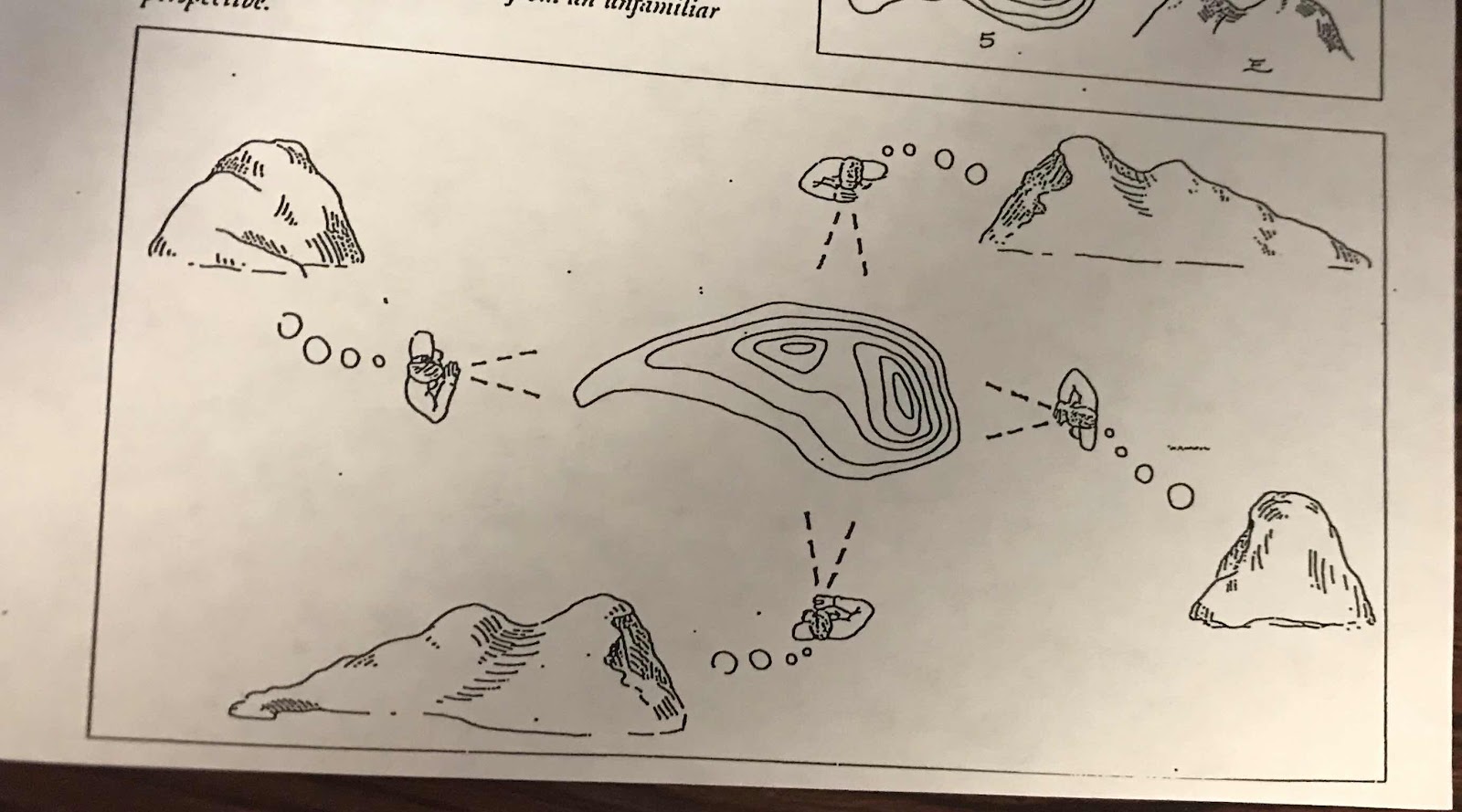 Part of orienteering is remember that a landmark looks different depending on your angle. Fulfilling the Great Commission, evangelism, justice work, healing, rebuilding, and reformation all look different in the ELCA depending on how you view the mountain of the baptized life. (I don't like mountain imagery for this kind of thing because we're not climbing, but still I hope you get what I am saying.) Occasionally we get a view or a description of what the mountain looks like from the perspective of the other expressions of the church, but it's a view from their angle and maybe not ours (whomever "we" is here). We have to process the information that is true for both (vegetation, some terrain elements, maybe weather or animals), but we mostly have to focus on the ministry (mountain) that's in our view.
The co-equal approach also acknowledges the significance of the location and circumstances of the local congregation. Any given congregation in the ELCA may choose to be in disagreement with the larger church body or to be in agreement with the church, but to express it differently. For example, a congregation of the ELCA that is distressed about the sanctuary church decision (after fully reading the actual parameters of the action) could decide that they can get onboard with the part about immigration reform, acting to make such reforms stricter in accordance with their interpretation of the scriptures and their prayers for God's guidance.
This is what it means to have both congregational polity AND a supportive denominational structure.
Your congregation decides things for themselves, but also benefits from the relationship with the synod and with churchwide.
If you have ever received a pastor who passed a psychological evaluation, has a seminary degree, had an internship, and was reviewed by a candidacy committee- you have benefitted from the structure of the ELCA.
If you have given money to help after a disaster or received money after one through a Lutheran organization, then you have benefited from the structure of the ELCA.
If you have gone to a WELCA event or to a Lutheran youth event or a Lutheran outdoor ministry or a college of the ELCA, you have benefited from the structure of the ELCA.
If you have had help when your church was in trouble or got a grant for a program or project, you benefited from the structure of the ELCA.
It is VERY true that the ELCA is not perfect and there are plenty of things that have happened through the years and at all levels that have been more hurtful than helpful. Nevertheless, this denomational is trying to hold the tension of congregational autonomy within a supported and supportive area and national denominational framework. We are church together and we are better church together.
When congregations immediately start talking about leaving the denomination without fully reflecting on the whole story and also what it means to be a denominational family, they deciding that they are better off without both the stresses and the bonuses of being in relationship. When they quit giving to the synod (which then gives to the national church), they're not changing the minds of people with whom they disagree, they're hurting the disaster responses, the adoptions, the home rebuilds, the camps, the campus ministries, the curriculum development, and many other realities of the denomational work in the world that create the space and time for people to hear about and experience Jesus.
Part of orienteering is remember that a landmark looks different depending on your angle. Fulfilling the Great Commission, evangelism, justice work, healing, rebuilding, and reformation all look different in the ELCA depending on how you view the mountain of the baptized life. (I don't like mountain imagery for this kind of thing because we're not climbing, but still I hope you get what I am saying.) Occasionally we get a view or a description of what the mountain looks like from the perspective of the other expressions of the church, but it's a view from their angle and maybe not ours (whomever "we" is here). We have to process the information that is true for both (vegetation, some terrain elements, maybe weather or animals), but we mostly have to focus on the ministry (mountain) that's in our view.When we threaten to leave or we actually do, we're telling our siblings in Christ that we refuse to do any work with them or alongside them because their view of the work is different. Worse, many churches are threatening to leave or beginning that action because of the opinion of a fourth viewer, unfamiliar with our polity or life together, but determined to weigh in on the matter.
I'm a Lutheran because I believe that the message of salvation by grace through Christ's faithfulness is the message that has saved the world and is saving it still. This powerful reality brings me joy and gives me structure. I feel grateful to be a member of the ELCA and I feel privileged to be part of working to make it better- a stronger witness in the world. Do I like everything? No. Do I keep working? Yes. That's what it means to be a family, to be church together, to accept that the congregation I serve can benefit and wrestle with our partner expressions, as well as focus on what we know to be needed in our own community.


