Showing posts with label sanctification. Show all posts

Monday, March 4, 2019

Getting Ready for Lenten Discipline


Some Christian traditions observe the season of Lent and some do not. 

Lent is a six- week period before Easter, wherein churches that observe the season focus on 1) Jesus' journey to Jerusalem and the cross, 2) preparation for baptism or renewal of baptismal vows, and 3) corrective spiritual discipline with a prayer toward increased faith and deepened trust in God. 

Sometimes when people think about spiritual disciplines for Lent, they think "giving things up"- a setting aside of something enjoyable for a season of deprivation (only to resume the habit or activity at Easter). The purpose of spiritual discipline isn't (usually) deprivation, but instead an exercise to make one stronger in internal and external faith demonstration. We should be setting aside things that cause us to feel separated from Christ and/or taking up actions or practices that help us to connect with the Ground and Source of our Being. 

For most of us, chocolate is not getting between us and Jesus. In fact, when we set aside candy or sweets as our discipline or make a new diet our Lenten focus, there can be a detrimental side effect of demeaning our body, which is a generous and valuable gift from God. We may need to make changes in how we treat our body, but that often begins with how we think of it. 

Back to the spiritual disciplines of Lent. What one takes up or sets aside should be connected to reflection on the life of Jesus and to the sacrament of baptism. Let's take a quick look at the baptismal vows spoken by parents or baptismal sponsors (or by an adult candidate for baptism): 

As you bring your children to receive the gift of baptism, you are entrusted with responsibilities:
to live with them among God's faithful people,
bring them to the word of God and the holy supper,
teach them the Lord's Prayer, the Creed, and the Ten Commandments,
place in their hands the holy scriptures,
and nurture them in faith and prayer,
so that your children may learn to trust God,
proclaim Christ through word and deed,
care for others and the world God made,
and work for justice and peace.

Those are some hefty promises, only really possible with the help of the Holy Spirit and when we have learned not to fear death and hell because of our freedom in Christ. Our Lenten disciplines, then, should be connected to these promises, helping us to take up habits that relate to our baptized status or setting aside the things that get in the way of living into that same baptized status.

We are not baptized into a "Jesus and me" life; we are born again into a life that is lived in Jesus for the sake of the world, from our closest neighbors to the people across the planet whom we will never meet. Each year, we are invited into a season of course correction for the sake of those relationship. Our redirection, our repentance, in anchored in Christ, so we are not floundering about, trying to find our way. Instead, we imitate the words and deeds of the pioneer of our faith, Jesus.

So, as you prepare for Lent, prayerfully consider your disciplines. Ask God to guide you into good work that will deepen your understanding of baptism, your awareness of the Spirit, and your trust in God's presence. Be prepared to be changed.

I think, and this is just me, that it is only when we have done the hard work of Lenten discipline and still realize how much grace we need that we are truly able to glimpse the powerful grace of the empty tomb and the resurrected Savior of the world.

This will be my dismissal phrase for Lent (at the end of church services) and I'm offering it to you now.

Go in peace. Be diligent in discipline and strong in faith. 
(Thanks be to God.)

Tuesday, November 27, 2018

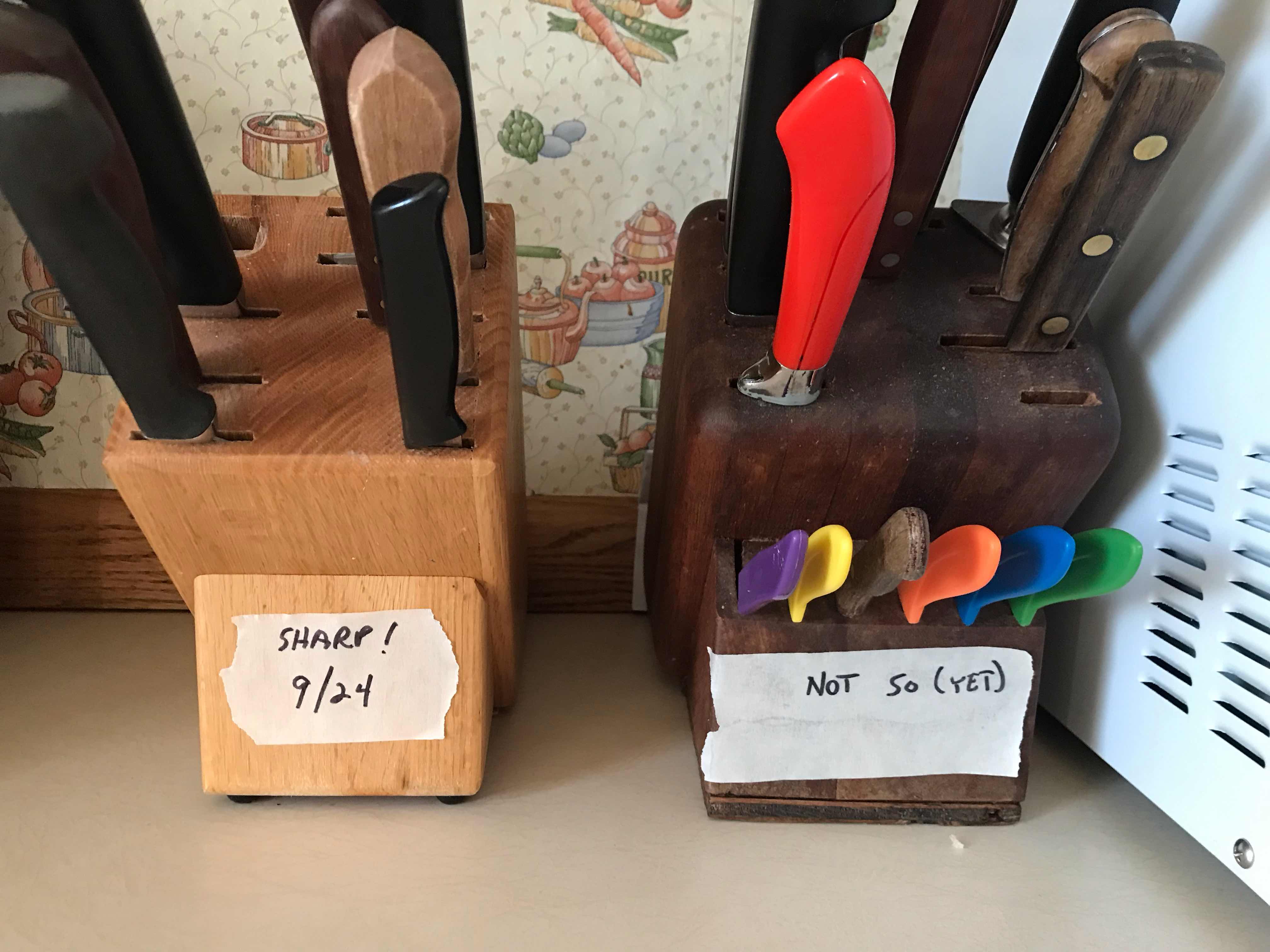
Sharper Image (Thoughts on Sanctification)

I've had this image floating around in my head and in my social media feeds for more than a week.

I even wrote a prayer around it here.

Lutherans famously are "weak on sanctification". I even have one colleague who had a t-shirt to that effect in seminary. I cringe.

The most significant theological aspect of Lutheran theology is justification. This "being made right with God by God's own work and not our own" is the whole basement of our belief system, built with the cornerstone of Jesus the Christ.

Lutheran theologian Gerhard Forde said here (in a really good article that I recommend!),
Sanctification, if it is to be spoken of as something other than justification is perhaps best defined as the art of getting used to the unconditional justification wrought by the grace of God for Jesus’ sake. It is what happens when we are grasped by the fact that God alone justifies. It is being made holy, and as such, it is not our work. It is the work of the Spirit who is called Holy. The fact that it is not our work puts the old Adam/Eve (our old self) to death and calls forth a new being in Christ. It is being saved from the sickness unto death and being called to new life…Sanctification is thus simply the art of getting used to justification. It is not something added to justification. It is not the final defense against a justification too liberally granted. It is the justified life. It is what happens when the old being comes up against the end of its self-justifying and self-gratifying ways, however pious. It is life lived in anticipation of the resurrection.

It takes nerves of steel to want to contradict or add to what Forde says because his pen was certainly often, if not always, guided by the Holy Spirit. Yet, I do think there is something not fully formed in this thought. Justification can be complete, through Jesus Christ, and we can be fully saved AND simul justus and peccator (simultaneously saint and sinner) AND still have growth in our life of faith and in our discipleship.

Sanctification does not have to be seen a completion of anything God has done, but instead the Spirit's on-going ordering of our internal chaos (as in the beginning of creation), so that we may more fully become the people God has made us to be.

Martin Luther himself understood that even when justification was complete (as it has been since the day of resurrection), we are still on a journey. He wrote in the snappily titled "An Argument- In Defense of All the Articles By Dr. Martin Luther Wrongly Condemned by the Roman Bull..."

This life, therefore, is not righteousness but growth in righteousness,
not health but healing,
not being but becoming,
not rest but exercise;
we are not yet what we shall be,
but we are growing toward it;
the process is not yet finished, but it is going on;
this is not the end, but it is the road;
all does not yet gleam with glory, but all is being purified. 

 
That sounds like sanctification to me- gleaming with the grace and power of Christ and yet becoming stronger in faith and discipleship, through the Spirit's power, day by day. Additionally, an enormous aspect of understanding the purpose of justification is that, through Christ's work, we have been freed so that we might more fully and purposefully love and serve our neighbors. It seems to me, then, that sanctification is, in part, coming to understand that our neighbors too have been justified by Christ.

It is one thing to believe that I have been made right with God. It is quite another to trust that the person whose motives I question, whose actions I despise, whose being I slander, has also been made right with God by the very same Jesus who has saved me! Surely we are all being moved along in our understanding of this.

Lastly, I think of Paul's words to the Philippians- his happy letter- wherein he is offering encouragement and words of promise to people whom he loved in Jesus.

I thank my God every time I remember you, constantly praying with joy in every one of my prayers for all of you, because of your sharing in the gospel from the first day until now. I am confident of this, that the one who began a good work among you will bring it to completion by the day of Jesus Christ. -Philippians 1:3-6

Now, it is possible to say that this is a comment to a group of Christians, not about individual growth in righteousness, but I believe that kind of theological hair-splitting isn't necessary. Clearly, God's work in and among Christians is never completed, aside from their salvation, and we are constantly being shaped, molded, reformed, restored, stretched, compelled, halted, and burnished for the sake of Christ in the world. We must take this work on God's part seriously and take our own selves less seriously. None of us is presently so good that God's work in us is done.

What's the TL:DR (too long: didn't read)here? Sanctification is a real thing. It matters for our faith and it is apart from justification. Sanctification remains God's work in us, yet we are called and empowered by the Holy Spirit to take part in it, to perceive it, to celebrate it, and to know that God remains at work in us- from the beginning to the end.

Tuesday, November 17, 2015

Knowing More Fully...

Even as we are more fully known.

Sister Joan Chittister says, "We don't change as we get older - we just get to be more of what we've always been." (The Gift of Years: Growing Older Gracefully)

This is the definition of sanctification for me. We are children of God, simultaneously saint and sinner, but we are not yet what we have been made to be in fullness. 

The on-going work of the Spirit within pulls, pushes, and propels us to being more fully the child (children) of God for the time and place and hope and future for which we were created. 

When there is great turmoil and fear in the world, like now, I can easily feel detached from many things. Yet, because I believe God is still working - even and especially in me- I believe that nothing is settled. History is within God, thus no other forces will even be footnoted in the final telling. 

Every glimpse of pain or horror in the world is also a chance to perceive one's own sanctification, to respond with Christlikeness and holy hope and to glimpse within one's own heart what has always been true about the self and what is becoming more true through the power of God. 

Thursday, May 28, 2015

Verbs are Action Words (Newsletter)

14 What good is it, my brothers and sisters, if you say you have faith but do not have works? Can faith save you? 15 If a brother or sister is naked and lacks daily food, 16 and one of you says to them, “Go in peace; keep warm and eat your fill,” and yet you do not supply their bodily needs, what is the good of that? 17 So faith by itself, if it has no works, is dead. 18 But someone will say, “You have faith and I have works.” Show me your faith apart from your works, and I by my works will show you my faith… 26 For just as the body without the spirit is dead, so faith without works is also dead. James 2:14-18, 26

            I just realized today that I haven’t posted a single thing to my blog since Easter. For some of you that doesn’t mean anything and for others, you’re screaming, “I know!” Though, in most weeks, I write sermons, litanies, commentaries, and (sometimes) book reviews, my blog remains a necessary outpost of ongoing thought and conversation. It is also the most frequent conversational intersection I have with people who are not active members of Lutheran Church of Hope. Among some of my friends, we have a phrase, “Writers write.”

            You can’t call yourself something, if you’re not doing the thing that proves the title. There are a few exceptions to that rule, but on the whole, we have to backup our words with actions. Having faith in God, trusting that we are people on the Way of Christ, and giving thanks in and for the Holy Spirit is good and important. However, mere assertion of faith through words is not enough to demonstrate what we have received through God’s own grace.

            Since we are decidedly not earning our salvation, we sometimes forget how much our actions matter and are essential to the life of faith. We are not convincing God to act or completing what Jesus has begun. Faithful actions- love for neighbors, care for creation, active pursuit of justice and peace- are part of a faithful life. Salvation is a one-time thing and not of our own doing. Sanctification, on the other hand, is an on-going work of the Holy Spirit.

            That work, sanctification, is about shaping us. The Spirit puts opportunities in our way, people in our lives, situations in our sight, and concerns on our hearts, so that we might respond and learn what it means to trust Christ’s desires for the world and God’s plans for the kin-dom. None of the efforts to which we are drawn happen magically or through our mere words among ourselves. They require prayer, sweat, tears, and effort. We must dare to get it wrong, but dare more greatly to trust in the forgiveness that exists for us- so that we might try, try again.


            Christians Christ. I do realize that “Christ” is not a verb. However, if “writers write”, Christians…? What is the verb that closes that sentence? It’s in your hands.

Sunday, July 20, 2014

No Kneeling or Sitting

6th Sunday of Pentecost

1 John 1:5-2:2

            Whenever I hear today’s verses from 1 John, this is what happens in my head, “If we say we have no sin, we deceive ourselves and the truth is not in us. If we confess our sin, God who is faithful and just will forgive our sins and cleanse us from all unrighteousness. We kneel or sit.” My years in churches that knelt or sat for the time of confession are not any greater in number than the number of years I’ve been with you, so I’ve never said or heard this phrase in six years. And yet, there it is. A biblical command and my automatic response…

            “If we say we have no sin, we deceive ourselves and the truth is not in us. If we confess our sin, God who is faithful and just will forgive our sins and cleanse us from all unrighteousness. We kneel or sit.”

            That automatic response leapt into my head all week as I thought about the reading for today. Then the Presiding Bishop sent her letter on Thursday with the instructions to read to you on Sunday. Furthermore, the plane that was shot down in Ukraine, the children who have been gathered from the U.S. southern border, and the violence that continues to escalate in Iraq, Iran, and Syria all loomed large.

            “If we say we have no sin, we deceive ourselves and the truth is not in us. If we confess our sin, God who is faithful and just will forgive our sins and cleanse us from all unrighteousness. We kneel or sit.”

            How could I address all or any of those things in a way that was empathetic, encouraging, and truthful? Could I deal with one, but not the others? What about the personal and family crises that have occurred this week? There is heartbreak here that you know that I know. And some people are gathered here because of a gorgeous and joyful wedding or other celebrations that have just past or are scheduled. People with joy in their hearts don’t always skip toward a hearty discussion of sin in the world.

            “If we say we have no sin, we deceive ourselves and the truth is not in us. If we confess our sin, God who is faithful and just will forgive our sins and cleanse us from all unrighteousness. We kneel or sit.”
            We kneel or sit often becomes our default move when we hear about sin. Being confronted with our own vain, idolatrous, and selfish choices makes most of us want to turn the other way, much less stay and reflect on them with other people (who are surely worse sinners!). This is the truth, though:

            “If we say we have no sin, we deceive ourselves and the truth is not in us. If we confess our sin, God who is faithful and just will forgive our sins and cleanse us from all unrighteousness.”

            Many of us, maybe most of us, can even accept the idea that we have not always done the right thing. Even those among us who are sure we’re pretty good have still failed in many and various ways. The harder thing to acknowledge is that we also have a hand in the larger sins that are around us. Our national struggle and missteps in the situation between Israel and Palestine does not occur apart from us. Decisions about immigration, hope, and welcome affect us all.

            The deaths of three hundred people in an airplane as a political statement and challenge reflects an overall disregard for human life on earth. That kind of behavior does not exist in a vacuum. We want to confess to feeling frustrated with our children or gossiping about our neighbor or fudging some information, but the extent of sin, within us and without us, spreads.

“If we say we have no sin, we deceive ourselves and the truth is not in us. If we confess our sin, God who is faithful and just will forgive our sins and cleanse us from all unrighteousness. We kneel or sit.”

            The writer of 1 John would never want “kneeling or sitting” to be the response to or the action of confessing. The entirety of the letter calls the Christian, the person walking in the Way of Jesus, into a community of action, of growth, of change. With the revelation of the Holy Spirit, we walk, we move from darkness into light. By confessing our shortcomings, great and small, we are forgiven and renewed according to the truth of God’s work in Jesus Christ.

            Forgiveness doesn’t happen in just still, quiet moments- when we hold our hands just right, when we kneel or sit, when we say the right words. The Holy Spirit doesn’t need us to hold still. The Spirit molds us on the way, washes us on the move, and makes us whole even as we mess up again. We ask for forgiveness because we know we need it. God gives it because of God’s very nature.

            “If we say we have no sin, we deceive ourselves and the truth is not in us. If we confess our sin, God who is faithful and just will forgive our sins and cleanse us from all unrighteousness.”

            I have to put new words at the end of that sentence. You do too. Being cleansed from unrighteousness, being made right with God, is not for nothing. It is specifically so that we can continue forward to work for justice, peace, reconciliation, and to care for creation- all things that are in our baptismal promises. We pray, we act, we call, we write, we cry out, we point, we encourage, we rage, we confess, we are forgiven… There is no kneel or sit.

            We are called and pulled into the action of God’s work with our hands, our feet, our mouths, our time, our possessions.

“If we say we have no sin, we deceive ourselves and the truth is not in us. If we confess our sin, God who is faithful and just will forgive our sins and cleanse us from all unrighteousness.” We work and pray. We listen and heal. We hope and play. In recognizing the truth of God’s mercy and grace, we are called to do just about anything and everything, besides kneel or sit, for the sake of Christ in the world. 


Amen.

Monday, November 5, 2012

Around the Edges (All Saints Sermon)


1 Kings 17:1-16

            A famous theologian once said, “You should preach with the Bible in one hand and the newspaper in the other.” That can be tough, because then in one hand I have stories of droughts and floods, wars and struggles between ruling parties, unexpected deaths, people struggling to make ends meet, and people longing for justice… and is that the hand that holds the newspaper or the Bible? Sometimes, it can be hard to tell one from the other without looking carefully and remembering what each one is supposed to do. The newspaper shows us a world that longs for God’s kingdom to come or has forgotten its promise. The Bible reminds us of the promise and shows us God’s actions through history, so that we have a foundation on which to base our hope in and expectation of God’s future actions.

            If the Bible were like other history books, today’s reading would be about Ahab’s reaction to the prophet Elijah. We would have a detailed account of the king’s comings and goings and how other, sycophantic “prophets” would have advised him, and (almost certainly) what Jezebel had to say about the matter. Yet, Israel’s history does not chronicle the kings as much as the people affected by the king and the king’s decisions. Remember that when Israel called for a king, the people were reminded that the Lord was to be their one leader and a king would come with some serious consequences for their national wellbeing.

            Thus, instead of learning more about Ahab, we get a story of Elijah fleeing for his life and a widow with a child, someone who is directly affected by the policies of the king. The first situation that is facing the widow is that she is a widow. Her source of income is gone. Her husband’s family, if still living, hasn’t taken her in to be with them. Her own family, if still living, would not be expected to do so. So she depends on the generosity of others, toward her and toward her son, so that they may live. She may be able to do little tasks in exchange for food or coin to make ends meet, but she certainly lives with very little extra and, consequently, very little participation in societal life.

            The second situation facing the widow (and her neighbors) is the drought. The writer of 1 Kings is careful to point out that the Lord says through Elijah that it will not rain for several years. The significance of this is not that the Lord wants people to suffer in a drought, but that the Lord wants them to remember who makes the rain. The Canaanite god, Baal, was thought to be the giver of rain. If it was dry, Baal was dead. If it rained, he was alive. But Elijah’s prophesy points out that it is the Lord God who is the giver of life. So now we have a situation where people are going to be tightening their belts and have less to give to the widow, whom God has commanded them to remember. We have a prophet who has angered a king who is clearly refusing to acknowledge the Lord as God (and the only God).

            Finally, the widow has a plan for how she and her son will die and here comes a prophet of the Lord, distinguished in some way that lets her know that he’s a holy man, who wants some of her last bits of food. Now, the widow is from the same region (Sidon) as Jezebel, so she is likely to be a worshiper of Baal. Yet she speaks to Elijah with the words he spoke to Ahab, “As the Lord your God lives…” Her circumstances are overwhelming and horrifying. If we were reading to this point in a newspaper article, woman struggling to make ends meet in bad times is confronted by a man who claims to speak for God who tells her to feed him… Who would root for her? Who would blame her if she closed the door on him? Who would say she should absolutely make him some food? Who would say, “The Lord never gives us more than we can handle” and expect her to bake that bread?

            Elijah promises her that she and her son will have enough food, throughout the drought, if she helps him. And so she did. Hooray! Faithful action pays off! It’s a heart-warming page 2 story!

            But not so fast, remember earlier in the story when the ravens feed Elijah? We’re all familiar with ravens- eating out of dumpsters and what’s been hit in the street. Who here would eat meat and bread brought to them by a raven? Even more so, in ancient Israel, ravens are nasty, unclean birds. You don’t eat scavengers, yet they are what God sends to keep Elijah alive. The unexpected birds are how God provides for the prophet.

Similarly, the widow, with all of the circumstances piled against her, should not be expected to provide for a prophet. There are better-favored people to do that, yet God’s provision for her allows her to have an expected role as a sustainer, as a provider, as a person whom God has not forgotten. The God she does not worship has not failed to provide for her and, furthermore, has not forgotten use her to the hope of others and for the hope of creation.

This is what it means to be a saint. It’s not about having great stories written about you or having powerful visions or heroic actions. It’s about faithful action, in spite of what else is happening, and it is about being the hope in God of the people around us. The people whose lives we remember today and the lives that the Spirit is shaping today are exactly this… lives that remember the people around them, lives that are structured by small, unseen remembrances, gifts, and help.

Sometimes we do have more than we can handle on our own. Sometimes life does pile up. It is not merely by our own determination that we survive, but by the help and support of others- who bring us bread, words of hope, silent companionship, refills of oil for our jars. This is what sainthood looks like… un-haloed, but still hallowed, unsung, but still a song, unremarked, but still remarkable.

It is work that happens through family and friends AND through outsiders and rejects (in this story, widows and ravens). This is how the Spirit moves-from all directions, expected and unexpected. This is how God reminds us who is in charge. This is how saints are made, how creation is renewed, and how Christ continues to make resurrection happen out of death in this life.

A famous theologian once said, “You should preach with the Bible in one hand and the newspaper in the other.” In one hand, I have stories of droughts and floods, wars and struggles between ruling parties, unexpected deaths, people struggling to make ends meet, and people longing for justice… and is that the newspaper or the Bible?

In the end, it doesn’t matter. Either way, the Holy Spirit is in these stories, breathing from the edges and from the middle, encouraging people (and sometimes animals) to actions that save and preserve life. It’s not the headline news, but it must be remembered. God is in charge, no matter what else happens, and, with that eternal truth, comes this corollary: the Spirit is still making saints. 

The Walkup Song of the Lord

Synod Sermon – Pentecost 19, Lectionary 27, Year A Isaiah 5:1-7; Psalm 80:7-15; Philippians 3:4b-14; Matthew 21:33-46 D ear Friends in Chris...