Showing posts with label God's story. Show all posts

Sunday, April 26, 2026

Trust the Comma and the Gate

George Burns and Gracie Allen were one of the greatest comedic duos in history. They were inseparable on the radio, on stage, and on television. Their television show was on from 1950–1958. After having some heart trouble, Gracie decided to retire. George attempted the show without her for one year, but it didn’t work without Gracie. She died of a heart attack in 1964. When George went through her papers, he found a note she wrote to him, which included the line, “Never place a period where God has placed a comma.” Never place a period where God has placed a comma. George Burns took this reminder from his beloved that his life on earth wasn’t over yet. He went on to continue acting, directing, and writing until he died at the age of 100 in 1996, always missing Gracie, but continuing to truly live his own life. 

A reminder that came from deep love, even in grief, “Never place a period where God has placed a comma.”

In today’s reading from John, Jesus introduces us to a radical idea that echoes in Gracie’s note. He says, "My sheep hearmy voice." Notice the tense. He doesn't say the sheep heard the voice of God back in the days of the prophets, nor that they will only hear it in the life of the world to come. Jesus speaks in present tense and John preserves that tense. Jesus is speaking, the Creator is speaking, the Spirit is speaking. Right now. 

Often, the story of our faith can feel like something long ago and far away — a collection of periods and finished chapters. The saints, the apostles, the reformers, the mothers and fathers of our faith — they lived ages ago. We sometimes talk as though the "voice of God" is something confined to ancient parchment. 

But Jesus describes a living, breathing relationship, an active communication and calling. Jesus tells us that to be called His followers, his people, sheep of his fold, and lambs of his flock means to still be listening to his voice. To hear His voice today is to recognize that the Divine is still speaking. There is a voice of Love and grace that is louder and more persuasive than all our modern noise, but we must pay attention to how we’re tuned to hear it and listen. 

Jesus warns us about that modern noise, the misdirecting sounds, and loud untruths. He speaks of the thief who comes to "steal and kill and destroy." These thieves don't just try steal our peace; they try to steal our future by lying about God’s punctuation and our identity as valuable and treasured.

A thief is always a master of the premature period. They whisper:

"You've made too many mistakes; your story is over." (Period.)

"This sickness is the end of you." (Period.)

"You’ll never understand the Bible, so you should quit trying." (Period.)

“No one will believe you now, so you might as well keep lying.” (Period.)

“It doesn’t matter if you keep going. No one cares.” (Period.)

These voices try to convince us that the gate is locked, that our purpose has expired, or that God has stopped speaking. They want to trap you in a finished chapter, convincing you that there is no "next" in your walk with the Shepherd. But a voice that tells you God is done with you is never the voice of the Shepherd. You matter. Your presence matters. You are part of God’s beloved creation. And you are defined by God’s love for you, not anything you’ve done. A sentence is never too long for one more comma and a new clause in God’s handwriting. 

Jesus corrects the thief’s grammar by declaring, "I am the gate." In the life of a shepherd, the gate functions as a comma. It is not a wall; it is a point of transition that swings in both directions.

There are seasons when the world is too loud and predators are too close. The shepherd guides us through the valley, by still water, and into the gate to take refuge in the fold. Here, the comma represents a pause—a place of rest, healing, and protection. We find "pasture" for our souls.

But the sheep do not stay in the fold forever. Jesus says they “will come in and go out.” The gate swings outward. This is the comma of service. We are led out into the world to be the hands and feet of the Shepherd, witnessing the protection and provision that only come from love and care and a deep understanding of our continuing story. 

Jesus grants a powerful promise: "I have come that they may have life, and have it abundantly."

Abundant life, a life where we are followed constantly by goodness and mercy, is found in the rhythm of the gate—the "in and out" of a life led by His voice. When we try to place a period on our lives — deciding we are too old to serve, too broken to be used, or too comfortable to change — we miss the abundance.

Gracie Allen knew that even in grief, God wasn’t finished with George. Jesus proclaims that even in our failures or our fears, He isn't finished with us.

Reject and renounce the false periods that come from thieves, that diminish your worth, that make you feel small, that make you question God’s work in your salvation. Listen for the Shepherd’s voice. Look and listen for the signs and words of love. Let Christ draw you into the fold when you need rest, and follow Him out into the world where He leads you to mission. Trust the comma, trust the Gate, and live the life that is truly full.

Amen. 

Sunday, January 16, 2022

At What Cost?

Scripture: John 2:1-12


A sermon is best presented as a smooth stone, something the Holy Spirit has worked on in me and then I present to you, with the Spirit’s help. You can then turn that stone over and over, seeing how it reflects brightness and absorbs shadows.  

A good sermon has heft, as well as tiny flaws- keeping you focused on the perfect God and not the imperfect preacher. If the standard for a good sermon is a smooth stone, as I just said, then today- I do not have a good sermon. Today’s words, with no less help from the Holy Spirit, have a ragged edge. This sharpness has snagged at me this week and resists polishing. 


It is not lack of preparation that has retained this unpolished roughness; it is the difficulty of the question at hand. The texts of the day bring us to a question that cannot be answered in this life, not without great risk to integrity and faithfulness. This is my content warning. While there are some smooth edges ahead, this sermon is more of a cutting tool than a polished comfort object. 


When Jesus’ ministry formally begins in the gospel, according to John, he is at a wedding with his disciples and his mother. In Matthew, Jesus preaches, heals, and casts out demons. In Mark, Jesus preaches, casts out demons, and heals. Same actions, different order. In Luke, Jesus preaches, escapes a death threat (Luke 4:28-30), casts out demons, and heals people. A little extra excitement there, but same story. 


Why, then, does John start with this sign of water into wine?


A small segue into vocabulary: The author of the fourth gospel does not use the term miracle, or any similar word, in this book. Instead, the writer employs the term “sign”. Water into wine, healing of a blind man, speaking to a Samaritan woman, raising Lazarus from the dead- all of these are signs of God’s presence in Jesus and in the world. They are not miracles- one-off demonstrations of power. They are signs- indicators of the holy in the world and divine power at work. John 1:16 notes “from his fullness, we have all received grace upon grace”. The author does not use the word grace again but shows what it looks like through the signs Jesus works in the world. 


This sign, the sign of up to 180 gallons of good wine, is more than an indicator that God understands hospitality and reveals that understanding through Jesus. The sign of water into wine illustrates two very specific verses from John. 


John 1:18 No one has ever seen God. God the only Son, who is at the Father’s side, has made God known.


John 10:10 The thief comes only to steal and kill and destroy. I came that they may have life, and have it abundantly.


The sign of water into wine is a clear revelation through Jesus of the nature of God and the divine desire for us to have abundant life. God’s will is not for any person or other aspect of creation to scrape by a meager existence with little joy and rare celebration. God’s intention, as revealed through 180 gallons of good wine, is for us to live well, in harmony together, and with our needs met, so much so that we shall not want. 


None of this is difficult so far, right?  If I stop here, we have a smooth stone to hold. 


… but I’m going to go on. (You’re not surprised.) 


Here is the jagged edge in this story, the part that will not let go of me, the place where I continue to wrestle for a blessing in the hopes that I might limp away. 


When Jesus’ mother asks him to do something about the dwindling wine supply, he tells her, “Woman, what concern is that to you and to me? My hour has not yet come.” And his mother tells the servants, “Do whatever he tells you.” 


His hour has not yet come. 

His hour has not yet come. 

His hour has not yet come. 


The gospel according to John is divided into two sections, the book of signs, which goes through the raising of Lazarus, and the book of glory, which goes through the post-resurrection appearances. In John, Christ’s glory is revealed in his faithfulness through death and God’s same faithfulness through the resurrection, thwarting death’s alleged power. When Jesus speaks of his hour coming, he is referring to this time of glory. Jesus knows, as does his mother, that once God’s presence is revealed in him, human resistance to God’s grace and glory will begin. Are 180 gallons of wine worth that risk? The beginning of what will stir up anger, rejection, and plots to kill him until one succeeds? 


His own mother says yes. She knows what her yes means. She knows the cost of this sign of God’s presence. She can look at her adult son, seeing the baby he was, the child, the young man… and still she says it is time. And she knows the cost. 


Jesus’ death is not inevitable in terms of being required. It is inevitable because people resist grace, stonewall against repentance, and will run toward false gods like a sense of control, political power in this world, and judgment of others before they will yield to divine mercy and abundant grace. 


This water into wine came at a high cost. From the moment the steward sips the wine and calls the bridegroom, the clock (sundial?) has begun toward human rejection of Christ and an attempt to kill God’s presence in the world. 


This is the jagged edge of this sermon. Do we truly ever consider what grace costs God? 


I have received some excellent questions lately about how we can discern if something that happens is from God. The tension in this question comes from the fact that just because God permits something to occur does not mean that God caused the thing to occur. I will say that again: just because God permits something to occur does not mean that God caused the thing to occur. 


In John, the word we use for world is actually cosmos. As in, “for God so loved the cosmos”. God is present in the cosmos. God is active in the cosmos. God is still speaking in the cosmos. 


But at what cost to God? 


When we are trying to discern what God does and how God acts, we must weigh the cost to the divine, even though we cannot fully understand it. 


We know that God in Jesus was willing to begin the dangerous journey to the cross with 180 gallons of good wine. Each healing, each sermon, each exorcism from there on out was a step toward human rejection and divine suffering because of brokenness. Yet, God considered it worth the cost. 


What does it cost God to heal some people through death, rather than through medicine or miracles? 


What does it cost God when people count material possessions as blessings, but reject the teachings of Jesus about caring for others? 


What does it cost God to pour out love for creation, but to see human beings only partially embrace their vocation of stewardship of the earth? 


What does it cost God to know that Jesus promised to draw all people to himself, and yet we fight over who is in and who is out? 


What does it cost God to witness some people being healed because of their access to medical care, while others suffer or live in fear? 


What does it cost God to desire, deeply, abundant life for all of us and to watch us hesitate, hedge, and hem and haw about irrelevant things? 


What does it cost God to have brought humanity to deeper and deeper understanding about the wonders and mysteries of all that is, only to see us reject science, medicine, and reason for our own misunderstandings? 


What does it cost God to bring forth grace upon grace, in creation, in our relationships, in possibility- over and over, year after year, until the end only God knows? 


This is the jagged edge of this sermon for me. It is the side of the solid rock which I cannot smooth out for myself or for you. 


What does it cost God? 


I have no idea. 


I cannot imagine. 


And, in this area, I am not willing to risk being wrong. 


All I comprehend, in the end, with this rough edge in my hand, is this small balm: 


There are costs to God, beyond our knowing. 


And yet God charges us nothing. 


And that alone is the only good sermon. 


Amen. 

Wednesday, August 14, 2019

You and Me and the ELCA

A recent decision during the churchwide assembly of the Evangelical Lutheran Church in America (ELCA) has stirred up controversy. You can read the official statement about being coming a sanctuary church here and you can read a pastoral letter explaining that action here. You can read a letter from a bishop of the ELCA about the decision here. Talking points from Presiding Bishop Elizabeth Eaton can be found here. I strongly recommend considering denominational resources for interpretation of the action, rather that external news sources or hearsay.

Since there already exists a body of writing to explain the action at the churchwide assembly, I'd like to offer a brief explanation about the polity of the ELCA. 

The denomination has three co-equal expressions: the local church body (congregation), the synod level, and the churchwide level. As evidenced by the screenshot of the constitution of the ELCA, each expression of the church has its own work, but in that work supports the other two. The congregation works to the glory of God in the community, in word and deed. The synod level exists to support congregations in a specific area, to house joint resources, to provide some oversight and support to congregations and to pastors, and to facilitate communication between the congregation and the churchwide office, all to the glory of God. The churchwide office exists to be in relationship with Lutheran partners across the world, with other denominational partners, with other national and international agencies for the purposes of justice, peace, and disaster relief and prevention. 

Decisions made at the churchwide level rise up from congregations through synods to the floor of the churchwide assembly (CWA) every three years. If you look here, you can see how many resolutions and memorials were brought forward to be decided at the CWA. Due to the co-equal nature of the expressions, the churchwide office takes direction from congregations and synods, which serve as the springboard for the prophetic action of the more visible arm of the denomination.

The co-equal approach also acknowledges the significance of the location and circumstances of the local congregation. Any given congregation in the ELCA may choose to be in disagreement with the larger church body or to be in agreement with the church, but to express it differently. For example, a congregation of the ELCA that is distressed about the sanctuary church decision (after fully reading the actual parameters of the action) could decide that they can get onboard with the part about immigration reform, acting to make such reforms stricter in accordance with their interpretation of the scriptures and their prayers for God's guidance.

This is what it means to have both congregational polity AND a supportive denominational structure.

Your congregation decides things for themselves, but also benefits from the relationship with the synod and with churchwide.

If you have ever received a pastor who passed a psychological evaluation, has a seminary degree, had an internship, and was reviewed by a candidacy committee- you have benefitted from the structure of the ELCA.

If you have given money to help after a disaster or received money after one through a Lutheran organization, then you have benefited from the structure of the ELCA.

If you have gone to a WELCA event or to a Lutheran youth event or a Lutheran outdoor ministry or a college of the ELCA, you have benefited from the structure of the ELCA.

If you have had help when your church was in trouble or got a grant for a program or project, you benefited from the structure of the ELCA.

It is VERY true that the ELCA is not perfect and there are plenty of things that have happened through the years and at all levels that have been more hurtful than helpful. Nevertheless, this denomational is trying to hold the tension of congregational autonomy within a supported and supportive area and national denominational framework. We are church together and we are better church together.

When congregations immediately start talking about leaving the denomination without fully reflecting on the whole story and also what it means to be a denominational family, they deciding that they are better off without both the stresses and the bonuses of being in relationship. When they quit giving to the synod (which then gives to the national church), they're not changing the minds of people with whom they disagree, they're hurting the disaster responses, the adoptions, the home rebuilds, the camps, the campus ministries, the curriculum development, and many other realities of the denomational work in the world that create the space and time for people to hear about and experience Jesus.

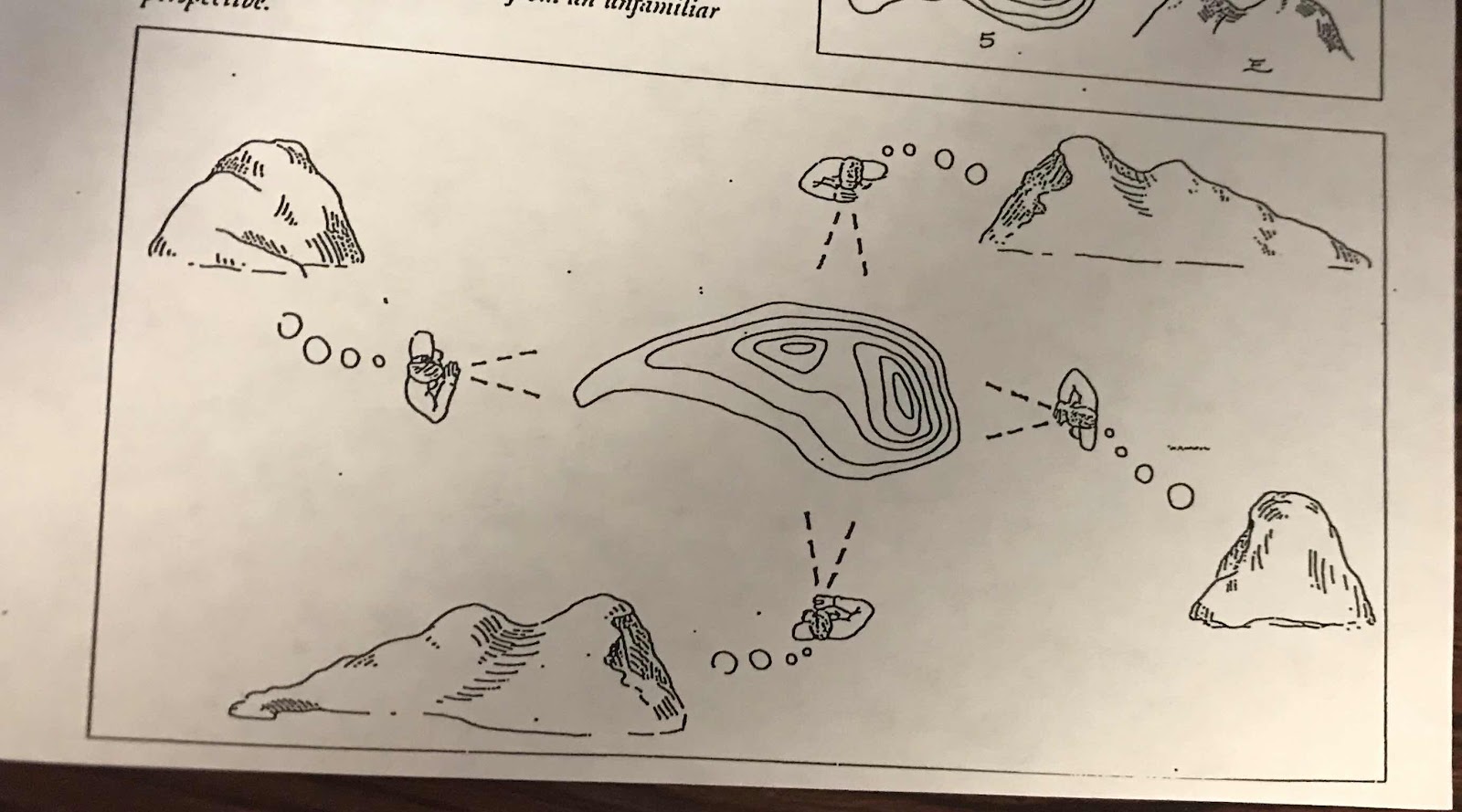
Part of orienteering is remember that a landmark looks different depending on your angle. Fulfilling the Great Commission, evangelism, justice work, healing, rebuilding, and reformation all look different in the ELCA depending on how you view the mountain of  the baptized life. (I don't like mountain imagery for this kind of thing because we're not climbing, but still I hope you get what I am saying.) Occasionally we get a view or a description of what the mountain looks like from the perspective of the other expressions of the church, but it's a view from their angle and maybe not ours (whomever "we" is here). We have to process the information that is true for both (vegetation, some terrain elements, maybe weather or animals), but we mostly have to focus on the ministry (mountain) that's in our view.

When we threaten to leave or we actually do, we're telling our siblings in Christ that we refuse to do any work with them or alongside them because their view of the work is different. Worse, many churches are threatening to leave or beginning that action because of the opinion of a fourth viewer, unfamiliar with our polity or life together, but determined to weigh in on the matter.

I'm a Lutheran because I believe that the message of salvation by grace through Christ's faithfulness is the message that has saved the world and is saving it still. This powerful reality brings me joy and gives me structure. I feel grateful to be a member of the ELCA and I feel privileged to be part of working to make it better- a stronger witness in the world. Do I like everything? No. Do I keep working? Yes. That's what it means to be a family, to be church together, to accept that the congregation I serve can benefit and wrestle with our partner expressions, as well as focus on what we know to be needed in our own community. 

Tuesday, June 11, 2019

Imagine Something Better

Imagination matters. And we are failing our children when it comes to the fullest use of imagination.

Experiences of play wherein different locales, ways of being, changing movement, and evolving responses are critical to our children's emotional and psychological development. Opportunities for imagination come naturally to most children and if we, as adults, ask questions, encourage, and give healthy shape to such play, we are then shoring up a strong mental and ethical foundation for our children.

Because moral imagination is a real concept and, I would argue, a real thing. Moral imagination, even in play, involves the capactity to wrestle with ethical concepts and frameworks and apply them in new and different settings. In order to be grow into an adult ethic that seeks justice and wholeness, children have to be taught the truth of certain historic events. Girded with historical realities, in all their complexities, children can imagine their reactions, test those responses with adults or in their minds, and then sort out how to choose between options. This skill becomes the moral imagination adults require to be responsive and compassionate citizens of communities.

In recent weeks, I learned of two particular failures to tell the truth that will, if unchecked, compromise the development of moral imagination in the children who interact with these situations.

This screenshot is from Twitter and was a school assignment for upper elementary/middle school students in North Carolina. There was a long conversation between some parents regarding the assignment, mostly centering on parents who believed there was no problem with the assignment and parents who found it appalling.

Initially the assignments seem benign, offering children a variety of opportunities and ways to respond to lessons about the Holocaust. Presumably there is a list of recommended books or resources that accompanies the assignment to help. Additionally, this assignment is asking for some level of imagination. So, what's the problem?

The problem is that such an assignment cannot be fully rooted in having been told the truth about the Holocaust. This is not an assignment that would come after reading The Diary of Anne Frank or Elie Wiesel's Night. A letter from a concentration camp? It's not summer camp. There are no letters. There is survival, and barely that.

Assignments that actually wrestle with honest accounts of the Holocaust would ask children for their own reactions to what they read and heard. They would write letters about their own response to pictures, accounts, film clips, or novels. Students would be presented with the truth and then accompanied in how to emotionally, intellectually, and psychologically process the horror.

Assignments like "write a letter to your parents" or "write a skit" are the imaginative equivalent of skipping rocks across a pond. It takes some skill, but it tells you nothing about the depth of the pond. Additionally, a child who completes this type of assignment to success in the grading parameters for this class will believe themselves to have understood the depth of the assignment. When later confronted with additional information about concentration camps or the Holocaust- such as children were only kept alive for medical experimentation or days were spent in back-breaking labor or in fear for your life or the potential that you survived via the Kindertransport, but you never saw your parents again- when confronted with these realities, a young adult will retreat mentally to the reward of what was previously imagined (that sixth grade skit they wrote) and treat that as the truth.

It is very hard to write over mental scripts, which is why we have to be honest from the beginning.

Which brings me to the second failure: the Roar Vacation Bible School (VBS) from Group Publishing. You can read an excellent reflection on this VBS and its problematic issues here. Long story less long, this is an "Africa"-themed curriculum in which children pretend to be Israelite slaves, Africa is refered to as a "country", and students are asked to add "clicks" to their words to mimic an particular language and dialect.

What's the problem here? (Besides having an all-white creative team at Group Publishing.)

First, Africa is a very large continent with 54 separate countries, most containing a variety of people with differing ethnic identities. Nigeria and South Sudan are two different places with a variety of ways of being. We don't say that Belgium and Italy are the same, so why is conflating African nations acceptable.

Second, slavery is both a historical and contemporary issue. Even if you want to make the (not good) argument that it was/is an economic system (as opposed to a system of oppression), it remains true that enslaving people, particularly implying that people can be owned, is neither just nor good nor a viable economic system. Enslaving people is wrong. Furthermore, enslavement based on race or ethnicity creates generational trauma. We have no idea how long it takes that generational trauma to heal because we haven't stopped doubling down on some of the lies about enslavement in history and in modern times.

Third, the internet is real. If you want to show what a "click" language is like, get thee to YouTube and find a video with a native Xhosa speaker. It takes about thirty seconds unless your internet is slow. Then it takes 45 seconds.


Yes, the enslavement of the Israelites is a biblical reality and Pharoah's treatment of them was particularly harsh. Children can, however, be told the truth and asked to consider what people may have felt or thought without actually being told to reinact enslavement. Similar to some of the Holocaust assignments, pretending to be a slave while being faux-yelled at in a (safe) VBS setting makes a mental imprint on kids that they understand what this experience is like. They don't. Without being told the truth and then guided into processing the horror, they are imprinting a lesson that may never be written over. "I understand what X is like because I had this experience/lesson when I was a kid."

I know what it is like to water a huge garden from a five gallon bucket, refilled repeatedly, in the North Carolina heat. I know what it's like to be yelled at while doing it. I do not know what slavery is like. I can only imagine slavery because I have read accounts and historical information. I have enough understanding to comprehend a horror that I have not experienced and to be able to extrapolate, morally, that I should keep alert to prevent, to the best of my ability, such circumstances in the future. Prevention is not because I'm a savior of people, but because I am moral participant in the universe and enslaving people is not in the arc of justice.

It would be easy to say that this is just one assignment or one VBS experience, but a failure to be honest hobbles the moral imagination for years to come. If I think my imagination suffices for the truth of an experience, rather than someone else's own account of it, then I will never actually extend my ethics beyond myself.

I've been pregnant twice, so I can "imagine" what women who seeks abortion services are feeling/thinking.

I've been broke, so I can "imagine" what people who are without funds experience.

I've been sick, even to the point of being unable to work, so I can "imagine" the implications of various long-term illnesses.

I've been spanked, so I can "imagine" the consequences of long-term physical and mental abuse.

My country has been attacked, so I can "imagine" the impact of growing up and living in a war zone.


I can imagine all day long, but there are truthful accounts of real people who do tell their own stories. Reading or watching their own words, their owning of their experience, strengthens my moral imagination so that I live in an ethical framework that includes other people's truth, not just my imagining of it. And I am trying to raise my children to do this same thing.

Each assignment, each VBS or Sunday School lesson, each car conversation, or library visit matters because they are all blocks in the foundation of who our children are and who they will be. If we want them to be fully functioning, morally imaginative adults- then we have to equip them with the truth, good and bad and ambivalent, of human history. When we tell the truth, and the whole truth, there is no place for lies or fake news to take root.

And then, I imagine, the world becomes a better place.


Monday, April 22, 2019

God's Long Now

Easter Sunday
Luke 24:13-35
If God had a clock, what would it look like? What would God’s desk calendar look like? I’m not just  thinking about marking the passing of time; I’m thinking more about the scope of time. Most of us are familiar with a 24-hour clock. We’ve seen or we’ve been people with five-year-journals or planners. 2ndPeter says that for God, one thousand years is like a day and a day is like one thousand years. 

God’s concept of time is what I would call the “Long Now”. When humans talk about the Long Now, they are discussing time in ten thousand year increments. They work to think on a grand scale about time, about people, about medicine, about the care of the earth. The Long Now is a shift toward thinking that’s not just about investing or retirement, but for a reality that we cannot even imagine, for a time and a people or a planet, long after we are forgotten on this plane of existence.

I find the Long Now fascinating, but I’m even more intrigued by the idea of a Divine Long Now. It pulls at my spirit to think that God’s sense of time is so high, so deep, and so broad, that God’s sense of now puts us in the same time frame as Abraham and Sarah, as King David, as Jesus, at the women at the tomb, as Cleopas and his friend. God’s now already encompasses our own descendants, ten, twenty, and thirty generations out from us. God’s Long Now is a horizon we can barely grasp, and yet its scenery is so replete with holy grace and healing that we cannot ignore it.

Why am I thinking about God’s Long Now and God’s sense of time?

I think the Emmaus story contains what is possibly the most painful statement for humans to utter. We had hoped. Cleopas and his friend are probably drained. They witnessed the crucifixion. They stayed in Jerusalem until the sabbath was complete and then headed back to Emmaus. They heard the witness of the women, but were unsure how to understand it. 

So they say those words, “We had hoped.” I think “we had hoped” is exactly the opposite of the Long Now. We had hoped says we wanted to see this, we wanted to witness God’s glory in our lifetime, we had expectations that were not met, we do not know how to understand what has happened. We had hoped that the good old days would last forever. We had hoped that we would hold onto power. We had hoped that it would be our turn to be on top and maybe get to do a little oppressing of our own. 

We had hoped. 

Where people say, “We had hoped”, God says, “The story isn’t finished. In fact, we’ve only just begun. I’ve been keeping promises for generations. I’ve upheld every covenant I’ve made. I’ve worked to heal creation again and again and again. I’m pouring out love and mercy and grace, even to the extent of walking among you. And you think we’re finished?”

In my holy imagination, God sighs, with compassion, as Jesus walks down that road, explaining the scriptures, revealing God’s nature, character, and faithfulness… again. As this goes on, the Spirit is on the move- shoring up the witness of the women, bringing new life to bear in plants and animals, inspiring faith in people who were witnesses to the crucifixion at the margins of the story. Even as Jesus focuses on a pair of followers, God’s view of the Long Now is on the move.

God’s planner is eternal. And I don’t mean like our perpetual calendars, where you just shift the numbers to show a new date. I mean, God’s scope and plan for the on-going outpouring of love, the effort to bring us all into right relationship, the making of all things new (which is different than all new things)… God is always doing that work. As long as God is doing that, the only time that exists for the Divine is now.

When we think of first-century Palestine, when we think of the lie of Pax Romana, when we consider the other places or times that the incarnation could have taken place, that Jesus could have been born… we are only considering that from our own perspective in time. In God’s Long Now, Jesus life, death, and resurrection were but a minute ago and none too soon because people just seem(ed) unable to grasp the nuances of Divine control and power, revealing holy love. 

What happens to our understanding of time if we realize that we have been baptized into God’s Long Now? Our grief and pain over death remain very real. Our frustrations with the world remain true. We remain in compassionate disagreement with one another over many things.

And yet, we know that our trust in God, our generosity, our patience, our kindness, and our joy matter deeply because they bear witness to the reality that God is not made in our image, but that we are made in God’s. Our Easter joy is rooted in and grows out of the truth that God forgives and brings resurrection and restoration out of the worst that humans can do. When our hope in this truth bears fruit, the harvest is for justice and peace, for compassion and healing, for the little, the lost, and the least, for the prodigal son, his frustrated brother, his grieving father, and his unmentioned mother.

All creation lives for and leans toward this blessed alleluia-filled, glorious Easter blessing: that resurrection is always now. That God’s power was neither stronger then or is coming stronger in the future, but is now as it always has been. God’s Long Now means that Jesus breathed again just a second ago. He only just broke the bread at the table with Cleopas and his friend. It has only been a minute since Jesus inspired Augustine and Aquinas, since he strengthened Martin and Katie Luther, since he moved people to build Notre Dame cathedral the first time, since he stirred firmly those who worked to spread the good news in word and deed around the world, since he gave the inspiration to people to build this very church. Each of these people, these faithful, these witnesses could have looked at what they faced and said, “We had hoped.” Instead, they stepped out bravely in faith. And in God’s divine time, all of it happened right now.

And a right now resurrection includes, surrounds, and compels us to be people we never dreamed we could be, to do good that never previously occurred to us, to be present to one another, showing up, in ways new and old, but with timing that is always now.

We are God’s people by God’s call, God’s faithfulness, and God’s use of us in the world. We are resurrection people- serving a God who renews, restores, and reforms life and lives through grace upon grace. We are Easter people.

And because of God’s divine plan of time, Easter is always now. Jesus breathes again, in us, now. The earth is relieved, now. Our alleluias ring out now. We respond to grace now.

Christ is risen. He is risen indeed. He is with us, between us, in the breaking of the bread, out in the world forever, but also and always right now.

Amen.

Thursday, January 3, 2019

Revelation Read-Along: Day 17

The series took a hiatus while I gave time and energy to be with a grieving family and a dying saint. I appreciate your patience. 


Reading: Revelation 13

Advent Theme: Simplicity

Jesus said, “Let the little children come to me, and do not hinder them. For the kingdom of heaven belongs to such as these.” (Matthew 19:14) I think about that verse when I read Revelation 13. So much has been made about this chapter, gallons of ink spilled on it alone, that it can be hard to read it with new eyes. Thus, think about how you might explain this to a child. If we cannot explain the scripture to a child, then either our interpretation is off-base or Jesus was wrong. Which one of those two would you like to pick? (I do realize that creating a binary there isn’t necessarily helpful, but please let it stand for this post.)

Let’s approach chapter 13 as though we were going to explain it to a 9-year-old. We have a different relationship with dragons now, but imagine if you didn’t have books and movies about dragons. Imagine the rulers of the world used the images of power and fire, like a dragon, to make people scared. How would you feel if you saw shields with dragons or red flags, like dragon fire, carried on long poles as an army rode by?

Then what would it be like if your friends and their families all said, “We have to follow the emperor. He is looking for all the people who don’t decorate their house with dragons. If you don’t sing the dragon song, he will send the army to kill you.”

Your family and you believe that a house should only have words from God in it and no pictures. Your family will not get on their knees when the emperor’s dragon flag goes by. Your parents say that you are not allowed to sing the dragon song- not at home, not on the playground, not if you’re by yourself. They say that the emperor says he is God, but you know that he is not. Your friends aren’t allowed to play with you anymore because their families are scared and they believe in the emperor, or at least in the emperor’s power.

Sometimes the emperor makes things that seem good happen. His army triumphs over invaders. He allows extra grain to come into the market. He slows down the sacrificing of people in the Coliseum since it is for his entertainment that this happens.

When your parents talk about the emperor with their friend, the ones they know from house church, they use a code. In this code, a different number represents each letter of the alphabet. They use the numbers in conversation so that no one will overhear them speaking ill of the emperor.

What do you do, oh, proverbial 9-year-old?  

This is the essence of chapter 13. It is revealing the symbolism of Rome and the emperor as a cult. Like most cults, this one demands the worship and devotion of those who wish to benefit from the cult’s power and resources. As the cult grows in power, those who are uncomfortable or even fully dissenting will have to work harder and harder to resist and to survive.

Gematria is the system of determining the numerical value of letters. Jewish people at the time of John’s writing would have been familiar with this system and it has counterparts in Greek, as well as in other languages around the world. The name “Nero Caesar” has a numerical value of 666 in Hebrew. In textual variants, the number is sometimes 616, but that also becomes “Nero Caesar” in Greek or Latin. The famous number is just a coded way of talking about the emperor. “I’m thinking of a number. It’s for someone’s name. Can you guess who?” 

The other significance of 666 is in relationship to the use of the number seven (7) throughout Revelation. John uses 7 as a number of completion and perfection. Six falls short of seven. It can never be the perfect number. The use of 6 in relation to the beast and the dragon is to remind the readers, once again, that the empire is NOT the same as God’s kingdom.

Potential Takeaway: John’s readers are shown through more symbols (apocalyptic literature for the win!) that what the world offers cannot reach what God freely gives. We often mix up those two systems, believing that we can easily acquire worldly stature, but we will have to work hard for heavenly grace. Grace is grace. It is free and is truly appreciated when we realize what it cost God to give it (becoming human and suffering our rejection in the flesh). As we grow in appreciation of grace, we will then be led to respond to it by correct worship, caring for others, and stewarding the world that God made. 


Gracious and generous God, Your power is so much greater than anything the world can show us. Yet we remain bombarded with the signs of earthly status and success. Guide me into faithful worship in thought, word, and deed- that I might resist that which fades and find strength and hope in what is eternal. Amen. 

Wednesday, July 18, 2018

The Idol of Virginity

CN: This might not be for you if you're uncomfortable with the idea of me having sex. Hi, Dad! :)


There's an article circulating the internet right now where the TL:DR is "real" Christian men prefer debt-free virgins without tattoos. Some men (and women) may prefer this in a wife. Nevertheless, the blanket prescription that living your best wife life depends on retaining your virginity, rejecting college, and continuing to live with your parents until marriage is not only false, it's dangerous.

I'm going to digress.

There was a point in my life where I was taught and I believed that retaining my virginity until my wedding night was the highest virtue I could attain. I was certainly expected to go to college. I could change my own tires and learned how to figure out when I was being upsold unnecessarily at the mechanic's shop. I worked in a grocery store, a hotel, as a tutor, a babysitter, and an office assistant. In the two years that I was at a four-year school (graduating when I was 20), I never even drove to the beach for a weekend. I broke up with a guy who pressured me to have sex with him because that was not in the plan. The plan, the big plan, beyond graduation and everything was to be a virgin when I got married. It was the Right Thing To Do.

Then I met a guy. I moved to Nome, Alaska, worked for a radio station, did my first tequila shots, saw the Northern Lights, and met a guy.

I liked this guy. I liked him a lot. He was interesting, smart, generous, and had a great dog. We stayed up very late talking, had intensely competitive Scrabble games, and cooked for each other.

But here was the kicker: he didn't care that I was a virgin.

By this I mean, he neither celebrated it nor denigrated it. To him, it was one part of me, just like the fact that I would never beat him in push-ups, but that I would always kick his butt in Boggle. He told me that it would be wrong to be excited about something that was just a choice I had made since he wouldn't have been offended or put off it if I had made a different choice. Being a virgin was just part of me, not all of me. Accepting all of the parts of me was what made love, love.

It took me a while to see this for the grace that it was and is. The party I wanted for having held on to a specific social construct of purity was an idol that I had built with help from certain denominations and role models in my life. None of them had ever talked about the worth of my friends who had been raped, molested, or simply chosen differently and what they would bring to a relationship. Or, worse, it might have been mentioned that a truly, godly man would see past those things.

SCREW THAT NOISE.

Showing grace and love to a partner means loving who they are. In the Mr. Rogers's way, "I like you just the way you are" isn't that you're perfect, but that you don't have to earn my affection. I care about you as you.

When you love someone, you love who they are- which is a combination of the good and bad things that have happened to them, the choices they have made, and the paths they didn't choose. In love, we don't celebrate the pain in a person's past, but we do love who they are in the wake of healing. In love, we don't idolize isolated skills or choices, but accept them as part of what makes the beloved just so.

So in my life, I've only had sex with one man. It's the same man who likes that he's been the only one, but wouldn't care if there had been 1 or 50 before him, because he loved who he met and how her experiences had shaped her.

Since I'm not a Christian man or any kind of man, I'm going to speculate on what they might like. I think a real man (or woman or person!) will love and appreciate a person for who they are. Part of loving someone is knowing that the person is going to grow and change and accepting a future together is agreeing to be part of that change and trusting that the person in question will love you as you are evolved (sanctified) into the future that's ahead of you.

Putting "virginity" (typically a social construct about the absence of penis in vagina sex) on a pedestal is idolatry as much as any other kind.

Love yourself. Be kind to yourself. Move slowly and make choices, with the Holy Spirit, that minimize your regrets. Forgive yourself and get help to deal with the pains that happen to you.

And remember that a person who is worth sharing a life, a car, vacation time, and a bed with will graciously do all these things to you as well... and to themselves.


I have written about a similar topic here.

Friday, June 8, 2018

No Breath Holding

With the apparent suicides of Kate Spade and Anthony Bourdain this week, I keep thinking about a sign that I recently saw on Onslow Beach in North Carolina. This sign is clearly for the sake of the people swimming and the lifeguards in the area. I think, though, this sign has implications beyond the beach, beyond the ocean, beyond vacation and into every day "just keep swimming" with which many people struggle.

There have been three times in my life when I thought it would be better "not to be". Even in my brain that doesn't quite function as it ought, angels and endorphins worked overtime and I survived. Lots of people don't. It's not that they didn't have angels and endorphins, it is that the lies of the pain made it hard to hear the truth.

When your brain is unwell, when you are mentally ill, your misfiring synapses lie to you. They tell you that the world would be better off, that oblivion is easier, that while people may be sad- you are saving them from having to deal with you- pathetic wretch that you are. The misfiring synapses of your unwell brain do not care about your family and friends, the extended community who loves you, the hope and a future that is God's plan for you, the real contributions that you will intentionally and unintentionally make for the fullness of your days. They just lie. Mostly, because they are symptoms of illness, they don't know any better. But those cruel jerks can be loud. So damn loud.

Which brings me to the sign.

NO BREATH HOLDING


If you think that your body, brain, or spirit are lying to you, don't hold your breath. Don't keep faking it. Don't pretend you aren't drowning. Don't pretend it doesn't hurt. Don't just keep swimming. Tell someone, anyone, over and over and over, that you ache. 

And, yes, I know that feels impossible. 

I know there are people counting on you to keep it together, to be the life of the party, to put on the good face, to be the one "with it all together", but the truth is that there are MANY PEOPLE WHO LOVE YOU FOR WHO YOU ARE AND NOT YOUR ABILITIES, TALENTS, RESOURCES, OR PERSONALITY. They love you for you and, even if it takes a hot minute to regroup when you are honest, the people who love you will tear the world apart to find the wholeness that is the Divine will for you (because it is so for all people). 

Don't hold your breath. Breathe... breathe your truth of pain and grief and fear. And... And... And... None of those is bigger or truer than your worth, your value, your significance, and the love that exists for and in you. 

You matter. YOU matter. You MATTER. 

Don't hold your breath. Use it. 

NO BREATH HOLDING

The sign also applies to you when you are worried about someone you love. Maybe that person has seemed down for so long and now things are just looking up (this is often the riskiest time because the person has the energy to follow through with a long-held plan). Maybe your fun friend or your strong friend has seemed a little "off" or more unavailable lately. 

Don't hold your breath. 

Use it. Make the call. Drop by. Set up a lunch date, walk, coffee, coloring contest, whatever. Pay attention to old patterns. If your friend tries to resort to joking or deflects, look in their eyes, be honest, and say, "I care about you. You matter me. I want to be here for you. I want to help you." 

Don't hold your breath. 

Think about the resources in your community. Is 911 (or your local emergency #) is the best resource for a person who is suicidal? What are the community mental health resources? What would you do if your friend said they had a plan? 

Even if you don't know what to say, sitting quietly and affirming the worth of another by presence says more than many words. 

Don't hold your breath. 

Talk honestly about struggles in your friend groups and in your church. Don't accept a rosy picture all the time or demand to be "comfortable" when people are sharing their pain, grief, or fear. Allow stories of those who have been left behind after someone dies from suicide to be told. Be truthful about mental health, its importance, and how to take care of one's self mentally. 

Don't hold your breath. 

Embrace the sanctified imagination to think of Mary with post-partum depression, David after Absalom's death, Job's reactions to his terrible friends, Saul's confusion, Naomi's bitterness, and Onesimus's fear. 

Be willing to consider medications that might help silence your lying synapses by getting them to function properly- the same way you might take medicine for diabetes, chronic indigestion, asthma, or cancer. 

Be frank about your concern for someone's well-being. It is okay to say, "It is because I love you that I am asking this. Are you thinking about suicide?" 

Don't hold your breath. 


Beloved, we are in this life together. I want to live it with you. Some days, I can't swim, but I have learned to trust that the current will keep me moving. I lift my feet to try to keep from getting snagged on the bottom, I look ahead- hoping to avoid rocks, and I just float. Eventually, I'll swim again. 

But you, dear one, you matter to me. I cannot promise that life won't hurt, that there aren't terrible things that will happen, that sometimes the monsters seem to have a season. 

I can, however, promise this: You matter. You are loved. You are necessary. You are God's Beloved. 

Anything that says any different is lying to you, even if it is coming from inside your head saying that I don't really know you. Misfiring synapses are part of the forces that defy God and they lie. 

You can say no to them through honesty, through seeking help, and by leaning into being loved. 

And by this- 


Tuesday, May 1, 2018

40 M&Ms from the Galatians

It is my father's belief that people understand history best if they know how they are connected to it. Thus, he used to explain that he knew his grandparents who had been born near the turn of the 20th century. The oldest people they would have known would have remembered the time before the American Civil War. The oldest people they knew when they were children might have remembered the presidency of Andrew Jackson or the War of 1812.

Thus, because of my dad, I think of time in 50-year stories. I know someone born in 1954. If that person knew someone born in 1904, we've covered a century of knowledge. I'm only a time collapse away from a person alive before the Wright Brothers flight at Kitty Hawk.

At confirmation, the other day, the kids and I did a little math.

Let's say Paul's letter to the Galatians (the frontrunner for being the oldest text in the New Testament) is circa 50 A.D./C.E.

2018 - 50 = 1968 (so that many years separate us from the letter's estimated writing)

1968/50 = 39.36 (Per my 50-year story model, we are slightly less than 40 units from the writing of Galatians.)

I had the confirmands set out a row of 40 M&Ms or Skittles from them across a table. Those 40 M&Ms are forty life stories that are between us and Paul's letter to the Galatians. While there might not actually be a straight line between any of us and that group, there is a direct line of narrative and spiritual inheritance from the Galatians to us (contemporary travelers on the Way of Christ).

I find that amazing to consider. We are 40 generations from Paul, 40 M&Ms between us and the birth of people wrestling with what it meant to be counter-cultural in the Roman Empire. (In Christ, there is no Jew nor Greek, slave nor free...) There's less than a full Skittle between the Galatians and the life of Jesus. We are 10 Skittles from Martin Luther and he's 30 M&Ms from Paul.

And all of this is a blip when we consider that we are contained within the kairos of Divine, Eternal Love. Chronos means chronological or sequential time, whereas kairos is a reference to an open space in time that create opportunity and right moments. All our M&Ms are provided contained within God's own self and God's own time.

I realize that this way of thinking about time is a little abstract. Yet, it was moving to see 7th and 8th graders contemplate the reality that there are 40 life stories (and more) between them and the writing of the oldest book (a letter) in the New Testament. They reported thinking of everything in the Bible, including, Jesus as long, long ago and far, far away.

The truth is the brown-skinned Jew from Palestine is closer than we think. And his first witnesses are only 40 candies away.


Sunday, April 1, 2018

Transfigured Alleluias (Easter 2018)


Mark 16:1-8

The butterflies above us are more than just paper shapes. Seven weeks ago, on Transfiguration Sunday, we waved strips of paper that said “Alleluia” and “Hallelujah”. As we heard the story of Elijah and Moses appearing to Jesus, the awed disciples, and Jesus’ dazzling appearance (as well as the command to listen to the Beloved Son), we waved our papers. We knew the goodbye was coming, the season with no alleluia.

At the end of that service, we carried the “alleluias” away- putting away the phrase “Praise God” for the season of Lent. It is not that we haven’t been grateful or that in Lent, resurrection isn’t true. It is just a trip within the journey of our faith life for more solemn contemplation and reflection.

We are not who we were seven weeks ago. We have experienced physical changes, events of life- both good and bad, and learned or forgotten things (or both) in the time since we last said “alleluia”. Since we have changed, the nature of our alleluias has changed as well. Our changes do not change God, but they may change what we know about God, how we experience the Divine, how much mystery we are able to accept, how much grace we are able to perceive. We come to celebrate the resurrection and the victory over death, having experienced more of both in the past seven weeks.

A changed understanding of God alters our praise. Thus, after changes in life, we do not have the same alleluias we had seven weeks ago. In seven weeks, we have had a death in the immediate congregation, several elders injured or hospitalized, the suicide of someone’s sibling, the end of life of someone’s father and someone else’s mother, the deaths of several friends, car accidents, and falls.

In seven weeks, we have seen more than one school shooting and an uprising of youth across the country demanding safety and change. We have watched the Austin bombings and we have seen at least on unarmed black man be killed by police in his own backyard while talking on his phone.

In the past seven weeks, China removed term limits so that the current president may remain in place for life. Russia held an “election” and Vladimir Putin remained in power. We learned that slavery is a read and present struggle in Libya.

In Anchorage, a truck hit a bridge and everyone thought more seriously about our one road situation. We have heard ads, seen ads, and been inundated with mailers for Tuesday’s election. We thought winter might be ending and then we had a lot more snow.

In the past seven weeks, this congregation talked about stewardship with Chris and Karla. We explored evangelism with Intern Pastor Kate. We read “faith without works is dead” five times over five Wednesdays. We talked about the “I am” statements that Jesus makes in the Fourth Gospel. We learned about the stages of faith.

 In seven weeks, we took communion eight times. We passed the peace six times. We made sandwiches twice and waved palms once.

Our alleluias are not, cannot be, what they were. And they are not what they may be in seven more weeks.

This week I had two profound spiritual experiences. The first was on Thursday when I was meditating on my reading for the day. As I read about Jesus being brought to trial in the courtyard of the high priest, I imagined myself in the scene. In my imagination, the large courtyard had a stone wall that I could see over and watch what was happening. I was with a large crowd of people who had also come to see what was happening.

As I watched the proceedings, I felt overwhelmed by the awareness that I couldn’t do anything for Jesus. In fact, I heard a voice tell me, “You can do nothing for Jesus here.” If I couldn’t do anything for him there, where could I do something for him? I felt compelled to look around me.

In the crowd, there were people who were stricken by what was happening, sad and afraid. There were those who were angry, not necessarily with Jesus, but they were itching to see anyone get “their due”. There were people on the edges of the crowd, technically unclean and not permitted to mix with the rest of the group. There were people who looked crestfallen, having hoped that something would be different.

“You can do something for Jesus here,” I heard. “Jesus is also out here.” At that moment, I was physically aware that I was having the same reaction to this spiritual experience in my body as I would have in a real crowd. I felt hypervigilant about the mix of energies, the potential threats, and the heightened awareness of so many people’s desires, hopes, and dreams. It felt like a time collapse, as though I could look at the crowd and then look back at Jesus in the courtyard, then look at the crowd and look forward again to a contemporary rally, protest, or contentious online debate.

And still, I heard, “Jesus is also out here.”

On Friday evening here, we read through the passion narrative from Mark. In order to change things up, I prepared the service such that the gathered congregation would read the words of Jesus with single or joint voices reading the other parts. When the voices gathered spoke as Jesus, the sound filled the space. It almost vibrated. I had never experienced Jesus’ words being spoken with so much depth and tone.

As the sound waves moved through me, I heard “Jesus is also out here.”

My alleluia isn’t what it was seven weeks ago. Through being part of this community, and my family, and my social groups, and a citizen of this city, state, and country, I have had experiences that have changed what I understand about God, how I think about stewardship, how I approach evangelism, what I ponder about faith.

I feel overcome by the direction of the Spirit to pay attention to “Jesus is also out here”.

Resurrection itself is not what causes us to praise God with alleluias. It is the daily, hourly, minute-by-minute work of the Holy Spirit that stirs, compels, and consoles us. It is the peace that passes our understanding. It is the quality of grace that shapes, molds, and leads us to die to our own need for control in all things.

Jesus is also out here. Resurrection truth is that Christ has promised to meet us in our own Galilee- where we live, where we move, where we have our being- and be present to us there. Trusting this, we find our alleluias transfigured, multiplied, shared, and held tenderly.

We raise them high. They are not what they were. They are not what they will be. But right here, right now, they are how we praise the God who has defeated death, has brought us this far, and who gives us hope for each tomorrow and the work it will contain.

Alleluia, alleluia. Christ is risen.
(He is risen indeed. Alleluia. Alleluia.)


The Walkup Song of the Lord

Synod Sermon – Pentecost 19, Lectionary 27, Year A Isaiah 5:1-7; Psalm 80:7-15; Philippians 3:4b-14; Matthew 21:33-46 D ear Friends in Chris...