Showing posts with label Faithful Living. Show all posts

Monday, March 4, 2019

Getting Ready for Lenten Discipline


Some Christian traditions observe the season of Lent and some do not. 

Lent is a six- week period before Easter, wherein churches that observe the season focus on 1) Jesus' journey to Jerusalem and the cross, 2) preparation for baptism or renewal of baptismal vows, and 3) corrective spiritual discipline with a prayer toward increased faith and deepened trust in God. 

Sometimes when people think about spiritual disciplines for Lent, they think "giving things up"- a setting aside of something enjoyable for a season of deprivation (only to resume the habit or activity at Easter). The purpose of spiritual discipline isn't (usually) deprivation, but instead an exercise to make one stronger in internal and external faith demonstration. We should be setting aside things that cause us to feel separated from Christ and/or taking up actions or practices that help us to connect with the Ground and Source of our Being. 

For most of us, chocolate is not getting between us and Jesus. In fact, when we set aside candy or sweets as our discipline or make a new diet our Lenten focus, there can be a detrimental side effect of demeaning our body, which is a generous and valuable gift from God. We may need to make changes in how we treat our body, but that often begins with how we think of it. 

Back to the spiritual disciplines of Lent. What one takes up or sets aside should be connected to reflection on the life of Jesus and to the sacrament of baptism. Let's take a quick look at the baptismal vows spoken by parents or baptismal sponsors (or by an adult candidate for baptism): 

As you bring your children to receive the gift of baptism, you are entrusted with responsibilities:
to live with them among God's faithful people,
bring them to the word of God and the holy supper,
teach them the Lord's Prayer, the Creed, and the Ten Commandments,
place in their hands the holy scriptures,
and nurture them in faith and prayer,
so that your children may learn to trust God,
proclaim Christ through word and deed,
care for others and the world God made,
and work for justice and peace.

Those are some hefty promises, only really possible with the help of the Holy Spirit and when we have learned not to fear death and hell because of our freedom in Christ. Our Lenten disciplines, then, should be connected to these promises, helping us to take up habits that relate to our baptized status or setting aside the things that get in the way of living into that same baptized status.

We are not baptized into a "Jesus and me" life; we are born again into a life that is lived in Jesus for the sake of the world, from our closest neighbors to the people across the planet whom we will never meet. Each year, we are invited into a season of course correction for the sake of those relationship. Our redirection, our repentance, in anchored in Christ, so we are not floundering about, trying to find our way. Instead, we imitate the words and deeds of the pioneer of our faith, Jesus.

So, as you prepare for Lent, prayerfully consider your disciplines. Ask God to guide you into good work that will deepen your understanding of baptism, your awareness of the Spirit, and your trust in God's presence. Be prepared to be changed.

I think, and this is just me, that it is only when we have done the hard work of Lenten discipline and still realize how much grace we need that we are truly able to glimpse the powerful grace of the empty tomb and the resurrected Savior of the world.

This will be my dismissal phrase for Lent (at the end of church services) and I'm offering it to you now.

Go in peace. Be diligent in discipline and strong in faith. 
(Thanks be to God.)

Friday, January 4, 2019

Revelation Read-Along: Day 18

Reading: Revelation 14

Advent Theme: Absence

I am still reading Letters and Papers from Prison by Dietrich Bonhoeffer. I began reading it in 2005. I am, perhaps, a quarter finished with it. In my view, this is the most significant theological work of the 20thcentury. According to him, these are the things Bonhoeffer wrote after he truly understood the cost of discipleship. None of us truly comprehend that cost until we realize that we are paying it. 

Very early in Letters is this passage:

…God is teaching us that we must live as humans who can get along very well without God. The God who is with us is the God who forsakes us. The God who makes us live in this world without using God as a working hypothesis is the god before whom we are standing. Before God and with God we live without God. God allows Himself to be edged out of the world and on to the cross. God is weak and powerless in the world, and that is exactly the way, the only way, in which God can be with us and help us. Matthew 8:17 (he took up our infirmities, and bore the burden of our sins) makes it crystal clear that it is not by his omnipotence that Christ helps us, but by his weakness and suffering.

This is the decisive difference between Christianity and all religions. Man's religiosity makes him look in his distress to the power of God in the world; he uses God as a deus ex machina. The Bible, however, directs us to the powerlessness and suffering of God; only a suffering God can help. To this extent we may say that the process we have described by which the world came of age was an abandonment of the false conception of God, and a clearing of the decks for the God of the Bible, who conquers power and space in the world by his weakness…
 
After I read this for the first time, I closed the book and didn’t open it again for five months. I could not stop thinking about this phrase, “Before God and with God we live without God.” What did it mean for one of the most faithful people I can think of- one whose heart for serving others did not let him stay safe but to throw himself into the mess of trying to overthrow Hitler- what does it mean that he believes in an active and compassionate God who does not give us an adequate framework for living

This is what comes to mind when I read Revelation 14. I think of all the people who have told me that their religious practice is “private”. What they believe or how they imitate Christ is an interior practice, not meant for discussion, reflection, or for display in public. It is true, however, that everything we do reveals to the people around us what we believe. To follow Jesus, to truly be a disciple, to show that one’s heart is at rest in the one true God means paying attention to the details. It means spiritually reflecting on one’s habits, purchases, hobbies, time spent, time wasted, words said, words unsaid, generosity shown, generosity withheld. What we do and what we leave undone is what makes the mark on us- revealing to all who will see it where our loyalties lie.

Which brings me back to Bonhoeffer’s cryptic writing. There are parts of the Bible that are just mysterious. They are neither road map nor pointillist painting. They are written for a people that we are not. The Spirit is present in these words, but She may not be speaking a language we understand. Before God and with God, we admit that we do not always comprehend the words of God and then we go on. Frankly, my dear, we have enough to work on with what we do understand.

Potential Takeaway: Throughout history, faithful people have had to make difficult decisions and felt as though God was silent as they struggled. They were never alone. It is a painful part of being human that we are not always as fully connected with our Creator as we could or should be. It is not a matter of letting go and letting God, but rather trusting that God is present, is acting, and will make all things new. Our consolation in this is that when we feel this way, we are not the first to do so, nor the last. 

Holy God, in the beginning, the Spirit brought creation and order out of chaos. Your creation has never known a time when You were absent, when your love was not intimately present. Strengthen me to trust you ever more deeply and yet to live out my faith more boldly and bravely- showing your truth to all whom I encounter. Amen. 

Tuesday, December 18, 2018

Revelation Read-Along: Day 15

Reading: Revelation 12:7-18

Advent Theme: Adversity

An interpretation and re-telling of Rev. 12:7-18, Revised Julia Version

And then fighting began in the spiritual realm, near God’s throne. Michael, who is a leader among the angels, and the other angels fought against the Satan, the adversary of God’s will. The spiritual forces that oppose God’s will battled mightily, but they were defeated and they could not last near the throne of God. To be clear, the Satan is the same one who is sometimes called the Devil or by other names. The Satan works to deceive the world and there are spiritual forces- on many levels- that are willing to try to work against God’s purposes. At the end of the battle, the Satan and his minions fled back to the earth, to try to make trouble there.  

Then John heard a booming voice in heaven, stating clearly:

“It is the right time. Here are the saving power and everlasting leadership of our one true God. Here is the authority of his Anointed One, the Messiah. For the one who tries to make trouble for our friends, the saints, has been defeated. Oh, that sly one tried to present a case for how they were weak in faith, but they persisted!

The saints of God won by a three-fold victory. First and foremost, Jesus claimed them through his own blood. Secondly, their testimony was certain- identifying themselves with Christ. Lastly, they both lived and died in Jesus Christ. 

It’s too bad for those who will not do those things. The Satan is loose on the earth and is angry because he knows his is a losing battle.”

So, when the Satan realized his heavenly visa had been revoked, he stirred up trouble on earth. Eagles took away the woman whom Satan harassed so that she could rest in safety in a place apart from fear and pain. He still tried to whisper lies to her, lies that he sent in a variety of ways. Yet, God’s creation would not let the lies stand. The very soil and water of the earth witnessed to the power and majesty of God’s creative love and mercy. The lies of the Satan could not stand.

The Satan was mad. Stomping off, the Satan- the spiritual adversary of the Christ followers- vowed to make life hard for all who seek to live a life of faith and hope.

The Satan made a stand at the edge of the abyss and waited to for willing accomplices, with whom to wreak havoc.

Potential Takeaway: There are spiritual and earthly forces that oppose God’s will. The internal force of sin is a manifestation of the human desire for control and our struggle to understand that only God is God. And that God is good. A very real part of the life of faith is renouncing the forces outside and within us that seek to oppose God’s will for life and wholeness. 

Holy and mighty God, Your word is love and your gospel is peace. Yet the forces that oppose You do so with such violence that it can be difficult to walk a path of justice and peace-making. Guide me in following You, identifying Your work and word, and living into Your truth alone. Amen. 

Sunday, March 11, 2018

Jesus and Stage 4 Faith

Scripture Passage: Matthew 15:21-28


            Most, if not all, 12-step recovery groups use the Serenity Prayer during a meeting. In many cases, the prayer is said at the beginning of the meeting and again at the end. “Lord, grant me the serenity to accept the things I cannot change, the courage to change the things I can, and the wisdom to know the difference.” It is interesting that people who have hit a wall in their lives- in their addiction or relationship with an addicted person- implore God for these things. Within the prayer, there is no “if it is your will, Lord” or “Please, God” or even “If you do this, Almighty One, I will do…”
 
            That last phrase is particularly important. It is impossible to achieve a sense of serenity, that is God’s alone to grant, if you are still trying to control things in around you- including God. And many, many people try to control God with their behavior- if I pray in exactly the right way, if we complete our sacraments or sacramental rituals in exactly the right way, if we never miss a Sunday, or raise our children just right…. then God will reward us.

            If, in the back of our mind and heart, we retain the idea that God will deliver if we hold up our end of the bargain, we create a horrible distance between the Divine and ourselves, not to mention a terrible canyon between other people and ourselves. If God is simply waiting for us to act first, then God is passive. The God who made and kept promises to Sarah, Miriam, Mary, Martha, Lydia, Mary Magdalene, Eunice, and Lois is not passive.

            Since the nature of the Divine is eternal love (1 John), God does not (and has never) waited for any human 1) to move first and 2) to be able to fully uphold our end of any covenant. Grace alone makes God, God. Thus, it is only God who can grant serenity, courage, and wisdom for us to respond to the circumstances of our lives.

            Sometimes it is easier for us to grasp a concept if we consider it from a different angle. In Italian, the Serenity Prayer begins, Dio concedimi la serenité… God, concede to me… The use of the word “concede” versus “grant” helps us to have a better sense of what we are asking of our Creator. We are requesting a concession that is only God’s to give. I cannot ask another person to concede serenity to me. Even if I knew people who had serenity to spare, they wouldn’t be able to give it to me. Furthermore, when we ask God to concede something to us, we are acknowledging that the concession comes at God’s will, not ours and not in exchange for our good work.

            The Canaanite woman in today’s gospel reading is asking for a concession. She is pleading with Jesus for him to concede a miracle to her and to heal her daughter. And, much to our chagrin, Jesus seems in no hurry to grant that concession. Generations of pastors have tried to save Jesus from this moment, wanting to make it clear that he was teaching the disciples a lesson or otherwise purposeful in his initial rejection of this grieving Gentile. Those theologians, well-meaning and worried, want to control how Jesus appears and how you hear and see him and how he is perceived.

            If we are to accept both the full humanity and full divinity of Jesus, then it is neither our task nor within our capability to save Jesus from himself. The fully human Jesus had to develop in his faith, just as we do. The Jesus we see in today’s story is making the move from Stage 3 to Stage 4 faith. A person at Stage 3 faith has found peace in belonging to a group and within the group identity. They feel defined by responsibility to the group and zealous in committing to the norms and tasks of that group.

            A person in a congregation who is a Stage 3 believes strongly in the rules of the group and takes personal pride in policing those norms. The value of the symbols and rituals of the community, as well as correctly performing those things, define faith and faithfulness for the person at Stage 3.

            The person who is ready for Stage 4, however, finds a real tension. The majority of adults in this room and around the world are in either Stage 3 or 4 and, painfully, people in those two stages struggle to understand and empathize with one another, more than people in any other stage. At Stage 4, people have begun to realize their lack of control over the larger world. They see that they have not only tried to categorize people but also that they have attempted to box God in by their own definitions and expectations.

            Moving into Stage 4 can often feel like or actually be a crisis of faith. If in this dark night of the soul, we aren’t kind to ourselves or to others, we may feel as though we experience a loss of our faith. A healthy move into Stage 4 involves accepting that our relationship with God is about the direction of the relationship, not about specific answers to specific questions, A person into Stage 4 becomes more comfortable with mystery and a lack of certainty, as personal integrity in the lived faith journey.

            Within today’s gospel, Jesus is confronting what it would mean to extend the concession of healing to a Gentile woman who dares to ask it of him. Within himself, he has the divine power to grant her request, but he also has the human compulsion to continue to maintain the boundaries and right behavior that he has been taught his whole life. What would it mean to let that boundary become permeable, to lower his guard and consider that this woman may be as much a child of God as his own mother, siblings, and disciples are?

            The story happens quickly as we read it, but in my sanctified imagination, I can see it drawing out- long pauses on Jesus’ end as he reflects, the silent shock of the disciples, the frustration of the woman and her fear for her daughter. For people who are in Stage 3, a person who moves to Stage 4 and is grappling with ambiguity, the realization of the loss of control, and a release of some of the community rules and standards seems like a backslider, a person who cannot be considered faithful. To a person at Stage 4, the person who is still faithfully in Stage 3 seems too binary, too demanding of answers, and too sure of what they know. Both will have to learn to be peaceful together for the sake of the community and the work of following the Way of Christ.

            Thus, we find Jesus, the pioneer of our faith, moving into his own Stage 4- knowing his own power and connection with his Heavenly Parent and the Spirit, but also experiencing the human tension of needing to change his views, pressure to expand his thinking, and the reality of living with discomfort and mystery in pursuing the will of God. If we see that Jesus has the experience, do we think that we can or will avoid it? Should we try?

            When we approach God for concessions, serenity, courage, wisdom, healing, strength, relief, wholeness, it is important for us to be open to the deep truth that we cannot control how and when God will grant us these requests. The further into our faith development we go, the more we realize how little we control. Most of you may be thinking, “I’m already too aware of how little I control”. Coming to peace with that, my friends, is the reality of the mature faith of Stage 4. We cannot produce our own peace with that. It is something that we seek, as a concession, from God.

            Our friends and neighbors who have found themselves outside the church or organized religion or on the outs with their Creator are most often the people who were not able to make the move between 3 and 4 because leaning into the mystery of God feels like too much. Church splits most often happen when the people at 3 and the people at 4 cannot work together and one group disdains the other. When our spiritual practice focuses on doing and doing correctly (or thinking correctly), we miss the call of God to be human beings and we shut out the moments of stillness that would strengthen our trust in the holy.

            What is the concession you want to ask of God? Or concessions? Are you prepared to acknowledge that not only are they God’s alone to grant, but that truly they come about through God’s grace, not by any good work on your part? Are you prepared to sit, quietly, marinating in the mystery of resurrection, the Holy Spirit, and the presence of eternal Love? Are you willing, like Jesus, to be moved to consider that a person or group that you believed to be anathema is also beloved by God? Can you ask for and wait to receive God’s own peace?

            Dio, concedimi la serenità di accettare le cose che non posso cambiare, il coraggio di cambiare le cose che posso, e la saggezza per conoscere la differenza.

            God, grant me the serenity to accept the things I cannot change, courage to change the things I can, and wisdom to know the difference.

Amen.


Friday, February 23, 2018

Noah and Developing Faith

This is the first in a six-part sermon series in the stages of faith. The stages of faith have a
couple components. James W. Fowler mostly famously wrote about stages of faith, but others have contributed to the body of knowledge. They came about as a result of psychologists and sociologists, with theologians, coming to understand that our faith does not remain the same through our entire life. In the past 150 years, we have come to understand, scientifically and otherwise, that the way children and adults grow and change has an impact on how they think, on their emotions, and how they react to the world. Everyone understands that they currently are not the way they were when they were four.

However, for a long time, faith was treated kind of like the multiplication tables- separate and apart from any kind of higher math. Simply memorize a basic set of facts and one knows all that is needed to be faithful. Faith or spiritual development, though, is just like our physical, emotional, psychological, or physiological development. It continues to grow and to be affected by the things that happen to us and happen around us.

     It is important to realize that we cannot separate faith and life without denying one or the other. If we say that what happens in our life has no impact on our faith, we are saying one of the two is not as important as the other. When you have a belief in something beyond yourself- for most of us here, that’s God, revealed through Jesus- that belief affects every aspect of your life. It could be through the effort to keep them from interacting or through the reality of how you see them interacting.

     When an adult becomes angry or frustrated, we are able to recognize if they are acting like a young child. We recognize that it is a problem if they continue in that behavior, but we are also sympathetic to moments of behavior reversion. What becomes problematic, with regard to the stages of faith, is that we have so individualized faith and the experience of faithful living. As a society, we have set up ways of being faithful such that where you are different from me in faith practice and experience, you must be wrong.

     Regrettably, faith leaders, including myself, speak about God, about Jesus, about the written Word so definitively, that if one doesn’t see eye to eye with the presenter or has a different perspective- the one who is in disagreement with the leader is treated as incorrect and sometimes pushed out of the community. The reality of stages of faith, just like other stages of development, means that we can be at different stages at different times. Someone who is our age peer may be in a different stage than we are.

     Part of advancing and maturing in faith is coming to understand how one’s own faith is the product of a wide variety of experiences and learning and the work of God. That same work of God, however, is happening in other people who have very different experience and different exposure to information. What I want us to consider is that Lent [the liturgical season] is six weeks. It is not a journey; it’s a trip with a set purpose. We start at Transfiguration and we end at the resurrection. That is the trip of Lent. The life of faith, however, is a journey. We may make the trip of Lent many times in the journey. Like a movement is only part of a symphony, Lent is a section of the music of the whole life of faith.

    Let’s move into Stage One faith. James Fowler suggested that there is a Stage Zero, which is birth to age 2. What happens to a child in Stage Zero can have an effect on how that child later thinks about God. Those thoughts can be rooted in how good, bad, or indifferent the care is that one receives in this stage. One’s experience of love and those who are caregiving as warm, nurturing, accessible, forgiving, and apologizing for mistakes or withdrawn, withholding, and frustrated or neglectful… these make a foundation for how someone comes to think of God. Stage Zero also builds the foundation for the experiences of Stage One.

     The Intuitive-Projective stage is from ages 3-7. People in ages 3-7 draw conclusions based on information at hand and then apply those conclusions to themselves using their imagination. So they look around, they consider what they hear about good and evil, what they see, how others talk, and then they apply that information to themselves. This is a very self-focused stage and very literally-minded.

     For example, consider a crown. A crown is a recognizable symbol of power. The people who wear a crown get impressive titles and are able to control what other people do. If I am five years old and I have a crown, I am a princess (or a queen). I am a princess because I have a crown. As a five-year-old, I understand what a crown is symbolically and I am applying its symbolism to myself literally.

     From a more theological perspective, Stage One is characterized by a
- sense of awe (wonder in learning, seeing connections, and intuiting connections)
- sense of need (awareness of wants or things necessary for well-being and that there are people who can be counted on to provide them)
- awareness of nature (Many of us may associate this with the experience of being outdoors, relaxed, and deeply aware of something beyond ourselves. This feeling goes beyond the awareness to the understanding that we neither produced the feeling nor the experience ourselves.)
- perceiving greater meaning in life (By the end of Stage One, you are aware that there are things (people, places, situations) that you are not and cannot control.)
- a sense of innocence
    
    In Stage One, a person may also have the first experience of God in one’s life- either by experiencing God or by becoming aware of a need for God.

     To make this clearer, and to actually connect it to Jesus, let’s talk about the story of Noah and the flood. How do we talk about the flood to children? (I personally have no idea why we decorate nurseries and playrooms in symbols and scenes from a divinely- caused genocide.)

     We usually start with the animals, entering the ark two by two. We don’t usually go so far as to say that God was, through Noah, saving the animals from the rain that God was sending. The two giraffes, the two elephants, the two lions, the two mice- all make a nice picture entering the ark together, the original peaceable kingdom in children’s Bibles. (We never discuss what the lions eat, how the ark smelled, the frustrations.)

    How do we talk about the rainbow to children? It’s a promise- God’s promise to not cause that kind of destruction again. Does God call it a rainbow? No, God calls it a bow. We also teach children that the people were making bad choices or at least everyone but Noah and his family. God looked around and was displeased with what had happened. God decided to start again from scratch, except for keeping Noah as his human sourdough starter. We also talk with children about the dove returning with the olive branch, which makes its own nice picture.

    Since the Noah story doesn’t appear in the Revised Common Lectionary, we don’t often discuss the story of the flood, along with its before and after scenes, as adults. Rare are the word studies, lectio divinas, and multipart Bible reflections on Noah and his saga.
Reactions from adults:
- the whole story seems like a lot of work (to build a boat, to start again from scratch, to be in the ark with the family and the animals)
- Noah lived a very long time
- God reuses the canvas- painting over it again
- The celebration afterward by Noah and the way his children reacted

     I think about God’s commitment to non-violence, or at least a specific kind of non-violence, at the end of the story. If I want to shoot a bow and arrow, as a right-handed person, I hold the curve of the bow in my left hand and draw the string back with my right. The curve of the bow is pointing away from me, aimed in the direction in which I want to shoot.

     So if the curved part of the bow points in the direction one wishes to shoot, when God hangs up the Divine bow- it is pointing away from creation. God puts the bow to rest in a peaceful position, aimed away from the world we know and what we understand God to have so loved. The bow at rest also is not in the sky as a reminder to us, but as a reminder to God. It indicates that God may once again feel that this was a bad plan, that it might be better to start over, that our human failure to uphold covenant isn’t worth the Divine energy. This story, however, tells us that God has created a non-violent image as a reminder to God’s own self, a holy Post-It note about commitment to a different way of being in relationship and upholding covenant.

    We teach this story in one way to children and that way of understanding the narrative is appealing. It is, however, generally unsatisfactory to us as adults, given our reactions to, thoughts about, and feelings toward the same story through our life experiences. For a comparison from a different field, it is a like a Twinkie compared to black forest cake. A Twinkie is satisfactory if one has a sweet tooth or if rich, dark chocolate is too much for a person's taste buds- usually the case for kids. Many, if not most, adults, however, will choose the complexity of the black forest cake over a Twinkie as a dessert. It’s not as sweet, but a little of it is more satisfying to a palate that has had more exposure to different tastes and textures.

   (Of course, there are times when we may want a Twinkie as an edible symbol of a simpler time in our life. Similarly, we may occasionally return to an earlier stage of faith exploration to find stability and hope in a difficult time.)

When we are at a stage of faith wherein we trust that
- God provided safety for animals
- God made a way out for people
- God made a covenant, with the bow as a sign, against destroying all life by flood…
we are in a place of safety and security in our faith and our relationship with God.

     Regrettably, we are not able to remain in the place of security. If we remain, faithfully, where we are as children, it affects our stewardship, our evangelism, and our other ways of being in the church and being church in the world- our ways of imitating Christ. On the one hand, our approach to anything of these things as children are sometimes more open. On the other, the world needs to be met by adults who have grown in faith, moving further along into ways of trust in God that are less rooted in certainty and more grounded in trust amid mystery.

    This affects our stewardship by changing our understanding of Who contains and provides all things. It alters our evangelism as our story becomes deeper and broader in our more mature contemplation of who God is and what God’s grace has done for all people and us. Our faith is made more complex and useful to God by being layered with what we have wrestled with and the blessings with which we have limped away from our dark nights of the soul.

     As we consider what it means to imitate Christ, the Holy Spirit will not let us believe that it is enough just to do what Jesus would have done. Instead, true imitation of Christ is rooted in being open to whatever God wants to do in our lives, just as Jesus was open to what the Holy Parent wished to do in his.

    Moving out of Stage One faith means moving out the stage where what I understand about God and faith is all related to me. We move from childish (different than childlike) faith to a new stage. Moving into a new stage gives a fuller understanding, not just of Divine mystery, but of the grace of God, which we have not earned and cannot do so. Instead, God pours it out freely. When we are in a world where there are school shootings, addictions, grief, theft, struggles for power that don’t actually seem rooted in positive change, it is very important to have our faith at an adult level, not to remain at a childish view of trust and faithful action.

    Such an adult view might reflect on: What does it mean to worship a God who has hung up the Divine bow? What does it meant to imitate Jesus by being open to whatever a non-violent God is going to do, direct, or demonstrate in my life and to know that holy grace will be sufficient for whichever of my needs arise in that situation? What does it mean to know that at one point the Divine frustration level was so high that it seemed preferable to start again? What does it mean that God has regrets?

     We can separate life and faith without disregarding one or the other and the Holy Spirit will not release us into that negation. This is why being in community matters. Most of us can only handle do this work, maturing in faith, a little bit at a time and in a place where we feel safe, where we know questions are acceptable, and we also know that it is okay not to have all the answers.

     We move into more mature faith as we come to trust that God is enough. Enough in our grief, enough in our frustration, enough to meet our efforts, and enough when we need to pause for a time and simply remember animals being saved, two by two.

     There is a world beyond the doors of Lutheran Church of Hope that needs people who are imitating Christ to show up. And when they show up, they must be prepared to be open to how the Spirit is going to use them, in their adult faith, to grow, to stretch, to heal, to protest, and to making clear that God’s commitment to non-violence extends beyond the story of Noah into the creation today that God so loves.

     Most of us have left Stage One faith. We can revisit it in times of need, but we don’t get to stay there. We don’t get to stay there, not because it isn’t sufficient, but because the restlessness of the world and the irresistibility of the Spirit’s call will not let us stay there. And God’s grace goes with us into the world that is watching for us to imitate Christ.


Amen.


Saturday, December 2, 2017

Six Cans


I realize these six cans don’t look like much, but they represent a big deal to me. I made dinner for a group tonight and I wasn’t entirely sure how many people were coming. I have a tendency to overestimate and overprepare, ending up with way more food than necessary. 

I have come to realize, though, that cooking too much is my attempt to control a situation. I want everyone to enjoy themselves and for the event to be perfect. This isn’t actually mine to control. Having too much food doesn’t guaratee a good time. It’s just a lot of food.

No one who was coming would likely be in danger of starving. And if someone came who I knew needed more food, I could help with that in a different way.Furthermore, having a good time is up to each person. I am not the guarantor of other people’s good times. (#truth)

So, four cans of black beans and two cans of vegetarian refried beans represent not only my desire to be a good hostess, but also my willingness to let go of the outcome. If we run out of beans, it will be okay. Fun can still be had. 

Who knew six cans of beans could mean so much? 

Thursday, June 22, 2017

What Kind of Stranger Are You?

"What kind of stranger are you?"

The small black girl paused in her climb up the playground equipment and asked me that question. She was speeding around the playground with my white daughter and another little black girl. The three preschool age girls united in laughter, daredevilry, and energy were challenging each other to scrambling up, over, and under everything in sight. 

I tried to be inconspicuous as a spotter as they climbed on the equipment, trying to eye all of them equally for potential falls. Halfway through scaling the wooden framework, one of the little girls turned and looked at me. 

"Is that your daughter?"

"Yes."

"Can we play with her?"

"Sure!"

"Are you a stranger?"

"Um, yes, I am a stranger to you, but not to her." 

"What kind of stranger are you?"

I froze for a moment, cutting my eyes away from hers. For a kindergarten aged black girl in Anchorage, Alaska, what kind of stranger am I? What kind of stranger am I to her mom or dad, her older brother, her next door neighbor, her teachers, her cousin, her pastor or community leader? 

"Well," I said carefully. "I am the kind of stranger who you can ask for help if you are hurt or lost or scared. But you should not go anywhere with me or take anything from me. I am the kind of stranger who will be kind to you, but I still want you to know that not all strangers are the same." 

There's no way to explain to any child that strangers are not always the danger. That sometimes the danger is in your house or your school or the people in positions to protect you. I didn't say that I am a stranger who has fought for things for all Alaskans- like Medicaid expansion, more Medicare doctors, community policing, and more detox beds in the Anchorage Bowl. I didn't tell her that I'm the kind of stranger who wrestles with privilege and frustration and anger. I didn't tell her that I'm the kind of stranger who has a #BlackLivesMatter pin stuck into my bright pink pussy hat and I mean both symbols wholeheartedly. 

As far as she knows, I'm the kind of stranger who watches out for all the kids on the playground. I'm the kind of stranger who will push her on the swing. I'm the kind of stranger whose daughter will refer to other girls whose names she does not know as "my sister". (I don't actually know why she does this, but V told me once that all girls are her sisters. I didn't argue.) I'm the kind of stranger who will pretend to be a tickle monster under the slide, but will only tickle hands and arms of children to whom I am not related. I am the kind of stranger who will offer a bandaid for a scrape, but not a snack because I don't want children I don't know to be in the habit of taking food from people they don't know outside of an organized setting or a grownup's permission. 

I'm the kind of stranger who is not close to being perfect or even that good, but I'm strange enough to keep persisting in being better. 

What kind of stranger are you? 

Sunday, March 12, 2017

A Good Yarn about Believing

At this time four years ago, I did not know how to crochet. I was in the middle of a very dark
depression that came on about two months after V--, my youngest, was born. Each day was a effort toward my goal of "everyone alive at the end of the day". I wanted a craft to do, something that didn't involve intense focus. The only handicraft I knew at the time was cross-stitching, which is not mindless.

I had started using a knitting loom in the fall. This is a round loom with pegs around which you loop the yarn. Using a hook, you pull stitches over one another. I made a scarf for my sister and some hats. Carrying around even the small loom, though, seemed awkward. I wanted to be one of the people with a small ball of yarn and needles in my bag that I could unobtrusively pull out during a meeting.

When my mother-in-law came in June 2013 to help out while Rob went to Ft. Rucker for 13 weeks, I asked her to teach me to crochet. I knew that she knew how and that she could show me. With a hook and a ball of yarn, she showed me the stitches she knew, how to practice a chain to get tension right, adding at the end of a row to make sure the increases are correct, and how it is okay to pull out a couple rows to fix a mistake.

And, thus, a crocheter was born. I was hooked- which is a crochet pun, since that is what the crochet tool is called. In fact, I was so into crochet that I promptly went to the yarn store and crocheted a lap blanket for her before she left to go back home. In the first two months of knowing how to crochet, I made a pillow cover, a neck pillow, 10 crowns for birthday party favors, a tiny blanket for a stuffed otter, and a queen-sized blanket for my brother who moved in with us.

In the middle of my darkness, the loops and strips of yarn made me feel as though I was accomplishing something. They drew out of myself and out of my head and into a space of quieter focus and peace. I learned that crocheting during a meeting helped me to listen to others better, because it slowed down how quickly I wanted to respond.

It became easier for me to meet people because people will help a fellow crafter learn a new pattern or find a specific tool. I had a new language- hooks, gauges, swatches, stitch markers, in the round, join, increase two together, and magic circles. I had a new identity. I was a crocheter. Now, four years into that identity, my son offers my services on the playground. I've made hats for three second-graders who are not my child and I have requests for more.

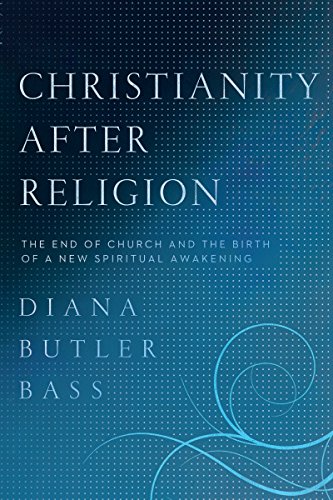
This reminds me think of a book I read in 2012, so before I became a crocheter. In Christianity After Religion: The End of Church and the Birth of a New Spiritual Awakening, Diana Butler Bass writes about how the church has a framework of believe, behave, belong.

She talks about how the model outside of church for learning a skill follows a different pattern. In the book, Bass uses the example of a person who wants to learn to knit. This person might ask someone to teach them or join a knitting group, thus seeking to belong in order to acquire the skill. Through belonging, the person learns to behave like a knitter- buying yarn, patterns, starting projects and leaving them around, and knitting. Through belonging and behaving, the person eventually becomes to believe things about knitting and knitters- about focus, skill, planning, generosity, or artistic ability. Belong, behave, believe...

Bass says, "Relationships lead to craft, which leads to experiential belief. That is the path to becoming and being someone different. The path of transformation."(201)

For a long time, people have approached being a follower of Jesus, the Way of discipleship, in the other order... with believing first, then behaving, and, after those were correct, then one could "belong". That order makes people wary of church, wary of Christians, and wary of the God who is supposedly represented by these two groups.

When we flip the order, as a community of faith and as individuals, we offer the welcome that reveals the truths that saves, the truth that welcomes, the truth that Nicodemus sought, under the cover of night. Belonging gives a sense of safety that leads to behaviors that reflect Christ's love- the love that defined his life, death, and resurrection. The ability to be part of sharing and receiving that love and welcome builds to believing, trusting in things that are beyond our full comprehension and yet we perceive that they are true.

There is a program called "Everyone Teach Two", which involves people who know how to knit or crochet teaching two other people in their life how to do it. Teaching involves inviting the person over, having a meal, talking, having a small project started, showing stitches, and praise. What if our sense of evangelism was directed in the same way? The invitation, the welcome, the hospitality, the tolerance for questions, for mistakes, for laughter and conversation- and through belonging and behaving would come belief.

In June, I'll have been crocheting for four years. In August, it will be 30 years since my baptism. I am neither the best crocheter or the best follower of Jesus, but I feel secure in belonging in both categories. I can teach two. I belong, I behave, I believe. I believe there is enough yarn to go around and that there is even more of God's love.

Saturday, January 21, 2017

I Beg (A Prayer)

Oh, God-
I beg you- do not let my heart become hardened.

In the midst of grief and fear, frustration and pain, despondency and despair,
I beg you- do not let my heart become hardened.

As I continue to press that Black Lives Matter, that vaginas are not second-class reproductive organs, that LGBTQ people must have access to all human rights, that all children should be able to be educated close to their own neighborhood with the resources of all spread to all schools,
I beg you- do not let my heart become hardened.

As I listen to spin, to lies, to twisted realities, to perspectives that I do not comprehend and that I cannot support,
I beg you- do not let my heart become hardened.

When I hear others dare to use your name, or the name of Jesus, or reference the power of the Spirit for work and words that you would not own,
I beg you- do not let my heart become hardened.

The time to walk in the Way of Christ has always been now. It was and it is and it shall be.
I beg you- do not let my heart become hardened.

Amen.


Originally written for and posted at RevGalBlogPals.org

Wednesday, January 11, 2017

Christian Bill of Rights: Amendment V

Amendment V
The follower on the Way of Christ will not hold human institutions, including courts, governments, or social agencies, as sources of salvation or aids to sanctification. Those on the Way of Christ will, however, use all power and privilege to hold these institutions, adding the church catholic to them, to standards of justice and equity. Those on the Way are not in thrall to these institutions, but to the law of God- which is interpreted through the Living Word, the written word, and the on-going work of the Holy Spirit.

“If your brother or sister sins against you, go and correct them when you are alone together. If they listen to you, then you’ve won over your brother or sister. But if they won’t listen, take with you one or two others so that every word may be established by the mouth of two or three witnesses. But if they still won’t pay attention, report it to the church. If they won’t pay attention even to the church, treat them as you would a Gentile and tax collector.”  Matthew 18:15-17

Don’t spread false rumors. Don’t plot with evil people to act as a lying witness. 2 Don’t take sides with important people to do wrong. When you act as a witness, don’t stretch the truth to favor important people. 3 But don’t privilege unimportant people in their lawsuits either. Exodus 23:1-3


Then Jesus said to them, “Nations and kingdoms will fight against each other. There will be great earthquakes and wide-scale food shortages and epidemics. There will also be terrifying sights and great signs in the sky.  But before all this occurs, they will take you into custody and harass you because of your faith. They will hand you over to synagogues and prisons, and you will be brought before kings and governors because of my name.  This will provide you with an opportunity to testify.  Make up your minds not to prepare your defense in advance.  I’ll give you words and wisdom that none of your opponents will be able to counter or contradict.  You will be betrayed by your parents, brothers and sisters, relatives, and friends. They will execute some of you.  Everyone will hate you because of my name.  Still, not a hair on your heads will be lost. By holding fast, you will gain your lives.

Friday, October 28, 2016

When the Body of Christ is Fat

Bitmoji Julia enjoys tea
Within a very short amount of time, two people whom I love were called "fat ass". One of these slurs occurred in the church building and the other occurred in the same building and within the context of worship. Both incidents were the result of a person with already impaired judgment lashing out at the person who was in front of them, perceiving them to be unhelpful or denying aid or service. Regardless of the "why", the reality is that the name was uncalled for, hurtful, and aimed to be a deep cut.

The reality is that a person who is under the influence of legal or illegal substances and often displays impaired judgment can still tell that body shaming- comments about shape, appearance, or size- is a way to lash out at someone who is frustrating you. That means those words and that way of using them are deeply rooted in our culture. An additional truth is that when we, as a congregation, attempted to console and listen to those who had been hurt in this encounter, I don't know that we said anything about the slur "fat ass" being wrong. "You shouldn't have to hear that" or "I'm sorry that happened" is not the same as "That was a crappy thing to hear, especially since it's untrue."

Bitmoji Julia doesn't care for this.
I've turned these events over and over in my mind. I have an unformed set of theological thoughts roiling around in there and I can't seem to make them beautiful, but I can sense their truth. The church is not good at talking about body image- especially as it relates to size. Even as we come to understand race, culture, sex, gender expression, attraction, and even mental health as things that are innate, but not necessarily immutable- we have not applied that learning or that spiritual growth to body size and shape. Even in the life of a congregation, we reflect the cultural idea that a bigger body is related to immorality. Despite a wealth of scientific information related to body size and shape as inherited, that BMI is not worth the metal to make the calipers, that a sedentary life is the biggest health risk, and that diets rarely produce long-term, lasting results... despite all of this, the church still jumps on the bandwagon of good/bad food choices, silence in the face of fat and/or thin shaming, privatizing size (it's all your fault), and ignoring the call to physically move.

The church is the place where we are supposed to reveal an inclusive welcome, open arms, and a reflection that all people are children of God. What happens when we don't include size- fatness and thinness- in that conversation? When our scripture readings are about banqueting, feasting, rich wines and marrow, open tables, hospitality, and eating in community, how often do we subvert that welcome and the joy of creation by creating binaries about what we should and shouldn't eat, can and can't wear, do and don't look?

Bitmoji Julia feels this more than real Julia
Lest you think that I have no idea what I am talking about, I know my own weight so well that I know if I am down just 2 pounds. I wrestle with my own body image, including how much of it there is. I would be tempted to respond being called "fat ass" with saying, "You probably need your eyes checked because that's not all that's fat." Of course, I acknowledge that while I have high BMI (worth nothing!), I am on the smaller side of being overweight. My weight also doesn't conflict with what I enjoy doing- outdoors or otherwise and yet I am hyper-aware of it. When I think of the gifts I can give to God, I would quickly name my brain or my ears or my hands and feet- as though these exist on their own, instead of within the sanctified casing of the rest of my body.

I appeal to you therefore, brothers, by the mercies of God, to present your bodies as a living sacrifice, holy and acceptable to God, which is your spiritual worship. Romans 12:1

Bitmoji Julia tells it on the mountain
Then God said, “Let us [shape soil] in our image, after our likeness. And let them have dominion over the fish of the sea and over the birds of the heavens and over the livestock and over all the earth and over every creeping thing that creeps on the earth.” So God created [humans in the  Divine] image, in the image of God [they were created]; male and female he created them. Genesis 1:26-27

So, whether you eat or drink, or whatever you do, do all to the glory of God.1 Corinthians 10:31


So, what do we do with this? How do we move to make sure that body shaming is not part of church culture and that health, wellness appreciation, and confidence in God's creation is? 

1. Do not make food "good" or "bad". All food is a political choice. When we decide what to eat or what to provide, we are deciding where to put our money, our community resources and time, our energy, and our support (expressed and unexpressed). Think about what you want to communicate about how you perceive God in farming, ranching, research, community life, and vocation through the food you provide or consume- both as individuals and as a congregation. 

2. Fat people know they are fat. They probably know better than you what they weigh, their measurements, and where they can find clothes and where they can't. Do not participate in shaming by ignoring or by patronizing. Also, do not assume they have no idea how to make correct food choices or exercise habits. Don't moralize size. 

3. Consider what it means that a sedentary life is more dangerous than being overweight or obese. Who do you know who might need a walking partner who is understanding and willing to go slow? Who might need a friend to come by a couple times a week for a low-impact exercise video? Who else might need to know that they aren't alone in having Type 2 Diabetes? Could you rideshare to the hospital's T2 class or organize a presentation with a nurse at the church for the community? 

4.  Do not assume that all health issues are related to weight or that weight is automatically related to stress. Sometimes yes, but sometimes no. Are you the doctor of everybody? 

5. When someone struggles because of their size (thinness or fatness), do not pretend that their body is not a real thing. Being rejected from an exit row seat because one needs a seat belt extender isn't actually an FAA regulation and it is pretty insulting. Acknowledge that this is a hurtful thing and be willing to listen to what it stirs up in the person. When someone is called a "fat ass", listen to that story. Maybe it hurt them, maybe they dismiss it. Acknowledge that this is about an attempt to embarrass them about their body- a reality of their world and how they are created. 

6. Do not participate in body shaming of any type (yourself or others), including when it happens to people you don't particularly like. Loving your neighbor means critiquing their behavior with an eye toward repentance or metanoia (turning around), not being cruel about something that is part of how God has made them. 

7. The Body of Christ is the body of Christ. Sometimes it has a soft, squidgy tummy or flappy upper arms or large strong thighs or round face. The fat body of Christ can still come to your house and do a load of laundry when you are flattened by chemotherapy. The underweight body of Christ can still bring a pizza to a family after an adoption. The roly-poly body can collect your cups after communion with Spirit-filled smile and the body that cannot keep up with its metabolic disorder can still read the gospel during Bible study. The Body of Christ is the body of Christ.

What would it look like for the church to embody this? 


Thursday, October 20, 2016

Achiever

A few weeks ago, I found out that many people who know and love me had worked for a long time to
nominate me as one of the YWCA's Women of Achievement in Alaska. I started getting congratulatory texts and emails before I officially found out about the award. Due to my personality (but not my essence), I am primarily a do-er and thinker, so it was not unusual that I didn't know how to feel about this great honor and recognition.

My first reaction in text to a good friend was that there was no way I could accept this. Responding to her "Why not?", I said, "Because [the woman who watches my children] isn't getting one and I can't do anything without her." This is true and not merely self-deprecation. I am immensely grateful for Carolyn and for all who have the vocation of childcare, which help so many people work other jobs. 

When I found out that the award is only given to 10 women each year and the nomination process is extensive and requires many letters of recommendations, I was even more touched and even more unsure how to feel. In my perception of myself, I am just doing my job. The work of trying to make a more inclusive, less racist, more accessible, less divided, and more godly Anchorage seems like it is the summation of my job description- wherein I focus the energy for the work on the people whom I serve directly and indirectly in the Spenard/Turnagain neighborhoods and beyond. 

Acknowledging that learning to integrate my feelings is part of the emotional work I need to do, I also have to graciously accept this award. If someone tells you that you are doing well or that you look nice or that they appreciate you, diminishing their compliment or notice is not humbleness, it is calling them a liar. I don't serve a community of liars, so what I perceive as "only what I ought to have done" actually comes across as extensive and special effort. 

The CEO of the YWCA of Alaska, Hilary Morgan, said to me recently that almost all the women who receive this award react in the same way. We perceive that we have only been doing what we were supposed to do. Sometimes we do know that we have to stretch and never stop in order to achieve a level of achievement or success in a field where we may be the first woman or among the first women. Sometimes we have been told for years that we have to work harder because we are women. And some of us are naturally disposed to leaving it all on the field and we're surprised when we finally turn around and find that we have had a cheering section all along. 

The thing for me to remember in this, and perhaps for other as well, is that I am not what I do. I am not only as good as my last achievement. I am not defined by my last success nor my last failure. I am a child of God, which is my primary identity. What I do well is rooted in that identity. What I think about should be grounded in that identity. What I feel should springboard from that. When all of that is aligned (please, Spirit, help and guide me), then I feel appropriately grateful for recognition, able to thank those whose vocations have helped me achieve in mine, and able to receive an accolade, but not have it define me. 

This recognition is amazing and it is a big deal. A big enough deal that I have bought new shoes and a new dress and have a hair appointment and a makeup appointment and I will get my eyebrows and maybe my nails done. It's also a big enough deal that sometimes I just sit quietly and think about it, still overwhelmed. And then I put my pin in my sweater and go do my job. 

Tuesday, October 4, 2016

Litany for Loosing

This was written for a prayer service in Anchorage, Alaska in response to a significant rise in reported homicides and other personal crimes. It has a partner in the Litany for Binding.

Holy God of all creation, you are always moving toward resurrection, restoration, and reformation. With the help of the Holy Spirit, we are open to this work.

We truly welcome this.

God of love and light, you have provided us with diversity in race, creed, sexuality, experience, gender, and spiritual gifts- all of which can be used for healing and peace. With the help of the Holy Spirit, we are open to this work.

We truly welcome this.

God of peace and hope, open our eyes and ears to see and hear stories of pain and promise that we might hold space for one another and move toward reconciliation. With the help of the Holy Spirit, we are open to this work.

We truly welcome this.

God of consolation and mercy, those who grieve need accompaniment not only in the hours after death, but in the weeks, months, and years ahead. With the help of the Holy Spirit, we are open to this work.

We truly welcome this.

God of justice and peace, help us to value the vocations of all who live within our city, peace officers and fire fighters, teachers and municipal employees, tourists and residents. With the help of the Holy Spirit, we are open to this work.

We truly welcome this.

God of the living Word, grant us the courage and will to challenge complacency, resignation, and resistance against change and community. With the help of the Holy Spirit, we are open to this work.

We truly welcome this.


Holy God, you are the ground and source of our very being. You have revealed your faithfulness through keeping your covenants, sending your prophets, and through the birth, life, and resurrection of Jesus, your Son and our Savior. Knowing that you cause all things to work for good, we dare to ask that we would see that in Anchorage here and now. We ask to be part of how you heal and restore this city. We ask for change and we seek to accept how it convicts and transforms each of us in its wake. Stir up your Holy Spirit in us and send your peace to us and through us into the world. We ask all this in Christ’s name… [and all God’s children said]… Amen.

Thanks be to God

I think often these days of Edward Jenner, who pioneered (with others) vaccine science and whose work led to the initial near-eradication of...