Monday, August 1, 2016

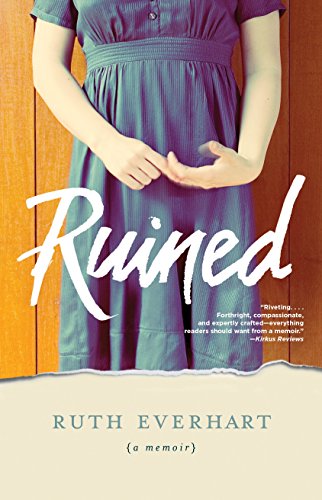
Ruined (Book Review)

Lately, I've craved sentences. As a voracious reader, I absorb large quantities of words, words by the gallon, the bucket, the ocean. However, in the present time of my life, I long for and adore simple sentences. Literally, I'm looking for something that could tattooed on the top of my foot.

Ruth Huizenga Eberhart has just such a sentence. In the middle of Ruinedher wrenching memoir of rape and spiritual agony, she writes, "The fall is a more universal theme than restoration." 


The fall is a more universal theme than restoration


Maybe I don't want that exactly inked into my skin, but its message is indelible. So was the four hour encounter in Ruth's 20th year shaped everything that came after it. As it so often does, the will of neighbor- his or her poor choice- causes a crisis when one has to examine where that choice intersects with the will of God. 

Ruth's rape, the aftermath, her relationships- all of these things intertwine with her pain, her grief, and her questioning about the God about whom she'd taught and the God she was actually encountering in silence and in space. Her lyrical writing, sometimes a little slowly paced, allows the reader to realize that God's silence is not always a big NO, but an invitation into a smaller, yet more spacious yes. 


Grace is more than forgiveness; grace says that it’s all right to need forgiveness in the first place. It’s all right to be imperfect, to intend well and mess up. To try again. Grace is getting a do-over. 


The fall is a more universal theme, because so few lack the language for expressing restoration, for understanding it, for believing it is possible. When Ruth eventually takes proactive steps to avoid being forever terrified of men who resemble her attackers, my eyes were so wide. Living day after day is surprising after a horror or a tragedy, but it happens. One hardly believes one can keep breathing. Attempting to keep something "normal" is brave. Ruth is very brave. 

Actively seeking to change something within yourself is courageous. Ruth is incredibly courageous. Her courage is not just evident in how she learns to view herself through God's understanding, but even more so in how she comes to see her experiences through God, divine mystery, and love. 

The fall is a more universal theme, but I believe it is only because we actually crave the stories of restoration. We long for the redemption narrative. We want to see it come out all right. This is because, in our hearts, we know our own falls and faults and we long to know that we too will sing restoration songs. 


I received a copy of this book for an honest review. My honest recommendation is that this book is completely worth your time and effort. 

Friday, July 22, 2016

Prayer on the Feast Day of St. Mary Magdalene

Holy Mary of Magdala, Apostle to the Apostles, Friend of Jesus, Soul Freed from Seven Demons, pray for us.
Brown-skinned prophetic sister, comfort those who are grieving and exhausted. Bring the consolation of company, rest, and return for their labor.
Watcher at the foot of the cross, give us the strength to bear witness to those falsely imprisoned in jails or by systems. Grant us the willingness to speak against a culture of fear-mongering and death.
Weeper at the tomb, strengthen us by your example and knowledge to keep walking, keeping speaking, keep singing, and to demand, still, that we want to see Jesus. And help us to radiate joy when he speaks our name.
Holy Mary of Magdala, Apostle to the Apostles, Friend of Jesus, Soul Freed from Seven Demons, pray for us.


This prayer was originally written for and posted at RevGalBlogPals.

Friday, July 8, 2016

Nothing's Good

The body count rises.
Arms raised, voices sobbing, blood pours.
Is there no balm in Gilead?

The wailing magnifies.
There are not enough garments to rend.
The ditches are full, but there are not enough Samaritans.

Grief is a monsoon, a typhoon, a deluge.
There is no memory of an antediluvian time.
The praying tongues are parched; sighs stopped in dried throats.

Hands flop helplessly.
The willfully ignorant caw and cackle, their hearts hardening within them.
How long, O Lord, how long, how long howlong howlong howlonghowlonghowlong?

How can we sing the Lord’s song in a land that refuses to see Christ
In Brown faces, in dark spaces, at 10 paces, in uniformed cases?
Jesus! Jesus.

Swing low, sweet chariot… come and carry us home.
I don’t think that’s a band of angels I see
And there are too many brothers and sisters who just can’t even anymore.

deep exhale


Originally written for and posted at RevGalBlogPals.org

Thursday, July 7, 2016

The Jericho Road

Luke 10:25-37

25Just then a lawyer stood up to test Jesus. “Teacher,” he said, “what must I do to inherit eternal life?” 26He said to him, “What is written in the law? What do you read there?” 27He answered, “You shall love the Lord your God with all your heart, and with all your soul, and with all your strength, and with all your mind; and your neighbor as yourself.” 28And he said to him, “You have given the right answer; do this, and you will live.”
  29But wanting to justify himself, he asked Jesus, “And who is my neighbor?” 30Jesus replied, “A man was going down from Jerusalem to Jericho, and fell into the hands of robbers, who stripped him, beat him, and went away, leaving him half dead. 31Now by chance a priest was going down that road; and when he saw him, he passed by on the other side. 32So likewise a Levite, when he came to the place and saw him, passed by on the other side. 33But a Samaritan while traveling came near him; and when he saw him, he was moved with pity. 34He went to him and bandaged his wounds, having poured oil and wine on them. Then he put him on his own animal, brought him to an inn, and took care of him. 35The next day he took out two denarii, gave them to the innkeeper, and said, ‘Take care of him; and when I come back, I will repay you whatever more you spend.’ 36Which of these three, do you think, was a neighbor to the man who fell into the hands of the robbers?” 37He said, “The one who showed him mercy.” Jesus said to him, “Go and do likewise.”

_________________________________________________________________________________

Dear Jerusalem Council, 

I would like to talk to you about the road between here and Jericho. As you know, we've lamented about it for years. We' ve expected the people of Jericho (our cousins, siblings, parents, and neighbors) to do the work of improving the road. Frankly, that expectation should embarrass us. We've had the power and the privilege for years. We know they didn't and don't have the political capital or the fiscal ability to do the work we're discussing alone, but we keep saying it will change if they just listen, stop writing to us, and maybe make some of the improvements to Jericho that we've suggested to make it more like Jerusalem. 

The violence has gotten out of hand. The ambushes, the murders, the extortions... villains, rogue soldiers, haters... the list goes on. I have heard many of you say that some bad actors does not mean action is required of us. Frankly, this is more than a few bad actors. It is the reality of the road itself. We have allowed the violence of the road, the rumor of the road, the threat of the road to expand beyond a means of travel. It is a specter of violence, pain, and fear that hangs over us and the people of Jericho and leaves no one untouched. 

I know we have discussed this issue again and again and again. However, some of our priests say, "This kind of change takes time. We have to be patient." And we have heard certain Levites say, "If the people traveling the road did exactly what they were advised, they wouldn't get hurt or killed." We have turned our heads, wrung our hands, offered prayers, and seen the funeral processions. 

And yet, the road REMAINS a place of terror and death. 

How can we claim to be a city of light or, dare I say, of God if we do nothing about the road? How can we think ourselves better than the Romans, or anyone? Who dares to claim the favor of the Creator as we allow death and fear to run rampant on our watch? 

What would Esther say? Judah Maccabee? Joshua and Caleb? Naomi? Gideon? What of our ancestor Jacob who, though fearful, still finally fell into his brother's embrace despite all that had been between them? 

Do we actually want to do anything about the Jericho Road or does just talking about it after every death make us feel better about ourselves? We hear the pleas from Jericho. We seen the bodies piling in the wadi and in gehenna. We have heard of those who die- denied care or options that they could get in Jerusalem. Our inaction impacts not only trade, but the religious practice of our Jericho neighbors and family. Our refusal to change the situation of the road is causing people to feel separated from God, because we (also children of God) are failing to act in the way to which we have been called. 

The change to the road will not happen overnight, but it must start right now. We must say no more. We must refuse to allow another attack, another death, another moment of fear. We must hear the grief and the pain and allow it to wash over us and move us in its tide to a place of action and purpose. We do this WITH the people of Jericho, WITH the residents of Jerusalem, WITH all our neighbors who wish to see this pain far behind us and the lessons learned carried with us. 

So, what say you, Council? What say you, priests and Levites? 


What say you, white (privileged) America? 


For Alton Sterling and Philando Castile, may we change the Jericho Road of systemic racism in your name and in the name of so many others.

Tuesday, July 5, 2016

Corpus Christi

Thirty-five days ago, I left Poland. It has not yet left me and I don't really expect that it will. I am still sorting through what I saw, felt, heard, and experienced. Some of these things may take years to put together and some I may have already forgotten. Only God knows how these things will finally take shape or root within me.

There is one experience that I actually continue to think about almost daily. Going in, I thought about this with almost anthropological interest, but very little emotional attachment. Yet, now, I think of it constantly. When I think of this situation, I feel grief and frustration, sadness and hurt, impassioned and, yet, paralyzed.

By Manederequesens (Own work) [CC BY-SA 4.0], via Wikimedia Commons
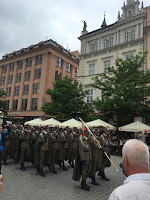
On Thursday, May 26th, Roman Catholic Poles, along with Roman Catholics around the world, celebrated the Feast of Corpus Christi. In Krakow, the Friend of Calvin who came to visit me and I were interested to see the observance of this feast. It is a national holiday in Poland with many shops and places closed for observance. There is a procession from Wawel Castle to Krakow's Main Square and St. Mary's Basilica.

The procession involves a priest carrying the Host, the consecrated bread of communion, in a monstrance under a canopy, which is itself carried by deacons. Behind the priest is a procession of hundreds, if not a thousand, people. There were soldiers, nuns (so many nuns), monks, priests, bishops, first communicants, town elders, town leaders, church leaders, Roman Catholic bishops and archdeacons, and probably several groups that I missed or don't know how to classify.

Krakow's Main Square, one of the largest in Europe, was filled with people who were not in the procession, but who came to see it, to honor the Host, to hear the sermon (presumably about Holy Communion and the presence of Christ. It was in Polish), and to receive communion. People stood(!) on pavement and cobblestones to listen. There were young men in dress shirts, ties, and dark slacks, wearing portable speakers to broadcast the sermon all around the square so that all could hear.

As the sermon concluded, the priest carrying the host (at the very front of the procession), began to move again- toward the Basilica and the altar. As the monstrance passed, people knelt. Some bowed deeply, but others fully knelt on the cold stones, crossing themselves. Some wept and stayed down. Others stood again after the Host had gone by. These people were acknowledging what they believe is the Presence of Christ, the Real Presence, in the wafer framed in the monstrance. (See the pic above for an example of an empty monstrance.)

I was pulled along in the crowd until I realized I was very close to where communion was going to be celebrated. Suddenly I realized that not only was I not in the right frame of mind to observe this, but that there were people behind me who would like to be closer. So I moved through the tightly packed crowd back to the more open air of the square, toward the clock where my friend and I hurriedly gestured that we would meet.
In chatting, we decided to go for a coffee, but when we sat down at a table in the square, I ordered bison grass vodka and apple juice. In a rare moment of actually feeling my feelings at the time they were occurring, I realized that I was mad. By this time in my trip, I had toured Jewish history sites in Warsaw. Friend of Calvin and I had gone to Auschwitz and Birkenau just two days before Corpus Christi. In all my reading, I knew that Poland (not alone in this) has not ever dealt fully with its anti-Jewish history (or present). Due to Germany's attack on Poland, most Poles felt/feel that they were more sinned against than sinning in World War II (and preceding), despite the complicity of Polish men and women in turning in their Jewish, homosexual, Roma, and "political" neighbors. Poland does not acknowledge complicity in the Holocaust, despite making money through "dark tourism"- the thousands of people who travel to see the concentration and death camps each year.

Additionally, Poland is currently struggling with government leaders (and communities) who want to keep their borders closed and reject immigrants. Anti-Jewish activities have seen a rise in the past few years, as well as anti-immigrant displays and commentary. All of this knowledge, of this awareness, of all the grief, came swirling into a head as I poured cold vodka down my throat and thought about the procession I had just seen.

People had reverently, tenderly, carefully acknowledged the presence of Christ in pressed bread, but would they do the same to their neighbor? Had they done the same in 1942 or 1968 (Polish Jewish Exclusion) or today? The Feast of Corpus Christ is nearly 1000 years old. This means that Poles (and others) likely observed this same procession in the German occupation. There were probably soldiers and others who knelt, receiving the body of Christ in their mouth, and then rose to go back to the hideous work of the war and its atrocities.

Christ is as present in the host, in the bread and wine, as he is in the person next to us. Furthermore, He is as present therein as he is IN us as we do anything in his name.

The truth is that most people willfully ignored what was happening around them or followed orders because they either believed what they had been told or shut their minds to the cognitive dissonance of the words of their faith and the words of their political leaders

We want to believe that we would be different. That we ARE different.

At least, I assume we do.

Most of us, though, still kneel reverently at the altar and, with Christ's body still in ours, make excuses for why we do what we do, say what we say, think what we think. It happens all the time.

How do we change that? What are the words, the steps, the turning that need to be done?

If Christ's presence in communion does anything, it gives us the strength to make that change. The power is actually IN us when we commune. We just have to be willing to join into the work, to participate in the change, to bear the cross of truth and to lift it high.

It seems likely that a very, very, very tiny percentage of people present in Krakow on 26 May 2016 were also present in that same procession in, say, 1943. Yet, the repercussions of the actions against Jewish neighbors and others, before and after, still reverberate through that country. And the repercussions of what I witnessed and felt on that day still reverberate through me.


Friday, May 13, 2016

God on the Go Kits

Like many congregations, we have lots of members who travel during the summertime. They may spend three months fishing or camping or traveling or hiking or playing. Given Alaska's long daylight hours, making it back into town on Sunday morning or even Sunday night doesn't always happen.
One could rail against that or one can ask for guidance in the Spirit for how to keep community and communion alive in these months of family and personal sabbath in the woods and wilderness. (Still, if you're in town, come on down!)

Inspired by Take Out Church, I made "God on the Go" kits for the faithful Alaskan family with kids. The kits and all their contents fit into the 64 ounce Ziplock containers with the lid snapping snugly. This should keep things watertight and just-right-sized for throwing in a duffle bag, backpack or suitcase. Or pushing under the seat of the camper. Or having at the foot of a sleeping bag.

I have included below the list of items inside and the explanation for each. This is exactly the information that each family receives in their kit. I plan to take one with me when we travel as a family and I hope others will also delight in this spiritual growth experience in their children and as a family.


GOD ON THE GO!

So let’s do it—full of belief, confident that we’re presentable inside and out. Let’s keep a firm grip on the promises that keep us going. He always keeps his word.
Let’s see how inventive we can be in encouraging love and helping out, not avoiding worshiping together as some do but spurring each other on, especially as we see the big Day approaching.

- Hebrews 10:25, The Message translation


What’s in the box?

A Flat Jesus                           
Baptism Bubbles                           
Holy Communion guide
Holy Communion instructions                  
1 Sharpie                  
1 Beach ball
1 “tablet” of paper         
Colored pencils + pencil sharpener                 
Stickers
Blessing chalk                           
Feelings play doh                           
Candle
Heavenly Sunshine songbook          
VBS reminder card
Bible apps/Music/Bible recommendations


1. Flat Jesus- Color your Flat Jesus. Take pictures of Him or with Him on your travels. Use the hashtag #GodontheGo if you share your pictures on Facebook or Twitter and link Lutheran Church of Hope or @hopelutheranak. Talk about how Jesus is always with you.

2. Baptism Bubbles- Remember your baptism(s) on occasion by blowing bubbles at each other. Talk about baptism both as a kind of washing and a welcoming. When the bubbles pop, think about how our sins (little or big things that we do that might hurt others or ourselves) are forgiven by God and can be forgiven by others. Sometimes bubbles leave residue, like sins have consequences. However, no matter what they do not last forever and they cannot separate us from God’s love.

3. Holy Communion guide- There’s a hand drawn sheet that talks about what we believe about Holy Communion. You might read through it a couple times or talk about Jesus eating with his friends. It’s important on occasion to talk about how your food gets to you (how God gets the food to you)… all the way from the seed (or the salmon roe) to your table. We are all connected.

4. Holy Communion instructions- These are here. At least once a month during your travels, take a little time as a family (2, 3, 4, 10). Get a plate and a cup (special or not) and a few crackers or a piece of bread and some grape juice or wine. (My parents let us have a sip of wine as a part of home communion as a kid.) Talk about Jesus being with his friends. Think of the words of communion and the words “For you”. Offer the elements to each other with that phrase. Pray together. Light your candle for this ritual and talk about what it felt like afterwards.

5 and 6. Sharpie and Beachball- Inflate your beach ball on occasion and write things for which you are thankful on it. Make this a habit- every 2-3 days- big fish, fun bonfire, visit from Grandma, trip to the zoo, clear sky… write them on the ball. If you meet up with family or friends as part of your adventures, have them sign the ball. Deflate it when the ink is dry and put it back in your kit. At the end of the summer, you’ll have a tangible reminder of all your thanksgivings of the summer. We can all bring our balls at the end of August and share our thanksgivings!

7. Paper, pencils, sharpener, and stickers- Use for praying in color (drawing a picture as part of praying or making a list), drawing pictures, writing lists or playing games.

8. Feelings Play-Doh- When someone needs a timeout, they may also need the feelings playdoh. They can use the dough to sculpt out their frustrations or pound them flat. Using something tactile in a timeout may seem like allowing playtime, but for younger kids- having to stay in one place with low stimulation- can really help. If the dough sits on the table, it sits. Sometimes grownups may need it too. You can use this in a conversation about choices or consequences as well.

9. Candle- The candle is for your communion, baptism, or forgiveness rituals. The congregation is also going to light a candle every Sunday morning to help them remember to pray for Pastor Julia on her sabbatical. You could do the same.

10. Blessing Chalk Use chalk to make a little washable graffiti where it’s safe and acceptable. A prayer for the boat or the car, on the side walk, at the park, etc. Bless your activities and the people involved.

11. VBS reminder card, Songbook, and suggestion sheet. I hope this is self-explanatory. :) 


Bible Apps for Kids (some are free, some are not, most are also available on Android based devices)

The Beginner’s Bible (iPad) by Zondervan
Adventure Bible Lite (or complete) (iPad) by Zondervan
Jesus Calling for Kids (iPhone) by HarperCollins ($9.99)
Smart Kids: Underground Mysteries (iPhone) by Barcelone Multimedia

(You may find others that are suitable for your family. These are just a couple recommendations. You might want to consider downloading a Bible app or devotional app for yourself.)

Recommended Children’s Bibles

Whirl Story Bible (available online or from LCOH)
Spark Story Bible
The Beginner’s Bible for Toddlers
Sprout Bible (WaterBrook Press)
Seedling Bible (WaterBrook Press)


Remember that a children’s Bible (like Whirl or Spark) is written at about a 3rd grade reading and comprehension level. If that’s not where your child is, you may wish to get a Bible aimed for younger readers. The best Bible to get is the one you will read! :)

Recommended translations for adults (if you’re curious):

New Revised Standard Version [NRSV] (most authentic academic translation)
Common English Version [CEV] (readable)
The Message translation (extremely readable paraphrase from direct translation)
New International Version [NIV] (readable)

****A “Study Bible” has footnotes to help you understand translation decisions and historical information. A “Devotional Bible” may have the same things, but will also have insets or guidance for how to pray about or interpret certain passages. Bibles marketed at specific genders, races, denominations, or age groups are exactly what they sound like. Be aware that everyone has a reason for what they’re writing or selling (even Pastor Julia).

Music:


We have enclosed a Heavenly Sunshine songbook in your kit. If you aren’t sure of the tunes, try YouTube. Look for kids singing the song. You may also consider buying “Wee Sing Bible Songs” or another children’s hymn album. Remember the Vacation Bible School songs will be Christmas carols.


Friday, April 29, 2016

Prayer Against Fear

Phantasm of fear, I renounce you!
I refuse to call you "spirit" for you are not of God. 
You work to oppose the creative forces of the Lord in life and resurrection. 
Your efforts will not last. 
And you know this. 

Delusion of fear, I renounce you! 
You may talk loudly, boastfully. 
You may bring your buddies, death and destruction, as backup to your threats.
You know your days are numbered. 
There is no fear in the life to come. 

Specter of fear, I renounce you!
Your work of dividing, fomenting, pain-causing...
We will overcome. With God on our side, 
You cannot stand. 
Perfect Love, the kind that comes from Christ, casts out fear. 

Revenant of fear, I renounce you!
Shrivel and die, you impotent thing!
You may plant, but you will not reap. 
You may build, but you will not inhabit. 
You may fish, but you will not catch. 
There is no home for you, no toe hold, no place of belonging. 
You are banished to wither and die... fertilizing the soil of hope and joy. 

So be it.
In the name of Christ, so say we all. 


cross-posted at RevGalBlogPals.org

Thanks be to God

I think often these days of Edward Jenner, who pioneered (with others) vaccine science and whose work led to the initial near-eradication of...