A couple weeks ago, I was asking a group of [church-going] children what they knew about the Bible. Among other shared information, we tried to name some Bible characters. They quickly shouted out, "Jesus!... Moses!... Abraham!..." The oldest kid in the group is probably 8, so that was okay. I asked for the names of any women or girls in the Bible. Mary's name was speedily recalled and then there was a stall. My own son raised his hand and said, "I can't remember her name, but there was the girl in the garden who ate the apple." Great, our group could literally only name Mary and Eve. So, looks like my work is cut out for me. Good news: there's a Bible for that!
I recently received a copy of the CEB Women's Bible for free in exchange for a fair review. This Bible is in the Common English translation- hence, CEB. This is not my favorite translation. All translation is interpretation and all interpretation is political. So, accepting the CEB as a study bible was a stretch for me going in to this project. Not all pastors share this characteristic, many LOVE and endorse this translation of the Bible and find it to be as accurate and helpful as early translations.
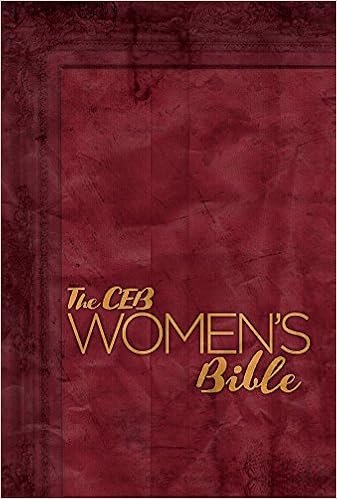
It turns out that, translation notwithstanding, this is an excellent study Bible. Nearly all the chapters have summary introductions that could be used for the people who like a big picture view or as prayer prompts before or after devotions. The inserted commentaries on situations, circumstances, and people are very helpful. There is one on birth control near Genesis 38 and on one women and property at Joshua 17. There's celebration (Psalm 31), pleasure (Ecclesiastes 2), mercy (Romans 9), adolescence (1 Timothy 5)- plus ministry and widows (separately) in the same chapter.
These short explanations given insight not only to the time of the Bible's events or writing, but also for how the verses impact the life of the reader today. I enjoyed every one that I read and I think they are the best feature of this Bible.
My second favorite element of the CEB Women's Bible is that there is at least a sentence or two portrait of every single woman who appears in scripture. No matter whole small her role, how implied her presence, how unnamed she may have remained through the centuries- she or her group get recognition in this volume. Through recognition comes thankfulness and growth in understanding. I have been doing work in Daniel lately and, boom, there was the portrait in words on Belshazzar's mother (Dan. 5). She's actually critical in the story because she remembers Daniel and his skill, when others have forgotten him. Yet, she doesn't usually appear in the stories people tell off the top of their heads regarding the writing on the wall incident. Regular use of this Bible and encountering these portraits will help the reader become more familiar with all the women of scripture and, perhaps, more emboldened to speak up in times of trouble.
It is extremely exciting to flip through the front matter of the book and see how many women were involved in the creation of this volume. Lay women, professors, writers, and clergywomen all contributed their talents to the creation of this volume. I am of mixed emotions when I see this. I am so happy- nearly tearfully so- that these women were sought out and their vocations and talents used well for this book. At the same time, I hope that the work in and on this Bible will be noticed- especially in academic and professional religious circles. This amount of research, talent, and commitment deserves recognition beyond making a commercially viable devotional Bible (which is NOT nothing- far from it).
Despite my own reservations with the translation (which are NOT shared by all other pastors!!!), I believe that I will continue to use this Bible for personal devotional reading, along with others. I do say to people that the best kind of Bible to get is the kind you will actually read. This Bible is very readable and the portraits, summaries, maps, and drawings all serve the purpose of increasing knowledge and learning in faith. I recommend this Bible, particularly if you do not presently have a study Bible that you enjoy using. If you are the kind of person who is bothered by adjectives in the titles of Bibles, I still recommend this Bible and a roll of electrical or duct tape to cover the title (or use a Bible cover). Several people in my congregation do this and it seems to soothe their angst and help them to use the Bibles they find most accessible.
The stories of women in the Bible- known, forgotten, and unknown- deserve attention, scholarly time, and church/devotional study. This Bible accomplishes that task superbly. It does it so well in fact that I recommend considering one's own preferences or biases (translation, title, margin size) as adiaphora (or unimportant) relative to having a truly helpful and revolutionary study Bible that spotlights the work of women in history and the work of women today.
I received a free copy of the CEB Women's Bible from the publisher in exchange for an honest review.
You can get a FREE sample of Ephesians from this edition of the Bible here. Try it!
Tuesday, November 1, 2016
Friday, October 28, 2016
When the Body of Christ is Fat
![]() |
| Bitmoji Julia enjoys tea |
The reality is that a person who is under the influence of legal or illegal substances and often displays impaired judgment can still tell that body shaming- comments about shape, appearance, or size- is a way to lash out at someone who is frustrating you. That means those words and that way of using them are deeply rooted in our culture. An additional truth is that when we, as a congregation, attempted to console and listen to those who had been hurt in this encounter, I don't know that we said anything about the slur "fat ass" being wrong. "You shouldn't have to hear that" or "I'm sorry that happened" is not the same as "That was a crappy thing to hear, especially since it's untrue."
![]() |
| Bitmoji Julia doesn't care for this. |
The church is the place where we are supposed to reveal an inclusive welcome, open arms, and a reflection that all people are children of God. What happens when we don't include size- fatness and thinness- in that conversation? When our scripture readings are about banqueting, feasting, rich wines and marrow, open tables, hospitality, and eating in community, how often do we subvert that welcome and the joy of creation by creating binaries about what we should and shouldn't eat, can and can't wear, do and don't look?
![]() |
| Bitmoji Julia feels this more than real Julia |
I appeal to you therefore, brothers, by the mercies of God, to present your bodies as a living sacrifice, holy and acceptable to God, which is your spiritual worship. Romans 12:1
![]() |
| Bitmoji Julia tells it on the mountain |
So, whether you eat or drink, or whatever you do, do all to the glory of God.1 Corinthians 10:31
So, what do we do with this? How do we move to make sure that body shaming is not part of church culture and that health, wellness appreciation, and confidence in God's creation is?
1. Do not make food "good" or "bad". All food is a political choice. When we decide what to eat or what to provide, we are deciding where to put our money, our community resources and time, our energy, and our support (expressed and unexpressed). Think about what you want to communicate about how you perceive God in farming, ranching, research, community life, and vocation through the food you provide or consume- both as individuals and as a congregation.
2. Fat people know they are fat. They probably know better than you what they weigh, their measurements, and where they can find clothes and where they can't. Do not participate in shaming by ignoring or by patronizing. Also, do not assume they have no idea how to make correct food choices or exercise habits. Don't moralize size.
3. Consider what it means that a sedentary life is more dangerous than being overweight or obese. Who do you know who might need a walking partner who is understanding and willing to go slow? Who might need a friend to come by a couple times a week for a low-impact exercise video? Who else might need to know that they aren't alone in having Type 2 Diabetes? Could you rideshare to the hospital's T2 class or organize a presentation with a nurse at the church for the community?
4. Do not assume that all health issues are related to weight or that weight is automatically related to stress. Sometimes yes, but sometimes no. Are you the doctor of everybody?
5. When someone struggles because of their size (thinness or fatness), do not pretend that their body is not a real thing. Being rejected from an exit row seat because one needs a seat belt extender isn't actually an FAA regulation and it is pretty insulting. Acknowledge that this is a hurtful thing and be willing to listen to what it stirs up in the person. When someone is called a "fat ass", listen to that story. Maybe it hurt them, maybe they dismiss it. Acknowledge that this is about an attempt to embarrass them about their body- a reality of their world and how they are created.
6. Do not participate in body shaming of any type (yourself or others), including when it happens to people you don't particularly like. Loving your neighbor means critiquing their behavior with an eye toward repentance or metanoia (turning around), not being cruel about something that is part of how God has made them.
7. The Body of Christ is the body of Christ. Sometimes it has a soft, squidgy tummy or flappy upper arms or large strong thighs or round face. The fat body of Christ can still come to your house and do a load of laundry when you are flattened by chemotherapy. The underweight body of Christ can still bring a pizza to a family after an adoption. The roly-poly body can collect your cups after communion with Spirit-filled smile and the body that cannot keep up with its metabolic disorder can still read the gospel during Bible study. The Body of Christ is the body of Christ.
What would it look like for the church to embody this?
Monday, October 24, 2016
Decolonize16: First Debrief
As soon as the #decolonizeLutheranism hashtag began to be used on Facebook and Twitter, I was in and involved. It was like jumping into a river and realizing that I could swim better than I thought I
could. The impetus behind the movement is to separate North American Lutheranism from being considered interchangeable with Mid-Western, primarily imported Scandinavian, culture and cuisine. By "decolonizing" or separating Lutheranism from that context, the people in and behind (and ahead of) the movement hope to release and refine our theological and biblical commitments toward inclusion, welcome, understanding, and embracing the height and depth and breadth of the love of God in the world.
The initial conference of this movement was on 10/23/16 at the Lutheran School of Theology in Chicago. It's a long way to for an Alaskan, but I couldn't stay away. Once some of my friends knew I was coming, they signed up too. Thus, I had reunions, reconnections, and reformation (of the current church) all in a day. What a day.
The framework of the conference was sections of the Augsburg Confession pared with seasons of the church year. We heard small sermons or sharing and then had small groups to talk about our reactions and our thoughts. I'm still thinking about so many things, but here's my first thought:
Nice is the law and honesty is the gospel.
Lutherans have a very specific way of thinking about the words "law" and "gospel". The law is anything, anywhere in Scripture (or in the world), that reminds and makes us glaringly aware of our need for God, God's work in Christ, and the aid of the Spirit. The gospel is the glad tidings anywhere in Scripture (or in the world) of how God is already aware of our need and is ahead of us, behind us, and within us- bringing us into the reality of our salvation through grace and the on-going truth of our sanctification.
In my small group, we talked about how people we know (including ourselves) resist the hard work of combatting racism, sexism, anti-LGBTQ behavior, and cultural appropriation without appreciation. One person in the group asked if we could figure out how to use the framework of law and gospel as part of this work. I thought of my own work around "being honest, not good". I'm not a liar, but in general- my desire to be liked, efficient, and good means that I don't always own up to my own feelings, reactions, and perceptions.
In order to decolonize Lutheranism, we must stop the idolatry of "nice" and "good". We can no longer excuse that racist jokes are "just how so-an-so talks". We can't pretend it's okay to ask a queer couple if we could just not mention their wedding in the announcement or on the church calendar like we do for other couples. We can't ignore that there are women, people of color, and LGBTQ individuals who are gifted from God, but are ignored for call and service in this church and- if they get called- are held to a much higher and more scrutinized standard of behavior.
Nice and good behavior asks for there not to be so much fuss about this. Niceness says, "It's been that way for a long time and change is hard." Good behavior accepts being a token, being diminished, being ignored as part of what it means to be a child of God in a certain context.
No.
I said, NO.
No more.
No more "nice", No more "good".
When my therapist told me that I needed to work on "being honest and not good", I looked her in the eye and said "Honesty is not one of the fruits of the Spirit."
But are we really being kind without honesty? Does true generosity exist without honesty? Can we truly love without honesty?
In order to decolonize Lutheranism, we must begin a full-throated, full-bodied, and fully embodied embrace of honesty. We have to die to nice and good and be aware of how God is resurrecting us to honesty in Christ. We have to be willing to say what is obvious, what hurts, and what needs to be done. We have to be willing to sit with the pain of complicity, the reality of what we can and can't fix, and the emptiness of the seats of those who will refuse to do this work. We have to be willing to make changes and re-think how our work as congregations looks, sounds, and feels even before we believe it "applies" to anyone already there.
And we don't do it so that "others" will come. We do it so that we can be a church, the church, churches who are actively teaching and learning how to live and how to die in Jesus Christ. We do it because it is, honestly, the right thing to do.
| Candle station for prayer at conference |
The initial conference of this movement was on 10/23/16 at the Lutheran School of Theology in Chicago. It's a long way to for an Alaskan, but I couldn't stay away. Once some of my friends knew I was coming, they signed up too. Thus, I had reunions, reconnections, and reformation (of the current church) all in a day. What a day.
The framework of the conference was sections of the Augsburg Confession pared with seasons of the church year. We heard small sermons or sharing and then had small groups to talk about our reactions and our thoughts. I'm still thinking about so many things, but here's my first thought:
Nice is the law and honesty is the gospel.
Lutherans have a very specific way of thinking about the words "law" and "gospel". The law is anything, anywhere in Scripture (or in the world), that reminds and makes us glaringly aware of our need for God, God's work in Christ, and the aid of the Spirit. The gospel is the glad tidings anywhere in Scripture (or in the world) of how God is already aware of our need and is ahead of us, behind us, and within us- bringing us into the reality of our salvation through grace and the on-going truth of our sanctification.
In my small group, we talked about how people we know (including ourselves) resist the hard work of combatting racism, sexism, anti-LGBTQ behavior, and cultural appropriation without appreciation. One person in the group asked if we could figure out how to use the framework of law and gospel as part of this work. I thought of my own work around "being honest, not good". I'm not a liar, but in general- my desire to be liked, efficient, and good means that I don't always own up to my own feelings, reactions, and perceptions.
In order to decolonize Lutheranism, we must stop the idolatry of "nice" and "good". We can no longer excuse that racist jokes are "just how so-an-so talks". We can't pretend it's okay to ask a queer couple if we could just not mention their wedding in the announcement or on the church calendar like we do for other couples. We can't ignore that there are women, people of color, and LGBTQ individuals who are gifted from God, but are ignored for call and service in this church and- if they get called- are held to a much higher and more scrutinized standard of behavior.
Nice and good behavior asks for there not to be so much fuss about this. Niceness says, "It's been that way for a long time and change is hard." Good behavior accepts being a token, being diminished, being ignored as part of what it means to be a child of God in a certain context.
No.
I said, NO.
No more.
No more "nice", No more "good".
When my therapist told me that I needed to work on "being honest and not good", I looked her in the eye and said "Honesty is not one of the fruits of the Spirit."
But are we really being kind without honesty? Does true generosity exist without honesty? Can we truly love without honesty?
In order to decolonize Lutheranism, we must begin a full-throated, full-bodied, and fully embodied embrace of honesty. We have to die to nice and good and be aware of how God is resurrecting us to honesty in Christ. We have to be willing to say what is obvious, what hurts, and what needs to be done. We have to be willing to sit with the pain of complicity, the reality of what we can and can't fix, and the emptiness of the seats of those who will refuse to do this work. We have to be willing to make changes and re-think how our work as congregations looks, sounds, and feels even before we believe it "applies" to anyone already there.
And we don't do it so that "others" will come. We do it so that we can be a church, the church, churches who are actively teaching and learning how to live and how to die in Jesus Christ. We do it because it is, honestly, the right thing to do.
Thursday, October 20, 2016
Achiever
A few weeks ago, I found out that many people who know and love me had worked for a long time to
nominate me as one of the YWCA's Women of Achievement in Alaska. I started getting congratulatory texts and emails before I officially found out about the award. Due to my personality (but not my essence), I am primarily a do-er and thinker, so it was not unusual that I didn't know how to feel about this great honor and recognition.
My first reaction in text to a good friend was that there was no way I could accept this. Responding to her "Why not?", I said, "Because [the woman who watches my children] isn't getting one and I can't do anything without her." This is true and not merely self-deprecation. I am immensely grateful for Carolyn and for all who have the vocation of childcare, which help so many people work other jobs.
When I found out that the award is only given to 10 women each year and the nomination process is extensive and requires many letters of recommendations, I was even more touched and even more unsure how to feel. In my perception of myself, I am just doing my job. The work of trying to make a more inclusive, less racist, more accessible, less divided, and more godly Anchorage seems like it is the summation of my job description- wherein I focus the energy for the work on the people whom I serve directly and indirectly in the Spenard/Turnagain neighborhoods and beyond.
Acknowledging that learning to integrate my feelings is part of the emotional work I need to do, I also have to graciously accept this award. If someone tells you that you are doing well or that you look nice or that they appreciate you, diminishing their compliment or notice is not humbleness, it is calling them a liar. I don't serve a community of liars, so what I perceive as "only what I ought to have done" actually comes across as extensive and special effort.
The CEO of the YWCA of Alaska, Hilary Morgan, said to me recently that almost all the women who receive this award react in the same way. We perceive that we have only been doing what we were supposed to do. Sometimes we do know that we have to stretch and never stop in order to achieve a level of achievement or success in a field where we may be the first woman or among the first women. Sometimes we have been told for years that we have to work harder because we are women. And some of us are naturally disposed to leaving it all on the field and we're surprised when we finally turn around and find that we have had a cheering section all along.
The thing for me to remember in this, and perhaps for other as well, is that I am not what I do. I am not only as good as my last achievement. I am not defined by my last success nor my last failure. I am a child of God, which is my primary identity. What I do well is rooted in that identity. What I think about should be grounded in that identity. What I feel should springboard from that. When all of that is aligned (please, Spirit, help and guide me), then I feel appropriately grateful for recognition, able to thank those whose vocations have helped me achieve in mine, and able to receive an accolade, but not have it define me.
This recognition is amazing and it is a big deal. A big enough deal that I have bought new shoes and a new dress and have a hair appointment and a makeup appointment and I will get my eyebrows and maybe my nails done. It's also a big enough deal that sometimes I just sit quietly and think about it, still overwhelmed. And then I put my pin in my sweater and go do my job.
Monday, October 10, 2016
Say it! Say it! Say it!
A couple years ago, I was discussing politics with a man I know and love. I mentioned that I was no longer going to vote for anyone who didn't clearly distance themselves from sexual assault, rape,
molestation, or abuse.
He replied, "It goes without saying."
No.
No, it does not.
In a baptismal service, we specifically RENOUNCE the devil and the forces that oppose God. We don't throw a little water around and say that everything else "goes without saying." We SAY the things that we believe because WORDS have POWER.
Therefore, I would like to update my position. I will not support any candidate who does not clearly state that they are opposed to sexual assault, rape, abuse, racism, violence and/or social isolation and/or denial of rights to anyone based on sexual preference, gender identity, or gender expression, religious bias, religious favoritism, bias based on skin color or body type, the limitation of reproductive choice, and (my personal bugbear) the privatization of the prison system.
I reserve the right to expand or contract this list, which is rooted in my understanding of the gospel of Jesus the Christ. There is no such thing as private faith or private sin. A life lived faithfully is a faith lived publicly. A public life involves speaking truth. Speaking truth means what is said matters, as well as what is unsaid. Nothing goes without saying.
| photo by Julia (Dunlap) Seymour February 2005 |
He replied, "It goes without saying."
No.
No, it does not.
In a baptismal service, we specifically RENOUNCE the devil and the forces that oppose God. We don't throw a little water around and say that everything else "goes without saying." We SAY the things that we believe because WORDS have POWER.
Therefore, I would like to update my position. I will not support any candidate who does not clearly state that they are opposed to sexual assault, rape, abuse, racism, violence and/or social isolation and/or denial of rights to anyone based on sexual preference, gender identity, or gender expression, religious bias, religious favoritism, bias based on skin color or body type, the limitation of reproductive choice, and (my personal bugbear) the privatization of the prison system.
I reserve the right to expand or contract this list, which is rooted in my understanding of the gospel of Jesus the Christ. There is no such thing as private faith or private sin. A life lived faithfully is a faith lived publicly. A public life involves speaking truth. Speaking truth means what is said matters, as well as what is unsaid. Nothing goes without saying.
Tuesday, October 4, 2016
Litany for Loosing
This was written for a prayer service in Anchorage, Alaska in response to a significant rise in reported homicides and other personal crimes. It has a partner in the Litany for Binding.
Holy God of all
creation, you are always moving toward resurrection, restoration, and
reformation. With the help of the Holy Spirit, we are open to this work.
We truly welcome this.
God of love and
light, you have provided us with diversity in race, creed, sexuality,
experience, gender, and spiritual gifts- all of which can be used for healing
and peace. With the help of the Holy Spirit, we are open to this work.
We truly welcome this.
God of peace and
hope, open our eyes and ears to see and hear stories of pain and promise that
we might hold space for one another and move toward reconciliation. With the
help of the Holy Spirit, we are open to this work.
We truly welcome this.
God of consolation
and mercy, those who grieve need accompaniment not only in the hours after
death, but in the weeks, months, and years ahead. With the help of the Holy
Spirit, we are open to this work.
We truly welcome this.
God of justice and
peace, help us to value the vocations of all who live within our city, peace
officers and fire fighters, teachers and municipal employees, tourists and
residents. With the help of the Holy Spirit, we are open to this work.
We truly welcome this.
God of the living
Word, grant us the courage and will to challenge complacency, resignation, and
resistance against change and community. With the help of the Holy Spirit, we
are open to this work.
We truly welcome this.
Holy God, you are the
ground and source of our very being. You have revealed your faithfulness
through keeping your covenants, sending your prophets, and through the birth,
life, and resurrection of Jesus, your Son and our Savior. Knowing that you
cause all things to work for good, we dare to ask that we would see that in
Anchorage here and now. We ask to be part of how you heal and restore this
city. We ask for change and we seek to accept how it convicts and transforms
each of us in its wake. Stir up your Holy Spirit in us and send your peace to
us and through us into the world. We ask all this in Christ’s name… [and all
God’s children said]… Amen.
Litany for Binding
This was written for a prayer service in Anchorage, Alaska in response to a significant rise in reported homicides and other personal crimes. It has a partner in the Litany for Loosing.
Holy God of all
creation, we know that violent death and mindless destruction do not come from
you. With the help of the Holy Spirit, we bind and reject these things.
They have no place here.
God of love and
light, revenge and aggressive retribution are not tasks you have given to us at
any time. With the help of the Holy Spirit, we bind and reject these things.
They have no place here.
God of peace and hope,
glorifying violence and denigrating other humans violate every commandment you
have given. With the help of the Holy Spirit, we bind and reject these things.
They have no place here.
God of consolation
and mercy, desecration of creation and division between people are not possible
in the true way of Christ Jesus. With the help of the Holy Spirit, we bind and
reject these things.
They have no place here.
God of justice and peace,
lawlessness and a breakdown of communities are in direct violation of how you
have taught us to live. With the help of the Holy Spirit, we bind and reject
these things.
They have no place here.
God of the living
Word, slurs, insults, curses, and threats sow seeds of dissension that are not
in your plan for us, this city, or any part of your beloved creation. With the
help of the Holy Spirit, we bind and reject these things.
They have no place here.
Holy Lord, holy and
mighty is your name. All glory, praise, and honor go to you. We trust and
believe that your word is true. In binding and rejecting all that is not of
you, we believe with our whole hearts that we are aligning ourselves with your
will for healing, unity, peace, and reconciliation in Anchorage. We ask that
you would continue in your powerful work and word and that we would be
privileged to alongside you here in the City of Lights. We ask you all this in
Jesus’ holy name… [and God’s children said]… Amen.
Subscribe to:
Posts (Atom)
Questions and Points to Ponder?
Each summer, it is a privilege and a pleasure to help with staff training at Christikon and at Flathead Lutheran Bible Camp. One of my favor...
-
Jesus Christ is the same yesterday and today and forever. - Hebrews 13:8 In every conversation about societal change, people who seek wi...
-
Bitmoji Julia enjoys tea Within a very short amount of time, two people whom I love were called "fat ass". One of these slurs ...
-
We know that all things work together for good for those who love God, who are called according to his purpose. - Romans 8:28 Never place ...


