Showing posts with label Hebrew Scriptures. Show all posts

Sunday, August 4, 2019

Bitumen, Bricks, and Guns


Genesis 11:1-9 Now the whole earth had one language and the same words. And as they migrated from the east, they came upon a plain in the land of Shinar and settled there. And they said to one another, “Come, let us make bricks, and burn them thoroughly.” And they had brick for stone, and bitumen for mortar. Then they said, “Come, let us build ourselves a city, and a tower with its top in the heavens, and let us make a name for ourselves; otherwise we shall be scattered abroad upon the face of the whole earth.” The Lord came down to see the city and the tower, which mortals had built. And the Lord said, “Look, they are one people, and they have all one language; and this is only the beginning of what they will do; nothing that they propose to do will now be impossible for them. Come, let us go down, and confuse their language there, so that they will not understand one another’s speech.” So the Lord scattered them abroad from there over the face of all the earth, and they left off building the city. Therefore it was called Babel, because there the Lord confused the language of all the earth; and from there the Lord scattered them abroad over the face of all the earth. 


Genesis is written down, not by Moses, but by temple leaders and others during the time of the Babylonian exile. In their grief and their fear, they commit to writing down the stories of their oral tradition, so that they may have a book of God's history and God's historical commitments (covenants) to them. Such a book was both a consolation and an encouragement when they were far from their own homeland and the site of their temple and, what was in their minds, correct worship.

In this series of stories about God's work in history, each story reveals things about God's nature and character, meaning the way God is from human perspective, and each story also attempts to answer some questions about why things are they way they are. What are questions that could be answered through the Tower of Babel story? 

- Why are there so many languages around the earth? 
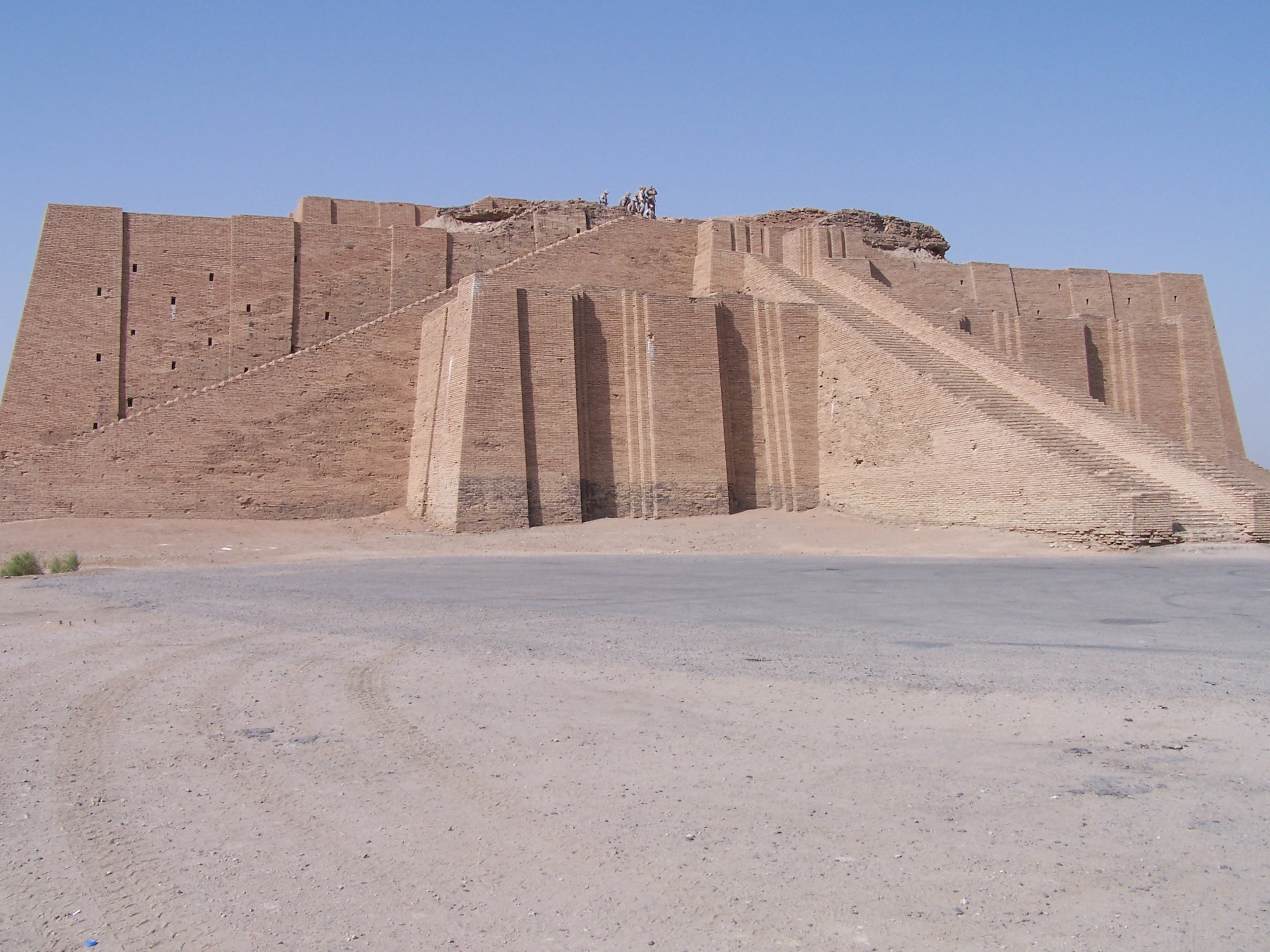
- Why do some people (nations) build ziggurats (stepped pyramids) and others do not? 
- What would happen if we tried to reach God through our own power? 

Ziggurats, stepped pyramids across Mesopotamia, were usually built to honor gods or to serve as temples of different kinds. Certainly the people who were taken from Jerusalem to Babylon in the exile would have seen such buildings, tall against the horizon, as well as other imposing architecture in Babylonian cities. Even prior to the exile, those who traveled and then returned to Jerusalem or traders coming to the city would have shared stories of the architecture in surrounding areas. People may have wondered or worried about their own buildings, but also knew that they had built in accordance with their tradition, which was influenced by God's communication to Moses and the very different nature of their religion, which worshipped one God alone. 

In the story, the people are building such a tower. They are building it either intend to reach heaven and control God or make a name for themselves by causing other people to seem them as being as powerful as gods. Their tower will speak to their unrivaled power and all will fear them and, consequently, do their will. God keeps this plan from happening by scattering the people and confounding their language. 

In such circumstances, the Tower of Babel story would have been a comforting one. Remember what happened when people thought they could build powerful towers and reach God? What did they think would happen? Did they think they would be able to control God? Don't they know the Lord's power? And look what happened! It didn't go so well for them, now, did it? 

The story, full of human pride and self-confidence, shows how the Lord does and will confound plans that attempt to control the Divine. Making a name for one's self either means taking the credit personally, which the people in the story intended to do, or giving credit to one's Maker, which the hearers of the story would have known was the right action. 

The Tower of Babel story makes a second important point. This point is discerned not from the words of the story, but from its location in Genesis. The Tower story is in Genesis 11. Genesis 6-10 deal with the story of Noah and the flood. Then we have Babel. Chapter 11 concludes with the lineage of Noah's son, Shem, which goes right up to Abraham. Chapter 12 of Genesis begins the story of Abram, a man whom God counted as righteous, even when Abram/Abraham made egregious mistakes. 

The location of the Babel story illustrates how some people never learn to honor God, since they would have been in the generations to have reflected on the flood, but didn't. Thus, the Lord thwarts their work and scatters them. Then God blesses Abram as well as those who bless Abram. The Babel story is situated as a reminder to Jewish (and then to Christian) listeners and readers that God keeps God's promises and that God extends blessing generously, even to those who are kind to God's people. Furthermore, God gave Abram the name Abraham, meaning "father of many". It was not a name that Abram could make for himself or give himself. 

What does this have to do with us today?

I would be remiss and very negligent in my duties as a pastor if I did not acknowledge that in the past 24 hours, 30 people died in mass shootings in the United States- in the incidents in El Paso, Texas and in Dayton, Ohio. More than 70 other people were injured physically. This does not count the mental and emotional pain causes to people who were witnesses to the shootings, the pain of the families of the victims (dead and survivors), and the stress and danger to police and first responders, as well as the strain on their families who worry always about this kind of situation. 

If I talk about guns or gun control, some people will say it is too soon, that the Second Amendment is what it is, or that guns don't have anything to do with this. If I don't talk about guns or gun control, some people will say that I am too afraid to be honest and that I softpedaled my role as a preacher and a prophet. So I am in a tight spot, but I am ultimately answerable to God and I want to share with you what the Spirit has laid on my heart in the last 24 hours. 

The bricks and bitumen that built the Tower of Babel were not to blame. They were useful tools and they could be used however people saw fit. Certainly they could be used as weapons, but their main intention was as tools. Once the people corporately decided to build a tower to make a name for themselves, to reach to the heavens and control God, they have changed the bricks from tools into weapons. The bricks and the bitumen become false idols that give the people imagined power that is not theirs to claim. 

Similarly, in our own time, our guns- as tools or toys- have exactly the role that we give them. If they are used or collected as things that feed our families, are enjoyable to shoot, or maybe used defensively in a rare, if not ever, situation, then they have an appropriate location and are no more than the bricks and bitumen were meant to be at Babel.

However, if our conversation around our guns (and I say our because we have guns at my house) becomes about the power they give us, the fear we have about someone taking them away, or the way they could be used to make a name for ourselves, the guns have become idols. We are giving them inappropriate power and use in our thoughts, words, and deeds. Idols are objects, people, or ideas that take up time, talent, and treasure that is rightly devoted to God. 

In parts of our country, and around the world, but specifically in the United States, our conversation around guns has become idolatrous. The answer is not necessarily to get rid of the guns, but to have much sharper and brighter lines about how we talk about guns. How often are guns used to solve a problem in popular entertainment? How often do we casually say or hear, "I could shoot him" or "I could shoot myself"? How often do we talk about a leader or a candidate, falsely, with regard to what he or she might do with our guns or the tools for our guns? How often do we grow silent during a conversation about gun ownership because we have mixed feelings, but we know stronger voices will shout us down? What are the corners of our culture where the forces that oppose God foment conversation about how guns will permit a person or persons to make a name for themselves

If we live in a culture (if!) with these symptoms, then guns- like brick and bitumen- have become weapons that we use to make a name for ourselves, rather than tools and toys. If we are genuinely intent on keeping the first commandment, You Shall Have No Other Gods Before Me, if we genuinely intend to fear, love, and trust God above all else- then we cannot permit guns to become or to remain idols. 

And we as followers of Jesus must be willing to embrace the joy of our salvation, we must be willing to walk the way of the cross, we must be willing embrace the Spirit that is greater than our fear and have real. honest conversations about guns in our homes, in our community, and in our world. If we do not, then the word for us- the word of our freedom in Christ to care for our neighbor- has been sown on rocky ground. 

The story of the Tower of Babel reminds us how quickly we can go wrong, how quickly we make idols of tools and then weaponize them that we may have control and make a name for ourselves. 

We have a name. We are children of the living God, the God who kept and keeps promises to Abraham, Isaac, Jacob, Mary, Martha, and John of Patmos (the writer of Revelation who warned about lukewarm faith). We are brothers and sisters in Jesus Christ. The power we need for living comes through our baptism, God's gift of faith, and Christ's renewal of our inner selves in holy communion. We cannot and must not embrace items or stories about anything else as sources of power- not our family names, not our heritage, not our denomination or political party, not any item we own, including our guns. 

If we want to show the world, if we want God to show the world through us, the truth of God's power and might- then we must stand up for Jesus and be willing to have the hard conversations that will tear the towers and idols of our culture. It is only this way, rooted in good soil, that our light will shine and others will see it and give glory to our Holy Parent in heaven. 


Saturday, March 23, 2019

Job 13, RJV (Reblog)

Originally written for revgalblogpals.org and posted on 3/22/19. 


Job 13, Revised Julia Version 

Look, I have heard everything you are telling me, “friends”,
And your words aren’t new to me.

I have the same information that you do;
And, frankly, you’re not offering different or better interpretation.

I want to speak directly to the Almighty and take up this injustice in that conversation. 

Y’all… you are looking at my situation and
Basically talking out of your rear ends. You’ve got nothing.

If you were just quiet, just grieved with me, that would actually a true help,
Not whatever it is you’re doing now.

Listen real carefully to me now:
Is it better to be quiet or
To speak about God and turn out to have lied?

Unless you are defending the Divine by speaking about Holy Prerogative
And Holy Mystery and our own smallness and trust in Holy Grace, it is better to hush up.

Do you think God is going to own everything you’ve decided is true about the Holy,
When you try to make the Divine in your own image?

God is going to correct you, quite sharply,
If you continue to speak for the Divine without waiting for the Spirit and just relying on your own understanding.

Aren’t you a little scared of that? Doesn’t God’s awe-fullness cause you to quake?

Your quick words of “comfort” are trash.
Your false piety is fit for the compost pile.

If anyone is to confront God and speak directly,
Let it be the one who has actually suffered.

In this case, that’s me. I’ll speak directly to God,
What more can go wrong than already has?
I want answers and I will demand them, but not from you.

And, look, if God decides to kill me for my impertinence, so be it.
I still have greater faith in God’s way than in the quick falseness of people.

God knows my heart, seeing beyond my grief,
To the trust I have that the Eternal One works justice.

So, listen to me, “friends”,
I know what I am doing, even in the midst of my life chaos.

I’ve thought about what I will say to God,
And that’s between God and me.

There is no one who is truly going to intercede for me from you lot,
That’s what I’ve learned from your platitudes and cross-stitched maxims.


Holy One, I am coming to you directly and I am asking for two things,
And I’m going to do my best to stand strong in the face of your answers.

Pull back, God, from whatever it is that you are causing to happen to me,
It is too much for me to bear and I am growing fearful of you in a way that does not and will not produce love.

Then, O God, then I humbly ask you to reveal yourself to me,
And, admittedly terrified, I will open my eyes to see what you show.

Or, conversely, hear me out and then provide clear answers to me in a way I can comprehend.
It’s your choice, O God. It always is.

I don’t think I’ve been perfect, but I have been doing my best.
Since perfection hasn’t been possible, can you just show me where I’ve screwed up?
I hope it’s not a long list, but it may well be.
What I cannot handle is your silence.
I thought we were in a relationship and now it feels as though I have been Divinely ghosted.
And I do not mean Holy Ghost. I mean, where have you gone?!?
I’m already struggling, God, and you can see how my “friends” are “helping”.
Are you going to pile on by denying me tangible signs of your presence?

Because that feels harsh. If I’ve earned this kind of punishment, so be it,
But please tell me. Right now, I’m racking my brain and coming up empty.

I feel hobbled in my vocations, in my prayers, in my efforts to just live.
I worry about additional spiritual ambushes.
It’s hard to walk faithfully in this situation.
I know that “may the Lord bless and keep” means that
It is entirely possible that the Lord may not.

But right now, I feel like I am wilting produce in your holy fridge,
And that’s a waste for both of us.

Here my prayer, O God,
And in your mercy, answer me.

Amen. 

Wednesday, December 14, 2016

Christian Bill of Rights: Amendment III

The follower on the Way of Christ understands that there is nothing that did not come from God and
that will eventually be either returned to God or rendered moot. Therefore, the follower on the Way is generous with all and to all.

Any immigrant who lives with you must be treated as if they were one of your citizens. You must love them as yourself, because you were immigrants in the land of Egypt; I am the Lord your God. (Leviticus 19:34)

[Jesus] answered, “Whoever has two shirts must share with the one who has none, and whoever has food must do the same.” (Luke 3:11)


Keep loving each other like family. Don’t neglect to open up your homes to guests, because by doing this some have been hosts to angels without knowing it. (Hebrews 13:1-2)

Friday, September 23, 2016

Friday Five: Read Your Bible

Prompts are from RevGalBlogPals! :)

1. What is your favorite Bible verse?

If I'm only picking one, it's Jonah 4:11. I like it enough that I literally made a bumper sticker for it.

But God said to Jonah, “Is it right for you to be angry about the bush?” And he said, “Yes, angry enough to die.” 10 Then the Lord said, “You are concerned about the bush, for which you did not labor and which you did not grow; it came into being in a night and perished in a night. 11 And should I not be concerned about Nineveh, that great city, in which there are more than a hundred and twenty thousand persons who do not know their right hand from their left, and also many animals?”

2. What is your favorite book of the Bible?

Judges. I don't think we learn enough from those stories about what happens to as a society increasingly turns away from good leadership and opts for thuggery. Furthermore, we fail to pay attention to the lessons of what happens to a nation that devalues the lives of women or other minorities. Lastly, nothing goes well when everyone does what is right in their own eyes. 

3. What is your favorite story from the Hebrew Scriptures?

Nathan confronting David about Bathsheba and Uriah. That took nerve and the Holy Spirit. 


4. What is your favorite story from the Christian Scriptures?

The Canaanite or Syro-Phoenician woman confronting Jesus about the people in the margins and what they deserve. 


5. What verse do you wish people would quote less often?


Matthew 5:4 "Blessed are those who mourn, for they shall be comforted."


Bonus: What is your favorite obscure fact or verse or story or thing about the Bible?


The consultations with Huldah (a woman!) about what to do given that the people and the king had not kept their end of the covenant with God. (2 Kings 22:14-20; 2 Chronicles 24:22-33)


Tuesday, November 17, 2015

Jephthah's Daughter and Fear

I've probably read Judges more than most "normal" people. I've read it a lot for someone who hasn't written a dissertation or a commentary on it. I can't escape it. There is something very truth-telling about human history in a book that perpetually shows how things go astray when they "do what is right in their own eyes", believing they have no holding center. They consistently forget God's deliverance and they fail to recognize God as their king.

In the midst of the present turmoil, pain over violence at the hands of violent, desperate people in Paris, in Beirut, in Syria, and elsewhere ... the pain is becoming fear and the fear is becoming irrationality. Our best selves are not speaking. We are not acknowledging facts (there are terror cells of the present perpetrators already within our borders plus others), nor are we acknowledging the role fear of the "other" has played in United States history (much less human history).

For me, the central story of Judges is the tragedy of Jephthah's daughter. Jephthah is a rough-edged guy, rejected by his family and his larger community due to the circumstances of his birth. He runs with a band of warriors who, if  they're not his family of origin's specific enemies- they might as well be. However, once the elders of his original community end up in hotter water than they can handle with other forces, they reach out to Jephthah for help.

He points out this hypocrisy, but they want him and his band. (He comes with his own army! Great!) According to Judges, Jephthah does a little reconnaissance work and does try to make peace with the king of the warring faction. Nevertheless, peace-making fails. Jephthah then makes a deal with the Lord. If Jephthah prevails over his enemies, he will sacrifice to the Lord the first thing he sees when he returns home.

Which will turn out to be his daughter.

This is the shift in the book. In earlier chapters, women had property, women were judges, women were part of the society and the promises of God. As the people did more and more of what was right in their own eyes, as they continued to drift further from waiting for justice and divine guidance, the value of women drops like a stone until Jephthah's daughter's fate seems ideal compared to what happens to the Levite's concubine in later chapters.

When people forget their guiding principles, their foundational hopes, their true origin stories, other things will flood in to fill the gaps left behind. Fear, anger, revenge, and false bravado are slippery little devils that will grow like weeds, especially in places with little light.

I worry that we are in a Judges moment, perhaps even a Jephthah moment. Our words, our promises, our decisions matter now more than ever. Otherwise, we will sacrifice what is most dear to us in the name of safety, security, and triumph- all of which are false gods.

Other ways aren't as easy, but for those of us who believe that God is God and there is no other... there are greater commandments for us to follow, including "Do not be afraid."

Thursday, June 19, 2014

Psalm 8 Revisited

One: O Lord our Lord, how majestic is your name in all the earth!
All: Majestic, magnificent, marvelous, mysterious is our God.

One: The angels sing of your glory.
All: Children recognize your power.

One: Your enemies do not prevail. The fortress of your love lasts forever.
All: Majestic, magnificent, marvelous, mysterious is our God.

One: When I think of all creation- space, animals, plants,
All: People, music, fish, mountains, oceans, and deserts.

One: It is more than I can comprehend- that I am born out of the same mind as whales and galaxies.
All: Who are we, that you have thought of us, made us, loved us, saved us?

One: Majestic, magnificent, marvelous, mysterious is our God.
All: You made people- all people, all kinds of people

One: You gave people, us, the work of caring for, of stewardship over
All: Flocks and herds, fields and forests, lakes and rivers, the wild and the tamed.

One: O Lord our Lord, how majestic is your name in all the earth!

All: Majestic, magnificent, marvelous, mysterious is our God.

Wednesday, May 21, 2014

Double Share

2 Kings 2:9-12

When they had crossed, Elijah said to Elisha, “Tell me what I may do for you, before I am taken from you.” Elisha said, “Please let me inherit a double share of your spirit.” 10 He responded, “You have asked a hard thing; yet, if you see me as I am being taken from you, it will be granted you; if not, it will not.” 11 As they continued walking and talking, a chariot of fire and horses of fire separated the two of them, and Elijah ascended in a whirlwind into heaven. 12 Elisha kept watching and crying out, “Father, father! The chariots of Israel and its horsemen!” But when he could no longer see him, he grasped his own clothes and tore them in two pieces.


What would a “double share” of the spirit of a modern prophet or saint look like? The one who received a double share of the spirit of Dietrich Bonhoeffer would likely not rest while there were unjust governments in the world. A double share of Rosa Parks would mean resisting oppression wherever it appeared, and putting oneself in a position to resist it.

Twice the spirit of Malala Yousafzai could mean moving forward even in the face of certain death for the sake of others and one’s own self. Doubling the spirit of Mother Teresa would mean walking past no one in need, even as one fears and grieves the perceived absence of the Lord. A double share of the spirit of Pope Francis I might mean defying the unspoken traditions of your denomination to lift up your deeper understanding of the gospel of Jesus Christ.

A double share of the spirit of Jon Stewart means skewering the loud voices of our time, on all sides, that seek their own advancement over the welfare of their neighbors. A second helping of the spirit of Fred Rogers would mean seeing all people, including children, as your neighbor and doubling the effort to lift them up to better circumstances. Twice the spirit share of Nadia Bolz-Weber means looking past what you think you are worth and fully embracing what God knows you are worth.


Elisha dared to ask for a double share of Elijah’s spirit. Would we dare to ask for a double share of the Spirit of any of these? More than daring to ask, would we (could we) dare to want it?

Sunday, December 18, 2011

Advent Crossroad: Fourth Sunday in Advent


Fourth Sunday in Advent: Malachi 3-4 (Narrative Lectionary)
            
           This time of year I think a lot about the fact that I had two Jewish grandparents whom I knew and loved. I had four Jewish great-grandparents who died before I was born, whose parents came from Eastern Europe to escape the horrific persecution of Jews. From my Jewish grandparents came my mother who came to know and believe in Christ in her mid-twenties, but still shared with her children some of the celebrations of her youth- Chanukah, Passover, Sabbath.

            This time of year, when we all reflect on families, I think of the Chanukahs of my youth and I think about the people who came before my great-grandparents. My family tree with many branches cut short on one side because of the violence against Jews in Russia and Eastern Europe in the 19th and 20th centuries. When I read stories of pogroms in ghettos and shtetls, I wonder if those were my distant cousins whose descendants the world will not meet, whom I will not meet.

            When I think of these people, my ancestors, who died because of their religious and cultural identity, I have wondered if I am betraying them. If I am not practicing Judaism (I am technically a religious Jew, just not of the Jewish faith.), am I undermining their sacrifice?

            It’s not just this time of year that has me asking these questions, but our reading from Malachi. Malachi isn’t really a name, but a title meaning “Messenger of YHWH”. This emissary is bringing another message from God: “See, I am sending my messenger to prepare the way before me, and the Lord whom you seek will suddenly come to his temple. The messenger of the covenant in whom you delight -- indeed, he is coming, says the Lord of hosts. But who can endure the day of his coming, and who can stand when he appears?”

            As I read Malachi, I think of all the stories we’ve heard from the Hebrew Scriptures. The story of Abraham and Sarah, of Joseph and his brothers, enslavement in Egypt and freedom with Moses, the giving of the law, the leadership of David and Solomon, the struggle to keep the faith in the midst of tribal warfare, and when kidnapped and taken to a strange land. Through these stories, the Bible points to God’s ultimate faithfulness despite human unfaithfulness.

            And now we come to the end of the Hebrew Scriptures. There are other stories that didn’t make it into the regular canon, the agreed upon list of Bible books. There are events that happen after Malachi’s prophecies- the Chanukah story with the lamp oil that lasts for eight days is one such story. But here is a place of turning, a fork in the road, a split in the tree. At this place, we either continue to remain in Advent or we move on to Christmas. Malachi says, “But for you who revere my name the sun of righteousness shall rise, with healing in its wings. You shall go out leaping like calves from the stall. Lo, I will send you the prophet Elijah before the great and terrible day of the Lord comes.”

            For me, as much as I might wrestle with what it means to be Jewish in ancestry, I cannot remain in Advent. This is not the end of the written word of God for me. Somehow, through the Spirit, I have been brought to believe that the sun of righteousness has risen and that Son’s name is Jesus. I may have moments of doubt and of darkness, but I cannot dis-believe the experiences I have had in Christ. The encounters that I have had with Jesus in other people.  My understanding of the powerful reality that God was born onto the earth and knows fully what it means to human.

            Here at the end of Malachi, the branch of Christianity grows out the roots of the tree of Jesse, the Jewish roots of our faith. From this tree we receive our Savior. From this tree we receive the roots of baptism and of blessing bread and wine. From this tree, we receive the understanding of the cloud of witnesses of faithful people who encourage us onward on our journey. Until we are gathered around that manger in Bethlehem and share in Mary’s pondering and the shepherds’ rejoicing, we who believe in God are all Jews.

            But here we are as Christians, believers in Christ, standing at the Advent crossroad and there are two questions for us. The first is will Christ return today? There is still time. And if not, there is still tomorrow.

            The second question that we must ask at this intersection is, “What about God’s promises to Jews?” If we have been brought into faith through Jesus, but there remain some who received God’s promises- what happens to them? What happens to them?

            God happens to them. The oracle of Malachi begins, “’I have loved you’, says the Lord.” The book speaks of God’s election and how God will prepare God’s people to endure judgment and being made holy. Again and again, throughout Hebrew Scriptures, God goes the distance to uphold the promises that have been made between God and God’s people. God does not fail.

"I have loved you" is the banner of a God-created and God-given relationship.  God re-creates and sustains that relationship in the face of human struggle and failure. If no one can endure or stand in the day of the Lord's appearance, then God will have to create and sustain that which can endure and stand. God will not fail.

            We are poised in a thin space between Advent and Christmas, a place where God meets creation, a place where God became creation. In this space we see backwards and forwards- history and future. It is only in this space that, just between waiting and birthing, we sit with the possibility and the mystery of what has been and what will be.

            There is a possibility that my ancestors might not have been killed and that I might still have become Christian. Who can say? But they were killed. Killed because of who they were and it is a great loss, but one that I cannot change. I do not forget them. I honor them by being honest in who I am and by holding fast to what I believe.
           
            And I believe in God’s work for the world in Jesus. I believe with Mary and Joseph, Abraham and Sarah, Joseph, Moses, David, Jeremiah, Josiah, Isaiah, Hosea, and Daniel in God’s promises from the beginning of creation. In God’s plans for hope and a future. In how God loves God’s people like a parent who lifts an infant to the cheek.

            God has not forgotten the promises made to my ancestors and yours. “I have loved you,” says the Lord. That love burns through all distinctions, all sins and all lies and leaves only what endures. God’s promises are all that can endure and, because of that covenant, God upholds those to whom life has been promised. Then. Now. Forever. God does not fail. 

Amen. 


Sunday, November 13, 2011

Like One Who Lifts an Infant to the Cheek


A Sermon on Hosea 6:1-6, 11:1-9


Who knows anything about Hosea (the book or the prophet)?

Hosea is a prophet in the Northern Kingdom, probably just a little more than seven hundred years before Jesus is born. The Northern Kingdom of Israel, remember, has more money, more tribes and more power, but it doesn’t have the Davidic line (the line of kings descending from David). During the time of Hosea’s prophecies, the Assyrians will come and conquer the Northern Kingdom and carry them off into exile.

One of the reasons we don’t get a whole lot of Hosea is because the book can cause a lot of indigestion. There are two main metaphors in the book: a husband/wife metaphor and a parent/child metaphor.

In that first one, the husband/wife metaphor, God is the faithful husband and Israel is the unfaithful wife, deserving of punishment- possibly death. While we can understand a metaphor of idolatry as adultery, we don’t always think about the fact that in ancient Israel, there wasn’t really any such thing as an unfaithful husband. Men controlled money, land, power and women’s lives. When we try to bring the metaphor forward into modern times, the language of faithfulness and unfaithfulness stands, but not the husband and wife language, which can get in the way of what prophet is using the metaphor to express.

How were the Israelites unfaithful? They didn’t honor their covenant with God, the God who had brought them out of Egypt and sustained them. By the time of Hosea, Israel had little religious cults that worshipped the Caananite ba’als. A significant portion of this worship involved fertility ceremonies- sacrifices, worship and sexual activity to ensure the fertility of the land, especially rain, safe planting and plentiful harvest.

We know that the Israelites should have trusted God to provide these things, but in an arid, desert climate- we can have a little sympathy for people who tried to hedge their bets so that they could have enough food.

After all, how many of us have ever said, “Knock on wood” or thrown some salt over our shoulder? Did we really think that would do anything? Then why do we do it? It’s something we’ve heard about and we think it can’t hurt to do it. Technically, if we trust God for and in all things, we don’t need little rituals like that. Furthermore, we shouldn’t perform little rituals like that. Same for the Israelites, but on a bigger scale.

Before I talk about the parent/child metaphor, I’d like to ask how many of you are afraid of God? I know we talk a strong and long line about God’s grace and mercy, but in the end how many of us still worry about God’s anger?

Here’s the thing, though. If we were going to be afraid of God, we shouldn’t be afraid of God because of who God is. We should be afraid because of who we are. We are to fear, love and trust God, but all of those emotions stem from knowledge that goes two ways… knowledge of God and knowledge of ourselves.

Lots of times, children get grouchy about the punishment their parents dole out, but there is a way to avoid punishment. What would that be? (Don’t do it in the first place.) This is the heart of the parent/child metaphor of Hosea. Israel deserves punishment for violating, for forgetting, for abandoning the rules of the covenant between them and God. God is tempted to wipe them off the map.

What stops God from doing this? Not a sense that the punishment would be too harsh, but the love that God has for them. Listen to those verses again:  

1 “When Israel was a child, I loved him,
   and out of Egypt I called my son.
2 But the more they were called,
   the more they went away from me.
They sacrificed to the Baals
   and they burned incense to images.
3 It was I who taught Ephraim to walk,
   taking them by the arms;
but they did not realize
   it was I who healed them.
4 I led them with cords of human kindness,
   with ties of love.
To them I was like one who lifts
   a little child to the cheek,
   and I bent down to feed them.
 5 “Will they not return to Egypt and will not Assyria rule over them because they refuse to repent? 
6 A sword will flash in their cities; it will devour their false prophets 
and put an end to their plans. 
7 My people are determined to turn from me. Even though they call me God Most High, I will by no means exalt them.
 8 “How can I give you up, Ephraim? How can I hand you over, Israel? 
How can I treat you like Admah? How can I make you like Zeboyim? 
My heart is changed within me; 
all my compassion is aroused. 
9 I will not carry out my fierce anger, nor will I devastate Ephraim again. 
For I am God, and not a man— 
the Holy One among you. 
I will not come against their cities.


I was to them like those who lift infants to their cheeks. I bent down to them and fed them.

What did I say before? If we were going to be afraid of God, we shouldn’t be afraid of God because of who God is. We should be afraid because of who we are. We are to fear, love and trust God, but all of those emotions stem from knowledge that goes two ways… knowledge of God and knowledge of ourselves.

Even though we don’t like to admit it, we know ourselves. We, like sheep, have gone astray and we will again. We could knock wood after each confession and assurance of forgiveness, to hope that we won’t need it again, but we know we will.

So we need the knowledge of God to bring us comfort. We are afraid because we know the judgment we deserve, but we trust in God’s goodness and mercy because of who God is and because of God’s compassion toward all creation. In the Hebrew Bible, knowledge isn’t only intellectual- head stuff. It’s in your gut, in your heart, in your body. Knowledge is knowing AND doing. Acting on knowledge brings relationship. God acts on God’s knowledge of creation and keeps God in relationship with all creation, because God will not break his end of the covenant.

We have to act on our knowledge of God. And this is what Hosea tries to impart to the Israelites (and to us) through his metaphors. God is the Holy Parent, bringing people into the world to share in creative love. As a parent teaches, so God gives us the Spirit to instruct us, shape us and help us become the people God means for us to be. God is a patient parent, who will allow mistakes, forgives them and knows there will be more. God’s love is unconditional, more so than even the best parents among us.  God’s love heals us, bringing wholeness and peace.


I led them with cords of human kindness,
   with ties of love.
To them I was like one who lifts
   a little child to the cheek,
   and I bent down to feed them.


God’s parental love always leaves the light of faith shining for us, drawing us back home. Amen. 

Sunday, April 3, 2011

When You Won't See It (Genesis 19)


Lent 4, Year A
3 April 2011

Genesis 19:1-11, Psalm 23, Matthew 10:5-15

What are your first thoughts when you think of Sodom and Gomorrah?

            What comes right before this passage? Abraham gets heavenly visitors, hosts them and learns that God has a son in store from him. Abraham can’t do enough for his heavenly visitors. Then the Lord talks to Abraham about the plans to destroy Sodom and Gomorrah. Abraham attempts to intercede for the cities and finally God agrees not to destroy the cities if there are ten righteous men to be found.

            Then we have today’s passage. Are there any righteous men there? According to the passage, “all the men from every part of the city of Sodom- both young and old- surrounded the house.” The passage draws us in so that we can make the decision that Abraham is asking God to make, “Are there 10 righteous men in this city?”

            What happens after this passage? The angels warn Lot and urge him to leave the city with anyone in his family who will listen to him. His potential sons-in-law, engaged to his daughters, laugh him off, so Lot leaves with his daughters and his wife. His wife looks back and turns to a pillar of salt. Lot and his daughters take up residence in a cave because they are afraid to be anywhere else. Eventually, the daughters give up hoping that they’ll go anywhere, get Lot drunk and he fathers his own grandchildren, not to put too fine a point on it.

            One of the daughters gives birth to a child she named Ben-Ammi and he becomes the father of the Ammonites. The other daughter names her child Moab and he becomes father of the Moabites. In the bible, there’s one famous Moabite—Ruth, the great-grandmother of David, whose line is the ancestral human line for…Jesus.

            Did Sodom and Gomorrah have to happen in order to get Moab, Ruth, David and Jesus? No, just like we do not need to sin additionally for grace to abound, so God is able to redeem bad circumstances, but would prefer that they didn’t occur to begin from the start.

            Because of this way this passage from Genesis is connected to today’s passage in Matthew, we can understand that for the majority of the Bible Sodom and Gomorrah appear as shorthand for places where people failed to be hospitable to God’s representatives or clearly fail to live up to God’s desires. Sodom and/or Gomorrah also appear in Isaiah, Jeremiah, Ezekiel, and Zephaniah. In those passages alone, the prophets are generally speaking to the people of Israel and accusing them of sins like neglect of the poor and needy, greed, excess, heterosexual molestation and inhospitality to strangers. In the New Testament, Matthew, Luke and Peter condemn towns to a fate like Sodom’s for failure to receive those who bear the word of God. Only in Jude are these two cities mentioned specifically in connection with homosexual behavior.

            This story is important to consider because it floats in our common knowledge, but we don’t often think of what actually happens and what it actually means. In desert climates, the failure to host someone means their death. A life you could have saved. If the sin of Sodom and Gomorrah is the failure to share what we have and to be hospitable to those who bring the word of God into our midst, then we’re all guilty. The world in which we live is not inherently a good place. We cannot escape the fact that each of us, daily, struggle not to compromise in some way what we know is right. If all men and women are made in the image of God and we fail to treat each of our neighbors as though they were Jesus himself, our hospitality falls short.

            So, where’s the good news in this? What’s the gospel message? If we say the reason this had to happen was to lead to the family of David, then we set up a situation where bad things have to happen for good to occur.

            Instead, what we learn about God through Jesus is that in every situation, the seeds for redemption are planted. When people don’t act in love, in peace, with mercy and welcome, all kinds of bad things happen- rape, crucifixion, separation, crime and any other number sins we care to name. Yet even when we walk through the valley of the shadow of death, God is with us, stirring the soil behind us, planting seeds of possibility in the fertilizer that’s left behind each disaster.

            The painful reality of the redemption of this story is that no one involved in it lived to see it. That’s quite a Lenten message. You may not know what good comes from the horrible things that happen in your lifetime.

            Is that the word of the Lord for me? For us? Today?

            I don’t know what to do with it, even in light of the cross, and so I need the consolation of something I can handle at this time.

The LORD is my shepherd; I shall not want.
 He maketh me to lie down in green pastures: he leadeth me beside the still waters.
 He restoreth my soul: he leadeth me in the paths of righteousness for his name's sake.
 Yea, though I walk through the valley of the shadow of death, I will fear no evil: for thou art with me; thy rod and thy staff they comfort me.
 Thou preparest a table before me in the presence of mine enemies: thou anointest my head with oil; my cup runneth over.
 Surely goodness and mercy shall follow me all the days of my life: and I will dwell in the house of the LORD for ever.

            That’s the word of the Lord for me. Amen. 

Wednesday, March 30, 2011

I Miss You

Tonight I was reflecting on the prophet Samuel at the beginning of 1 Samuel 16. God asks Samuel how long he intends to grieve for Saul. If you only pick up in the middle of Samuel, it's easy to forget that Saul is still alive at this point. He's just departed so greatly from God's vision (and Samuel's) for him, that God is asking Samuel to get out his anointing kit and go get another king for Israel.

Grieving someone who is still living is hard and painful.

In this Lenten season, I told myself I wanted to focus on forgiveness with regard to a specific situation in my life. In 2009, I had a couple very traumatic life events and someone to whom I was very close abruptly left my life without explanation or goodbye. I haven't heard from or seen this person since.

I've been picking at the scab over this emotional wound. Playing over the events in my mind, wondering what I could have changed, what I should have anticipated, what was my fault, what wasn't.

This wasn't an acquaintance. This was a very, very close friend. Someone with whom I had laughed, made plans, traveled, stayed up late, had adventures, trusted with secrets. This person was the only non-medical person present with me at the birth of my son and the first non-medical person to hold him. Five days later, the person left my life... apparently forever.

How long should I grieve this friendship, this bond, the plans that will never come to fruition? Do I cut off the branch, believing it will never bear fruit again?

This grief is complicated by additional longing for other people. Additional grieving of living persons. Following a significant church decision last year, several people left our congregation. While I support the decision, I cannot deny that the loss of the members has grieved me. Deeply.

It's not the lower numbers or giving. I miss the laughter that used to echo the halls, the hands that were always there to set up table, the loud amen that let me know a sermon point had hit home.

We still talk about the people who have left. Airing their stories. Pushing their names out of our mouths and remembering the life we shared together. And I don't think I am the only one who grieves, who misses friends and neighbors.

When people die, we may well struggle to make our peace with them and with death. The grieving goes on beyond what we expect and, often, beyond what we imagined we could handle. When we are grieving the living, it's hard to know what to say or how to frame our feelings.

I once heard it said, regarding grief, that your need to discuss it goes on beyond other people's ability to listen to it.

I've found that to be very true.

I think of Samuel, pouring oil over young David's head at God's command. As his hands performed the task, I think his mind probably went back to the last time he'd done the very same thing. He thought of Saul and there was the familiar accompanying twinge.

I miss you.

Tuesday, November 9, 2010

50 Essential Bible Passages: David and Jonathan Edition (#11)

In our current world, “friending” is a verb and is sometimes applied to someone you know in passing. Perhaps more than in passing, but not always someone you know well. Consequently, as our use of a word changes, our understanding of the relating concept changes as well. As “friends” become more casual, it’s easy to forget the role real friends play in our lives, the closeness we can have with them, the pain we can feel at their betrayal, the true mourning we experience at their loss. When I think of the word friend, abstractly, I think of Anne Frank referring to Kitty (the addressee of her diary) as her bosom friend, which leads my thoughts to the Beloved Disciple (unnamed) reclining against Jesus at the last supper- a bosom friend, indeed.

Friends give us support, a place to vent, a new audience for our laughter and stories, a shoulder to cry on, a place to be ourselves. Even the most introverted among us has one or two people with whom to share.

In the Bible, there are no greater friends than David and Jonathan. There is a contemporary argument that they were lovers, that their friendship extended into the sharing of their bodies. There may well be a case to be made for that and it could be a good case, but I find interpreting them as friends to be more significant and more impressive.

Jonathan first sees David when the latter comes to make a report to Saul, Jonathan’s father, after killing Goliath. (1 Sam 18:1-5)

1 By the time David had finished reporting to Saul, Jonathan was deeply impressed with David—an immediate bond was forged between them. He became totally committed to David. From that point on he would be David's number-one advocate and friend.

2 Saul received David into his own household that day, no more to return to the home of his father.

3-4 Jonathan, out of his deep love for David, made a covenant with him. He formalized it with solemn gifts: his own royal robe and weapons—armor, sword, bow, and belt.

5 Whatever Saul gave David to do, he did it—and did it well. So well that Saul put him in charge of his military operations. Everybody, both the people in general and Saul's servants, approved of and admired David's leadership.

David and Jonathan become close friends and confidantes, but Saul becomes frustrated and, then, angry with David’s popularity. Jonathan warns David of Saul’s plan to kill him and helps him escape, with the assistance of Michal (David’s wife, Saul’s daughter, Jonathan’s sister). (1 Samuel 20:1-4)

1 David got out of Naioth in Ramah alive and went to Jonathan. "What do I do now? What wrong have I inflicted on your father that makes him so determined to kill me?"

2 "Nothing," said Jonathan. "You've done nothing wrong. And you're not going to die. Really, you're not! My father tells me everything. He does nothing, whether big or little, without confiding in me. So why would he do this behind my back? It can't be."

3 But David said, "Your father knows that we are the best of friends. So he says to himself, 'Jonathan must know nothing of this. If he does, he'll side with David.' But it's true—as sure as God lives, and as sure as you're alive before me right now—he's determined to kill me."

4 Jonathan said, "Tell me what you have in mind. I'll do anything for you."

Jonathan tells Saul a lie about where David has gone. (1 Sam. 20:27-33)

27 But the day after the New Moon, day two of the holiday, David's seat was still empty. Saul asked Jonathan his son, "So where's that son of Jesse? He hasn't eaten with us either yesterday or today."

28-29 Jonathan said, "David asked my special permission to go to Bethlehem. He said, 'Give me leave to attend a family reunion back home. My brothers have ordered me to be there. If it seems all right to you, let me go and see my brothers.' That's why he's not here at the king's table."

30-31 Saul exploded in anger at Jonathan: "You son of a slut! Don't you think I know that you're in cahoots with the son of Jesse, disgracing both you and your mother? For as long as the son of Jesse is walking around free on this earth, your future in this kingdom is at risk. Now go get him. Bring him here. From this moment, he's as good as dead!"

32 Jonathan stood up to his father. "Why dead? What's he done?"

33 Saul threw his spear at him to kill him. That convinced Jonathan that his father was fixated on killing David.

David and Jonathan know that they will not be able to see each other again as David goes on the run to escape Saul. They have a tearful goodbye. (1 Samuel 20:40-41)

41 Jonathan gave his quiver and bow to the boy and sent him back to town. After the servant was gone, David got up from his hiding place beside the boulder, then fell on his face to the ground—three times prostrating himself! And then they kissed one another and wept, friend over friend, David weeping especially hard.

Jonathan and Saul are killed in the battle with the Philistines. When David hears, he is overcome with grief and composes a song (like you do). (2 Samuel 1:23-27)

23 Saul and Jonathan—beloved, beautiful! 


Together in life, together in death. 


Swifter than plummeting eagles, 


stronger than proud lions. 


24-25 Women of Israel, weep for Saul. 


He dressed you in finest cottons and silks, 


spared no expense in making you elegant. 


The mighty warriors—fallen, fallen 


in the middle of the fight! 


Jonathan—struck down on your hills! 


26 O my dear brother Jonathan, 


I'm crushed by your death. 


Your friendship was a miracle-wonder, 


love far exceeding anything I've known— 


or ever hope to know. 


27 The mighty warriors—fallen, fallen. 


And the arms of war broken to bits.

I suppose this is a good time to mention that I used the Message translation (Eugene Petersen) because I like the way it reads and it supports my thesis of the friendship between David and Jonathan. In truth, there does exist reasonable argument for an erotic relationship between them, the depth of their friendship (platonic) is more what I can relate to and what is revealed to me.

Sometimes we put too much expectation and weight on romantic relationships, thus making the relationship between spouses or sexual partners the life relationship with the most significance, only topped (or closely followed) by the relationship between loving parents and children. But there are other relationships that have meaning, for which we are willing to make sacrifices, in which we are spiritually bound to another person. Our sibling relationships and our friendships can also be among the most significant relationships of our lives.

I think, in Jonathan, David found a brother for his heart. In David, Jonathan found the man example of the man he wanted to be- apart from his father. The strength of their relationship, the depth of their love for one another, reveals a truth about the way God works. We do find, we do need, the family we create as much (and sometimes more) than the family we choose. It is by grace that our paths cross with those people and we’re able to recognize our kindred souls.

We like to think about the Bible as a family book and it is. But it doesn’t necessarily support the American 1950s ideal family. Instead, the Bible reminds us that we may find love, platonic love, agape love, in places where we do not expect it. And that kind of love has the same costs, perhaps more, than romantic love.

The story of David and Jonathan remains crucial to the biblical tale because it reminds us that we need friends, deep, close bosom friends, and that God blesses those relationships as well.

Truth and Consequences (Sermon)

Texts: Acts 5:55-60; John 14:1-14 I have been in a lot of conversations around the theme of forgiveness recently. It’s not just in Bible stu...