I live in Montana, a state with a very low number of diagnosed COVID-19 cases. Even more specifically, my county has not as yet had any cases. This passover is both a blessing and a curse because it divides the community, with some of our citizens feeling as though we have been spared because we have been careful and others suspecting that our precautions were "sound and fury, signifying nothing". (Macbeth)
Now we have the ever-present questions about what we can do, what we should do, and from what should we abstain. In the conversations around masks, distance, and open v. close, the word "fear" gets bandied about. It is murmured that people who are cautious are "fearful" or being led by fear, as opposed to faithfulness or freedom.
I cannot speak for everyone, but I can speak for myself. As a mother, as a wife, as a sister, as a friend, as a pastor, as a neighbor, as a daughter, as a citizen, I am not afraid. I am heartbroken.
My heart broke when I posted a sign in March, closing the church to the public and to in-person worship. Praying for those who depended on the building for 12-step help, a source of community, and actual sanctuary, I ached and I grieve.
Another fissure came through weeks of preaching without seeing faces, feeling the energy in the room, or hearing singing other than my own. Learning that singing may be off the table for awhile brought tears and sorrow too deep even for sighs. Remembering our harmonies between the Yellowstone and the Boulder, I hung up my harp. I ached and I grieve.
The experience of Holy Communion brings heart wholeness through Christ's presence in the elements and in the community as we eat, drink, and breathe together. In our present fast from the physical sacrament, the pieces of my heart vibrate with longing. Making the decision for the fast was right for our community, but I ached and I grieve.
This past week, I denied a person a hug because I had permitted a person outside my family to hug me the day before. In embracing one another, I also embraced a waiting period to be sure I neither caught nor transmitted anything but love and compassion. To be physically present to one meant denying another. For the same reason, I am continuing to only eat takeout from local restaurant and not to sit inside. In the waiting, I ached and I grieve.
A friend of mine, another pastor, talked with her community about the fact that continuing to worship virtually permitted the pastors of the church to be present- with masks and other precautions- to the sick and dying of the church. When a pastor hasn't been exposed to 50, 60, 90, 150 people on a Sunday, he can more easily go to a bedside or home because it is a more calculated risk for himself and the person he is visiting. This isn't the case in all places right now, but it is for this church and the pastors in question. In choosing the needs of the few for the sake of spiritual care, I am hoping not to drive away the many. For the whole church, I ached and I grieve.
I have offered commendation of the dying over the phone. Heartbreak. I have watched divisions and harsh words in online spaces and in-person conversations. Heartbreak. I have stood on steps and talked across the porch to people who are bored, lonely, and worried. Heartbreak. I have wept over whether I am currently an effective pastor to the 13 people with no internet connection at all. Heartbreak. I have seen an increase in our church's attendance online and wondered how we may be true community to those who are experiencing church in a helpful way for the first time. Heartache.
Recommendations about how to space people in pews, skipping coffee hour, and how to encourage masks in church are difficult to decipher and painful to consider.
Worry about people whose marriages were struggling, children and teens who need structure for their mental well-being, seniors who live alone and receive little information or communication- these things fill my mind.
Navigating tense political, emotional, and social conversations is a tightrope that I balance across, Bible in hand, not because I want to be liked, but because I want the relationship to remain open for the sake of Christ in both of us.
This is the truth, but not all of it. All of it would be too much to write and too much to read.
One final truth, though, I am not afraid of re-opening because of COVID-19 or because I am "cowed" by rules and regulations.
I am afraid my heart and my spirit cannot take it if someone or several someones became sick at church.
I am afraid my heart and my spirit cannot take it if we resume in-person worship, which means I am unable to visit the most vulnerable, even on their porch.
I am afraid my heart and my spirit cannot take resuming worship only to refrain from Holy Communion, sharing the peace, corporate speaking, and group singing.
I am afraid my heart and my spirit cannot taken it if I have to do more funerals, by interment only, and mourn apart from the consolation of being physically together.
So, yes, I am afraid. I am afraid not of the virus, but of more unending, bone-deep wearying heartbreak.
Some of these things will not be avoidable. They will likely come because this will be a long journey. But you can carry the baton for your pastor (and your neighbor) a little way if you understand and respect that they are not afraid. They are heartbroken.
Showing posts with label ELCA. Show all posts
Thursday, May 21, 2020
Wednesday, August 14, 2019
You and Me and the ELCA
A recent decision during the churchwide assembly of the Evangelical Lutheran Church in America (ELCA) has stirred up controversy. You can read the official statement about being coming a sanctuary church here and you can read a pastoral letter explaining that action here. You can read a letter from a bishop of the ELCA about the decision here. Talking points from Presiding Bishop Elizabeth Eaton can be found here. I strongly recommend considering denominational resources for interpretation of the action, rather that external news sources or hearsay.
When we threaten to leave or we actually do, we're telling our siblings in Christ that we refuse to do any work with them or alongside them because their view of the work is different. Worse, many churches are threatening to leave or beginning that action because of the opinion of a fourth viewer, unfamiliar with our polity or life together, but determined to weigh in on the matter.
I'm a Lutheran because I believe that the message of salvation by grace through Christ's faithfulness is the message that has saved the world and is saving it still. This powerful reality brings me joy and gives me structure. I feel grateful to be a member of the ELCA and I feel privileged to be part of working to make it better- a stronger witness in the world. Do I like everything? No. Do I keep working? Yes. That's what it means to be a family, to be church together, to accept that the congregation I serve can benefit and wrestle with our partner expressions, as well as focus on what we know to be needed in our own community.
Since there already exists a body of writing to explain the action at the churchwide assembly, I'd like to offer a brief explanation about the polity of the ELCA.
The denomination has three co-equal expressions: the local church body (congregation), the synod level, and the churchwide level. As evidenced by the screenshot of the constitution of the ELCA, each expression of the church has its own work, but in that work supports the other two. The congregation works to the glory of God in the community, in word and deed. The synod level exists to support congregations in a specific area, to house joint resources, to provide some oversight and support to congregations and to pastors, and to facilitate communication between the congregation and the churchwide office, all to the glory of God. The churchwide office exists to be in relationship with Lutheran partners across the world, with other denominational partners, with other national and international agencies for the purposes of justice, peace, and disaster relief and prevention.
Decisions made at the churchwide level rise up from congregations through synods to the floor of the churchwide assembly (CWA) every three years. If you look here, you can see how many resolutions and memorials were brought forward to be decided at the CWA. Due to the co-equal nature of the expressions, the churchwide office takes direction from congregations and synods, which serve as the springboard for the prophetic action of the more visible arm of the denomination.
The co-equal approach also acknowledges the significance of the location and circumstances of the local congregation. Any given congregation in the ELCA may choose to be in disagreement with the larger church body or to be in agreement with the church, but to express it differently. For example, a congregation of the ELCA that is distressed about the sanctuary church decision (after fully reading the actual parameters of the action) could decide that they can get onboard with the part about immigration reform, acting to make such reforms stricter in accordance with their interpretation of the scriptures and their prayers for God's guidance.
This is what it means to have both congregational polity AND a supportive denominational structure.
Your congregation decides things for themselves, but also benefits from the relationship with the synod and with churchwide.
If you have ever received a pastor who passed a psychological evaluation, has a seminary degree, had an internship, and was reviewed by a candidacy committee- you have benefitted from the structure of the ELCA.
If you have given money to help after a disaster or received money after one through a Lutheran organization, then you have benefited from the structure of the ELCA.
If you have gone to a WELCA event or to a Lutheran youth event or a Lutheran outdoor ministry or a college of the ELCA, you have benefited from the structure of the ELCA.
If you have had help when your church was in trouble or got a grant for a program or project, you benefited from the structure of the ELCA.
It is VERY true that the ELCA is not perfect and there are plenty of things that have happened through the years and at all levels that have been more hurtful than helpful. Nevertheless, this denomational is trying to hold the tension of congregational autonomy within a supported and supportive area and national denominational framework. We are church together and we are better church together.
When congregations immediately start talking about leaving the denomination without fully reflecting on the whole story and also what it means to be a denominational family, they deciding that they are better off without both the stresses and the bonuses of being in relationship. When they quit giving to the synod (which then gives to the national church), they're not changing the minds of people with whom they disagree, they're hurting the disaster responses, the adoptions, the home rebuilds, the camps, the campus ministries, the curriculum development, and many other realities of the denomational work in the world that create the space and time for people to hear about and experience Jesus.
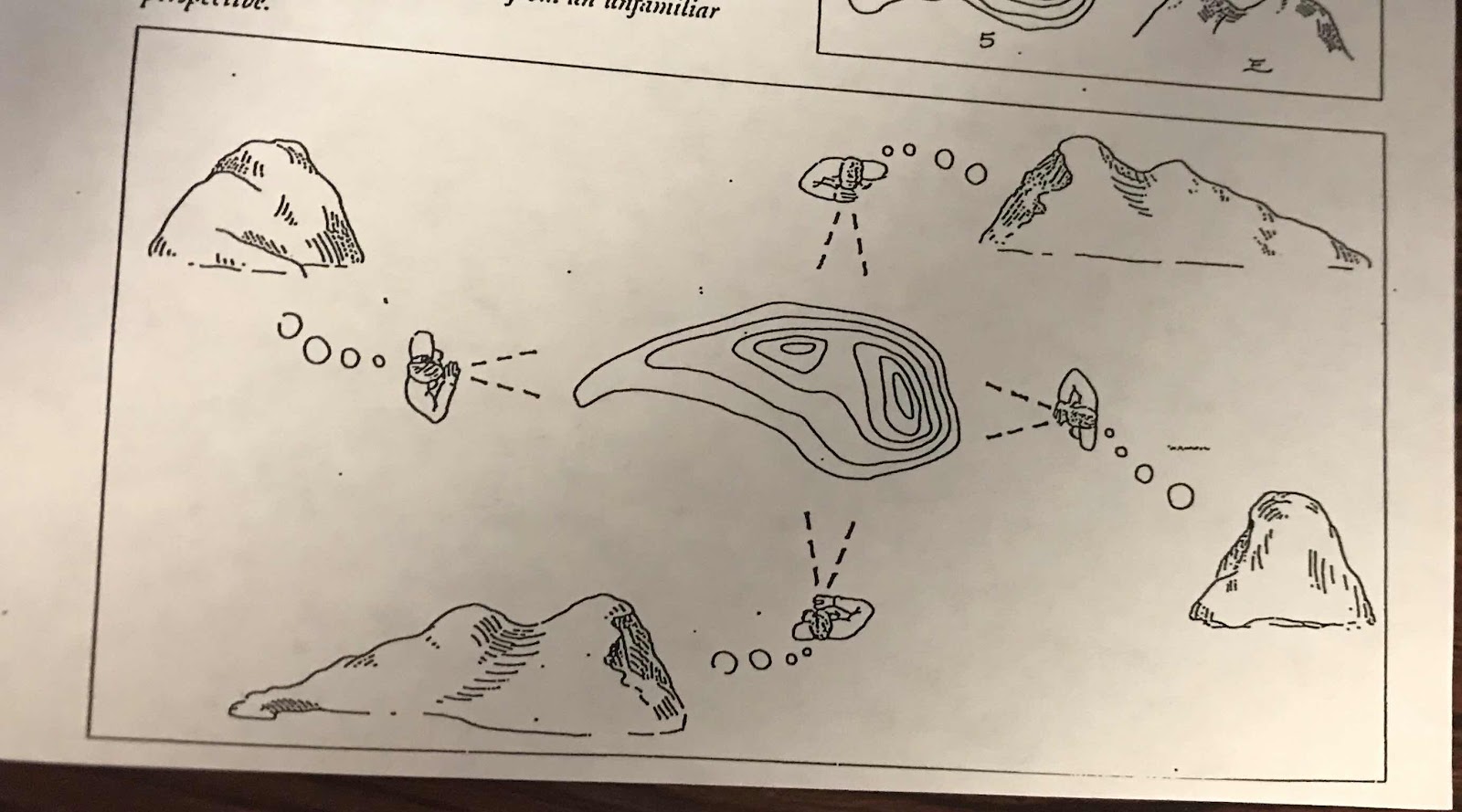
Part of orienteering is remember that a landmark looks different depending on your angle. Fulfilling the Great Commission, evangelism, justice work, healing, rebuilding, and reformation all look different in the ELCA depending on how you view the mountain of the baptized life. (I don't like mountain imagery for this kind of thing because we're not climbing, but still I hope you get what I am saying.) Occasionally we get a view or a description of what the mountain looks like from the perspective of the other expressions of the church, but it's a view from their angle and maybe not ours (whomever "we" is here). We have to process the information that is true for both (vegetation, some terrain elements, maybe weather or animals), but we mostly have to focus on the ministry (mountain) that's in our view.
The co-equal approach also acknowledges the significance of the location and circumstances of the local congregation. Any given congregation in the ELCA may choose to be in disagreement with the larger church body or to be in agreement with the church, but to express it differently. For example, a congregation of the ELCA that is distressed about the sanctuary church decision (after fully reading the actual parameters of the action) could decide that they can get onboard with the part about immigration reform, acting to make such reforms stricter in accordance with their interpretation of the scriptures and their prayers for God's guidance.
This is what it means to have both congregational polity AND a supportive denominational structure.
Your congregation decides things for themselves, but also benefits from the relationship with the synod and with churchwide.
If you have ever received a pastor who passed a psychological evaluation, has a seminary degree, had an internship, and was reviewed by a candidacy committee- you have benefitted from the structure of the ELCA.
If you have given money to help after a disaster or received money after one through a Lutheran organization, then you have benefited from the structure of the ELCA.
If you have gone to a WELCA event or to a Lutheran youth event or a Lutheran outdoor ministry or a college of the ELCA, you have benefited from the structure of the ELCA.
If you have had help when your church was in trouble or got a grant for a program or project, you benefited from the structure of the ELCA.
It is VERY true that the ELCA is not perfect and there are plenty of things that have happened through the years and at all levels that have been more hurtful than helpful. Nevertheless, this denomational is trying to hold the tension of congregational autonomy within a supported and supportive area and national denominational framework. We are church together and we are better church together.
When congregations immediately start talking about leaving the denomination without fully reflecting on the whole story and also what it means to be a denominational family, they deciding that they are better off without both the stresses and the bonuses of being in relationship. When they quit giving to the synod (which then gives to the national church), they're not changing the minds of people with whom they disagree, they're hurting the disaster responses, the adoptions, the home rebuilds, the camps, the campus ministries, the curriculum development, and many other realities of the denomational work in the world that create the space and time for people to hear about and experience Jesus.
When we threaten to leave or we actually do, we're telling our siblings in Christ that we refuse to do any work with them or alongside them because their view of the work is different. Worse, many churches are threatening to leave or beginning that action because of the opinion of a fourth viewer, unfamiliar with our polity or life together, but determined to weigh in on the matter.
I'm a Lutheran because I believe that the message of salvation by grace through Christ's faithfulness is the message that has saved the world and is saving it still. This powerful reality brings me joy and gives me structure. I feel grateful to be a member of the ELCA and I feel privileged to be part of working to make it better- a stronger witness in the world. Do I like everything? No. Do I keep working? Yes. That's what it means to be a family, to be church together, to accept that the congregation I serve can benefit and wrestle with our partner expressions, as well as focus on what we know to be needed in our own community.
Tuesday, June 25, 2019
Protected Borders, Ungleaned Corners
When you harvest your land’s produce, you must not harvest all the way to the edge of your field; and don’t gather every remaining bit of your harvest. Leave these items for the poor and the immigrant; I am the Lord your God. - Leviticus 23:22
1. A country has the right to protect its borders. For the purposes of this conversation, this country will refer to the United States of America, a landmass inhabited by native peoples and then colonized by explorers, freedom seekers, economic migrants, and convicts.
2. Economic migration is provided for through legal systems and applications. Seeking asylum due to persecution or danger is one way around the legal application process, but there remains the need for a paper trail to prove said risk. Police officials and government assistance offices may be in the pocket of or also threatened by the same endangering entities and therefore paperwork may be difficult or impossible to maintain. A system of merciful discernment is needed and must be applied as equally as possible in such cases.
3. When migrating, there are laws and guidelines requiring refugees to seek asylum in the first "safe third country" that is reached. A safe third country is determined by the ability of the asylum seeker to be able to declare for asylum without fear of being returned to their country of origin and to be able to live reasonably, working with and toward greater self-determination, in that country. Mexico's asylum system remains under development and is not presently able to guarantee genuine asylum to the majority who seek it there.
4. People who send their children through to the United States are hoping that their children will be able to connect with family members currently residing in here. Similar to the Kindertransport, chidren are being kissed goodbye and sent off with hope for a better life. Often parents know that they may not see their children again.
"Parents shall not be put to death for their children, nor shall children be put to death for their parents; only for their own crimes may persons be put to death." - Deuteronomy 24:16
Depriving children of genuinely safe and sanitary condition is punishing them for their parents' (perceived or real) crimes. This is specifically against the biblical injunction regarding generational punishments. When it comes to children, one hopes that one's nation will demonstrate its highest ideals and show that we (the nation) have learned from historical mistakes.
The Kindertransport worked in part because private British citizens put up money for the children and their transportation. If I knew that money I gave would go directly to provisions for a specific child, I'd have auto-debit set up in a heartbeat. As it is, I give through my denominational resource for caring for migrant and refugee children: Lutheran Immigrant and Refugee Services and AMMPARO.
5. It is possible to have a nuanced conversation about the crisis at the American southern border, the internment camp situation for housing children, and enforcing laws while showing mercy all at the same time. This is not the same as saying, "There is wrong doing on both sides." We can definitively acknowledge a present wrong and historical wrongs, while also working to figure out sustainable and life-giving solutions. It is when we take the time and energy to fight about who is more right that the truth is ignored and the actual call to make things better goes unheard. There may not be a quick fix, but there are long-term ways to solve these problems, to work for justice and peace, and to care for our neighbors.
If any think they are religious, and do not bridle their tongues, but deceive their hearts, their religion is worthles. Religion that is pure and undefiled is before God, the Father, is this: to care for orphans and widows in their distress, and to keep oneself unstained by the world. - James 1:26-27
1. A country has the right to protect its borders. For the purposes of this conversation, this country will refer to the United States of America, a landmass inhabited by native peoples and then colonized by explorers, freedom seekers, economic migrants, and convicts.
2. Economic migration is provided for through legal systems and applications. Seeking asylum due to persecution or danger is one way around the legal application process, but there remains the need for a paper trail to prove said risk. Police officials and government assistance offices may be in the pocket of or also threatened by the same endangering entities and therefore paperwork may be difficult or impossible to maintain. A system of merciful discernment is needed and must be applied as equally as possible in such cases.
3. When migrating, there are laws and guidelines requiring refugees to seek asylum in the first "safe third country" that is reached. A safe third country is determined by the ability of the asylum seeker to be able to declare for asylum without fear of being returned to their country of origin and to be able to live reasonably, working with and toward greater self-determination, in that country. Mexico's asylum system remains under development and is not presently able to guarantee genuine asylum to the majority who seek it there.
4. People who send their children through to the United States are hoping that their children will be able to connect with family members currently residing in here. Similar to the Kindertransport, chidren are being kissed goodbye and sent off with hope for a better life. Often parents know that they may not see their children again.
"Parents shall not be put to death for their children, nor shall children be put to death for their parents; only for their own crimes may persons be put to death." - Deuteronomy 24:16
Depriving children of genuinely safe and sanitary condition is punishing them for their parents' (perceived or real) crimes. This is specifically against the biblical injunction regarding generational punishments. When it comes to children, one hopes that one's nation will demonstrate its highest ideals and show that we (the nation) have learned from historical mistakes.
The Kindertransport worked in part because private British citizens put up money for the children and their transportation. If I knew that money I gave would go directly to provisions for a specific child, I'd have auto-debit set up in a heartbeat. As it is, I give through my denominational resource for caring for migrant and refugee children: Lutheran Immigrant and Refugee Services and AMMPARO.
5. It is possible to have a nuanced conversation about the crisis at the American southern border, the internment camp situation for housing children, and enforcing laws while showing mercy all at the same time. This is not the same as saying, "There is wrong doing on both sides." We can definitively acknowledge a present wrong and historical wrongs, while also working to figure out sustainable and life-giving solutions. It is when we take the time and energy to fight about who is more right that the truth is ignored and the actual call to make things better goes unheard. There may not be a quick fix, but there are long-term ways to solve these problems, to work for justice and peace, and to care for our neighbors.
If any think they are religious, and do not bridle their tongues, but deceive their hearts, their religion is worthles. Religion that is pure and undefiled is before God, the Father, is this: to care for orphans and widows in their distress, and to keep oneself unstained by the world. - James 1:26-27
Monday, March 11, 2019
Baptismal Service Commentary, Part 1
PRESENTATION
God, who is rich in mercy and love, gives us a new birth into a living hope through the sacrament of baptism. By water and the Word God delivers us from sin and death and raises us to new life in Jesus Christ. We are united with all the baptized in the one body of Christ, anointed with the gift of the Holy Spirit, and joined in God's mission for the life of the world.
This is when the family members of the person to be baptized, infant or adult, come forward with the candidate for baptism. Notice that the presentation, as an invitation, explains what baptism is. This explanation does not mention hell. In Lutheran understanding, the defeat of hell has already been accomplished for the baptismal candidate and for all people by God in Christ through the power of resurrection. Thus, baptism is not removing the threat of hell, but is bringing the baptized into a new life in Christ. Both coming to be baptized or to have baptized andthe living out of the new life are responses to what God has already done.
God is the prime mover, the originator of all things. All we do is notto earn grace, but in response to it. This is specifically and most certainly true in baptism.
PROMISES AND COMMITMENTS
As you bring your children to receive the gift of baptism, you are entrusted with responsibilities:
to live with them among God's faithful people,
bring them to the word of God and the holy supper,
teach them the Lord's Prayer, the Creed, and the Ten Commandments,
place in their hands the holy scriptures,
and nurture them in faith and prayer,
so that your children may learn to trust God,
proclaim Christ through word and deed,
care for others and the world God made,
and work for justice and peace.
Do you promise to help your children grow in the Christian faith and life?
Sponsors, do you promise to nurture these persons in the Christian faith as you are empowered by God's Spirit, and to help them live in the covenant of baptism and in communion with the church?
People of God, do you promise to support name/s and pray for them in their new life in Christ?
We do.
In the Promises and Commitments, the baptized or the family and sponsors of the baptized are committing to the shape of their new life in Christ. The baptismal life is not lived alone, but is lived out with other believers (and in the world). This life involves participating in faith community life, encounters and wrestling with the written word (scripture), regular participation in communion and affirmation of baptism, praying for others in word and deed, and becoming familiar with the most foundational texts of the faith (10 commandments, the Lord’s Prayer, and the Creed).
This life is lived out for this purpose: so that the baptized may learn to trust God and, through that trust, live a life that proclaims Christ, crucified and risen. This proclamation will be evident in the baptized life in what the person says and does, what she prioritizes and what he rejects. Indeed, it is to be hoped that, with the help of the Spirit, works of justice and peace flow in the wake of the baptized person, leading people to ask about the source of their courage and strength.
Baptismal sponsors agree to help with this work, as do congregation members. Even if a child is baptized in a “home” congregation, but lives elsewhere- the local congregation is committed to these promises to all children of God who come through their doors.
PROFESSION OF FAITH
I ask you to profess your faith in Christ Jesus, reject sin, and confess the faith of the church.
Do you renounce the devil and all the forces that defy God?
Response:
I renounce them.
Do you renounce the powers of this world that rebel against God?
Response:
I renounce them.
Do you renounce the ways of sin that draw you from God?
Response:
I renounce them.
Do you believe in God the Father?
I believe in God, the Father almighty,
creator of heaven and earth.
Do you believe in Jesus Christ, the Son of God?
I believe in Jesus Christ, God’s only Son, our Lord,
who was conceived by the Holy Spirit,
born of the virgin Mary,
suffered under Pontius Pilate,
was crucified, died, and was buried;
he descended to the dead.
On the third day he rose again;
he ascended into heaven,
he is seated at the right hand of the Father,
and he will come to judge the living and the dead.
Do you believe in God the Holy Spirit?
I believe in the Holy Spirit,
the holy catholic church,
the communion of saints,
the forgiveness of sins,
the resurrection of the body,
and the life everlasting.
The Profession of Faith is a statement of what the candidate or their family and the congregation both trust to be truthful about God and also ask God to help them believe. This profession begins in the via negativa, that is with what is not of God.
God will not defy Godself, thus we forcefully reject spiritual forces that tell lies about God and attempt to make us feel separated from God’s love.
God will not rebel against Godself, thus we forcefully reject the social and political forces of this world that attempt to subvert God’s will and purposes for reformation, restoration, and resurrection.
God will not deliberately harm or separate Godself from the beloved creation, thus we forcefully reject our own internal forces that cause us to make idols of ourselves, falsely elevating self above God and neighbor.
Once we have rejected what cannot be true about God, we are left with the Divine Mystery. In approaching that Mystery, all we have is the handful of ways that God has chosen to be revealed- through creation, through Jesus, and through the eternal work of the Holy Spirit, specifically in the church. We use the Apostles Creed, during baptism, to attest to these revelations, knowing that they do not represent the full nature of God, but a glimpse into the gift of eternal truth.
This first part of our baptismal service teaches and reminds us that:
1) God moves first.
2) We respond to God’s grace.
3) The world needs and is waiting for our response, because the faithful response of the baptized person points beyond their actions toward God, the Source and Ground of their being and all grace.
Monday, March 4, 2019
Getting Ready for Lenten Discipline
Lent is a six- week period before Easter, wherein churches that observe the season focus on 1) Jesus' journey to Jerusalem and the cross, 2) preparation for baptism or renewal of baptismal vows, and 3) corrective spiritual discipline with a prayer toward increased faith and deepened trust in God.
Sometimes when people think about spiritual disciplines for Lent, they think "giving things up"- a setting aside of something enjoyable for a season of deprivation (only to resume the habit or activity at Easter). The purpose of spiritual discipline isn't (usually) deprivation, but instead an exercise to make one stronger in internal and external faith demonstration. We should be setting aside things that cause us to feel separated from Christ and/or taking up actions or practices that help us to connect with the Ground and Source of our Being.
For most of us, chocolate is not getting between us and Jesus. In fact, when we set aside candy or sweets as our discipline or make a new diet our Lenten focus, there can be a detrimental side effect of demeaning our body, which is a generous and valuable gift from God. We may need to make changes in how we treat our body, but that often begins with how we think of it.
Back to the spiritual disciplines of Lent. What one takes up or sets aside should be connected to reflection on the life of Jesus and to the sacrament of baptism. Let's take a quick look at the baptismal vows spoken by parents or baptismal sponsors (or by an adult candidate for baptism):
As you bring your children to receive the gift of baptism, you are entrusted with responsibilities:
to live with them among God's faithful people,
bring them to the word of God and the holy supper,
teach them the Lord's Prayer, the Creed, and the Ten Commandments,
place in their hands the holy scriptures,
and nurture them in faith and prayer,
so that your children may learn to trust God,
proclaim Christ through word and deed,
care for others and the world God made,
and work for justice and peace.
Those are some hefty promises, only really possible with the help of the Holy Spirit and when we have learned not to fear death and hell because of our freedom in Christ. Our Lenten disciplines, then, should be connected to these promises, helping us to take up habits that relate to our baptized status or setting aside the things that get in the way of living into that same baptized status.
We are not baptized into a "Jesus and me" life; we are born again into a life that is lived in Jesus for the sake of the world, from our closest neighbors to the people across the planet whom we will never meet. Each year, we are invited into a season of course correction for the sake of those relationship. Our redirection, our repentance, in anchored in Christ, so we are not floundering about, trying to find our way. Instead, we imitate the words and deeds of the pioneer of our faith, Jesus.
So, as you prepare for Lent, prayerfully consider your disciplines. Ask God to guide you into good work that will deepen your understanding of baptism, your awareness of the Spirit, and your trust in God's presence. Be prepared to be changed.
I think, and this is just me, that it is only when we have done the hard work of Lenten discipline and still realize how much grace we need that we are truly able to glimpse the powerful grace of the empty tomb and the resurrected Savior of the world.
This will be my dismissal phrase for Lent (at the end of church services) and I'm offering it to you now.
Go in peace. Be diligent in discipline and strong in faith.
(Thanks be to God.)
Sunday, February 24, 2019
Resurrection of the Body
Luke 6:27-38
1 Corinthians 15:35-50
Seventh Sunday after Epiphany, Year C
Memories can be faulty, but yet this one feels clear to me. There we were, a group of students from
Yale Divinity School, gathered for the smaller section portion of our New Testament class. One student, after permission from the section leader, asked us all, "Do you actually believe in the resurrection of the body?"
The room, long and narrow, was very quiet as we all looked around at each other. Slowly, I raised my hand and said, "I do." There was incredulity all around, with some people unsure of how to put their own beliefs into words. Clarification was sought- did the questioner mean the body of Jesus or our own bodies? He meant both, but more the latter.
Wherever the conversation went, I maintained my affirmation, my credo. Of all the things in the Apostle's Creed that might be difficult for me, belief in the resurrection of the body as a real, not metaphorical, promise of God is not one of them. I can believe it for two reasons: first, I believe God loves bodies and, second, I believe Divine love is more expansive (and mysterious) than we can comprehend.
In Paul's letter to the Corinthians, which we have been examining for six weeks, this is the climax of his argument. He has brought them through some of their disagreements to remind them to be a community, functioning together the way that a body does. He reminds them that love is the hallmark of a community that finds identity in Christ. He teaches them that Jesus appears to all kinds of people and the Spirit gives each person their own gifts and their own vocation for the sake of the community.
He builds, then, to explain the great power of the Incarnation- God taking on flesh. Since Jesus had a real body, then the realities of salvation are tangible and true for this life- not just for someday when we "fly away". Now, in these last verses, Paul is pressing his ultimate point to the Corinthians who are trying to live in the Way of Jesus.
Granted, Paul's not terribly gentle as he roars up to his point. Fools, he calls, the Corinthians as he repeats the kinds of questions he has been asked about life after death. He is dismissive not because he doesn't have compassion, but because their questions miss the point.
The Corinthians don't have long life expectancies. There's high infant mortality and maternal mortality as well. There are wars, plagues, illnesses, and issues that come from the type of hygiene that existed and was embraced. Bodies felt frail and limited. Surely, eternal life would bring a sweet release from the aches and pangs of the bodies that they had known in this life. Certainly, God wouldn't make them shuffle on forever with the scars, wounds, defects, and deformities that they had struggled with in this existence.
For the Corinthians, like us, being rid of the body wasn't necessarily a rejection of Jesus's resurrection or God's promises. It was both hope for something better and a failure of imagination. Paul is trying to break into that failure pointing out that God does not give us something that we are not meant to have. This is not the same as saying whatever happens to us is God's will. That is not true, because free will means that we may make choices or be affected by the choices of others that are not what God wanted for us.
However, if we look at what we have- materially and spiritually, we have received grace upon grace. In that outpouring of grace, Paul is saying, we have real, genuine, tangible, bodies. Yes, they may hurt or fall short or not be the shape of our dreams, but our bodies are gifts from God. And if God gives us a gift, it is meant to be loved, spoken well of, and not discarded. Paul argues that if God gives us a body, it's probably a forever gift- just like grace, mercy, and love.
The sustaining of the forever gift of the body is a mystery, not to be solved in this life. It is meant to be enjoyed and, furthermore, put to good use for all the things that Paul has mentioned in the other 14 chapters of the book. It means nothing to form a community, to care for others, to show love, to live into vocation if it is just done metaphorically or mentally. The only way we can truly form a community of love is by actually caring for other people by doing for them. And doing things requires a body. Even prayer requires our brains, all the systems that feed and care for the brain, and the rest of our body to carry out the actions of the prayer. There is no purely spiritual activity. Anything that we do for God, compelled by the Spirit, will require our body if we are actually going to live into it.
And if our body is what God gifts us for this world, then we will have a body of some kind- a real, tangible, useful body- for the work of the life to come.
In a side note to this point, related more to the Luke reading than 1 Corinthians, when the gospel writer says, “Bless those who curse you, pray for those who abuse you”- it is notan indication that God expects us to endure abuse- to our bodies, our minds, or our spirits- as a regular occurrence. In the context of the whole reading, the sermon on the plain, it is to be noted that abuse may occur while one is living out the realities of being Christian. One may be called names for standing up for the marginalized or have rocks thrown at them (literally) while working on behalf of the poor. This is where Jesus’ words apply, we don’t fight back in those circumstances because it would take energy away from the good we were doing. Daily abuse, however, in a family, work, or romantic context- the kind that wears away at our bodies and our will, not to mention our ability to do good- this is not something that God causes as a test for us or means for us to endure. On-going trauma to our bodies is not God’s plan or will. Why? Because it is not in line with the reality that God has gifted us our bodies and loves them.
That is why I believe in the resurrection of the body. God must love bodies because God made them. Through generation after generation, eon after eon, God has sustained the bodies of animals, the corporeal form of plants, the solidity of rocks, and the fragile flesh of humanity. After speaking through fire, whirlwind, flood, and even stillness, God finally chose to take on the human form- embracing the body as the most beloved part of creation. Bodies bring other bodies into the world, show compassion, reveal passion, and devote care at the end of all things. God loves bodies. And, I believe, God does not destroy what God loves.
My second reason for believing in the resurrection of the body is this: Divine love is more expansive (and mysterious) than we can comprehend. Western Christians, especially Americans, often try to make the world into neat categories. We want black or white, cat or dog, apple or orange, male or female, Grizzlies or Bobcats, John Deere or International Harvester, downhill or cross-country, regular or decaf.
And, yes, sometimes there are only two choices. But more often than not, there's a third way. And a fourth way, a fifth, a sixth, and so much more. We have salt water and fresh water, but there are also marshes and estuaries when both kinds of water mix. Life in estuaries exists in that place for the health of both the fresh and saltwater systems. The things that live in estuaries exist in a third way, with their bodies.
Mountains and plains are both amazing and necessary, but mesas, canyons, dry riverbeds, deserts, and jungles also serve purposes for creation. We cannot simply limit the landscape to our favorite, because there are life forms beyond our knowing that live in all kinds of terrain- and their existence may make ours possible in an inter-relational way. We need their bodies and they may need our care.
God who made otters, beavers, and ducks- all who have their own purposes- also made the platypus- a venomous duck-billed, beaver-tailed, otter-bodied egg-laying mammal that intrigues, terrifies, and delights. Apparently, God even likes to mix categories.
My point is that God's majesty and mystery, God's power and might, God's love and mercy are so much higher, deeper, and broader than we can imagine. We attempt to limit God's expanse to what we understand, but instead, God's call beckons us to let go of the illusion of control and instead say, "Isn't this amazing."
When we do that with the concept of the resurrection of the body, we come to the same place as Paul. We have a body now that may end and there we will someday have a concrete form that will not end. We have spiritual gifts from God and the gift of our bodies for the sake of the world. We have brokenness now and we will have restoration, in this life and in the life to come. We have knowledge and strength and we have confusion and questions.
We ourselves are marshes, mixing salt and fresh, trust and doubt, physical and spiritual gifts and blessing. We are marshes, combining the real presence and the felt absence of living in the imitation of Christ. We are marshes, working for healing, renewing, and refreshing the world with our God-given gifts.
Yes, I believe in the resurrection of the body.
I believe in it because Jesus' body was resurrected as a demonstration of God's power and God's love.
I believe it because the Spirit helps me and the Bible tells me so.
I believe it because God's revelation since the beginning of all things shows a love for the real and the concrete, particularly bodies.
I believe it because God is bigger than what I know and what I can imagine.
I believe in the resurrection of the body, from the tomb, from the pains of this life, and in the life of the world to come.
Amen.
Subscribe to:
Posts (Atom)
Thanks be to God
I think often these days of Edward Jenner, who pioneered (with others) vaccine science and whose work led to the initial near-eradication of...
-
Jesus Christ is the same yesterday and today and forever. - Hebrews 13:8 In every conversation about societal change, people who seek wi...
-
Bitmoji Julia enjoys tea Within a very short amount of time, two people whom I love were called "fat ass". One of these slurs ...
-
We know that all things work together for good for those who love God, who are called according to his purpose. - Romans 8:28 Never place ...