Showing posts with label Women of the Bible. Show all posts
Showing posts with label Women of the Bible. Show all posts
Monday, March 26, 2018


Sunday, April 16, 2017
Whole Lotta Shakin'
In Matthew’s Easter account opens with two
women approaching the tomb and an earthquake. (The two events are only related
because of Jesus, not the former causing the latter.) The women are there to
witness if Jesus walks out of the tomb, but he doesn’t. The stone is moved and
he is simply gone. There is an angel sitting there, matter-of-factly, to tell
them that he has been raised and gone to Galilee, just like he said he would.
 We do not get a reaction of the women to the
earthquake or to the rolling away of the stone. Unlike in the other gospel
accounts, we don’t even know why the women are going to the tomb this morning.
They simply are. Of course, it is possible women were no longer able to be
surprised, given the events of the past three days and the fact that Matthew
inserts several earthquakes into his version of Jesus’ death and resurrection.
Both seio (the Greek word for shaking
and quivering) and seismos (the Greek
word for earthquake or commotion) are used liberally in Matthew’s account of
Jesus’ last days.
We do not get a reaction of the women to the
earthquake or to the rolling away of the stone. Unlike in the other gospel
accounts, we don’t even know why the women are going to the tomb this morning.
They simply are. Of course, it is possible women were no longer able to be
surprised, given the events of the past three days and the fact that Matthew
inserts several earthquakes into his version of Jesus’ death and resurrection.
Both seio (the Greek word for shaking
and quivering) and seismos (the Greek
word for earthquake or commotion) are used liberally in Matthew’s account of
Jesus’ last days.
All of this quivering and quaking indicates
that something deep is happening. This crucifixion, the betrayals, the death,
and the attempt to prevent anything unusual from happening to the body cannot
seem to occur without provoking a seismic reaction in heaven and earth.
Everything is shaken and stirred.
What should we make of all this movement? Is
this an attempt to give geologic proof to the story of the resurrection? It is
not. Matthew wants to counteract despair*. When Matthew is writing, nearly forty
years after the events of the day in question, the Temple has been destroyed by
Rome. The followers of the Way of Christ are beginning to experience serious
struggles. The Pax Romana, or Roman
Peace, was only peaceful in that you could be left alone as long as you
appeared to be cooperative in every way possible with the political leaders at
all levels- keeping your head down, your taxes paid, and your mouth shut. There
were wars or rumors of wars or quickly silenced insurrections with rebel
factions disappearing into the deserts to try to live quiet lives of worship
and devotion, which is an ironic way to rebel.
This kind of living leads to despair- the
expectation of every day being exactly the same as the day before and the
complete lack of expectation that anything can or will change. Doubt is not the
same as despair because doubt is logic combined with hope. Doubt looks at the
facts, but believes in a larger truth. Despair believes hope is lost.
The Christians in the time of Matthew had begun
to despair. Thus, his resurrection account is written to remind them that their
core story is an earth-shaking, ground-splitting, stone-moving, Rome-silencing
event. The resurrection truth, their source of their life in community, is one
that is designed to crush despair and feed the flame of hope.
This is a resurrection account in which Jesus
is not where you think he will be, does not appear first to whom you think he
will appear, and does not go to the place you expect him to go. (Galilee of the
Gentiles isn’t exactly the expected appearance location for a risen Messiah.)
In the face of all of that, despair cannot flourish. It is shaken off its
foundations. Despair needs suffering, oppression, and routine (the unholy
trinity).
Which brings the story to us. We also live in a time of some leaders
who act without thinking, think without studying, and study only those who
agree with their worldview. We also know a world of competing military powers
and oppression of the poor and marginalized communities. We know the exhaustion
of attempting to alleviate pain, which feeling frustrated in the momentum to
create real change.
Nevertheless, we are the same community who
needed to hear Matthew’s words. We are also people who need to remember that
resurrection is a seismic event. It shakes up everything. We are embraced by a
love and truth that will not let death have the final word. That reality
changes everything. Resurrection is an event of forgiveness, an event of God’s
on-going revelation of divine mercy, the power of the Spirit continuing to
create and transform. The earth cannot keep still under the power of that kind
of love. It might not be geologically correct to say that God’s response of
love to human violence shakes the earth to its core, but it is theologically
true.
Therefore, we do not despair. We keep the
faith. It is not a faith that comes from seeing or even hearing. It is a faith
that comes from God- God’s welcome, God’s inclusion, God’s hope, and God’s
refusal to let the creation remain unshaken. God’s love is the same, day after
day, year after year, eon after eon. That love is vast, however, that it
contains truths that are beyond our comprehension- that death is not an end,
that forgiveness happens, that all means all, that eternal love is exactly what
it sounds like. The vastness of the Divine Self encompasses all for which we
dare to hope, in the light of which- despair shrivels.
And then we crush it completely- with voices
that quake with joy and trust, “He is risen. Alleluia.”
He is risen, indeed.
Amen.
*This concept of despair is something I have adapted from a definition by Pastor Rob Bell.
Tuesday, November 1, 2016
Review: CEB Women's Bible
A couple weeks ago, I was asking a group of [church-going] children what they knew about the Bible. Among other shared information, we tried to name some Bible characters. They quickly shouted out, "Jesus!... Moses!... Abraham!..." The oldest kid in the group is probably 8, so that was okay. I asked for the names of any women or girls in the Bible. Mary's name was speedily recalled and then there was a stall. My own son raised his hand and said, "I can't remember her name, but there was the girl in the garden who ate the apple." Great, our group could literally only name Mary and Eve. So, looks like my work is cut out for me. Good news: there's a Bible for that!
I recently received a copy of the CEB Women's Bible for free in exchange for a fair review. This Bible is in the Common English translation- hence, CEB. This is not my favorite translation. All translation is interpretation and all interpretation is political. So, accepting the CEB as a study bible was a stretch for me going in to this project. Not all pastors share this characteristic, many LOVE and endorse this translation of the Bible and find it to be as accurate and helpful as early translations.
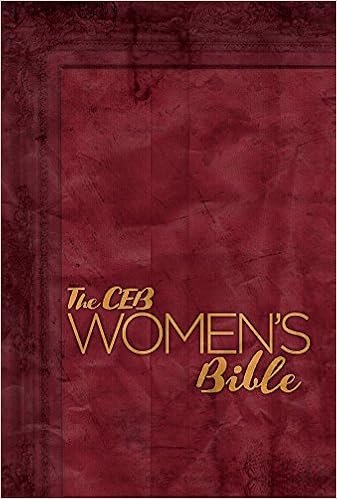
It turns out that, translation notwithstanding, this is an excellent study Bible. Nearly all the chapters have summary introductions that could be used for the people who like a big picture view or as prayer prompts before or after devotions. The inserted commentaries on situations, circumstances, and people are very helpful. There is one on birth control near Genesis 38 and on one women and property at Joshua 17. There's celebration (Psalm 31), pleasure (Ecclesiastes 2), mercy (Romans 9), adolescence (1 Timothy 5)- plus ministry and widows (separately) in the same chapter.
These short explanations given insight not only to the time of the Bible's events or writing, but also for how the verses impact the life of the reader today. I enjoyed every one that I read and I think they are the best feature of this Bible.
My second favorite element of the CEB Women's Bible is that there is at least a sentence or two portrait of every single woman who appears in scripture. No matter whole small her role, how implied her presence, how unnamed she may have remained through the centuries- she or her group get recognition in this volume. Through recognition comes thankfulness and growth in understanding. I have been doing work in Daniel lately and, boom, there was the portrait in words on Belshazzar's mother (Dan. 5). She's actually critical in the story because she remembers Daniel and his skill, when others have forgotten him. Yet, she doesn't usually appear in the stories people tell off the top of their heads regarding the writing on the wall incident. Regular use of this Bible and encountering these portraits will help the reader become more familiar with all the women of scripture and, perhaps, more emboldened to speak up in times of trouble.
It is extremely exciting to flip through the front matter of the book and see how many women were involved in the creation of this volume. Lay women, professors, writers, and clergywomen all contributed their talents to the creation of this volume. I am of mixed emotions when I see this. I am so happy- nearly tearfully so- that these women were sought out and their vocations and talents used well for this book. At the same time, I hope that the work in and on this Bible will be noticed- especially in academic and professional religious circles. This amount of research, talent, and commitment deserves recognition beyond making a commercially viable devotional Bible (which is NOT nothing- far from it).
Despite my own reservations with the translation (which are NOT shared by all other pastors!!!), I believe that I will continue to use this Bible for personal devotional reading, along with others. I do say to people that the best kind of Bible to get is the kind you will actually read. This Bible is very readable and the portraits, summaries, maps, and drawings all serve the purpose of increasing knowledge and learning in faith. I recommend this Bible, particularly if you do not presently have a study Bible that you enjoy using. If you are the kind of person who is bothered by adjectives in the titles of Bibles, I still recommend this Bible and a roll of electrical or duct tape to cover the title (or use a Bible cover). Several people in my congregation do this and it seems to soothe their angst and help them to use the Bibles they find most accessible.
The stories of women in the Bible- known, forgotten, and unknown- deserve attention, scholarly time, and church/devotional study. This Bible accomplishes that task superbly. It does it so well in fact that I recommend considering one's own preferences or biases (translation, title, margin size) as adiaphora (or unimportant) relative to having a truly helpful and revolutionary study Bible that spotlights the work of women in history and the work of women today.
I received a free copy of the CEB Women's Bible from the publisher in exchange for an honest review.
You can get a FREE sample of Ephesians from this edition of the Bible here. Try it!
I recently received a copy of the CEB Women's Bible for free in exchange for a fair review. This Bible is in the Common English translation- hence, CEB. This is not my favorite translation. All translation is interpretation and all interpretation is political. So, accepting the CEB as a study bible was a stretch for me going in to this project. Not all pastors share this characteristic, many LOVE and endorse this translation of the Bible and find it to be as accurate and helpful as early translations.
It turns out that, translation notwithstanding, this is an excellent study Bible. Nearly all the chapters have summary introductions that could be used for the people who like a big picture view or as prayer prompts before or after devotions. The inserted commentaries on situations, circumstances, and people are very helpful. There is one on birth control near Genesis 38 and on one women and property at Joshua 17. There's celebration (Psalm 31), pleasure (Ecclesiastes 2), mercy (Romans 9), adolescence (1 Timothy 5)- plus ministry and widows (separately) in the same chapter.
These short explanations given insight not only to the time of the Bible's events or writing, but also for how the verses impact the life of the reader today. I enjoyed every one that I read and I think they are the best feature of this Bible.
My second favorite element of the CEB Women's Bible is that there is at least a sentence or two portrait of every single woman who appears in scripture. No matter whole small her role, how implied her presence, how unnamed she may have remained through the centuries- she or her group get recognition in this volume. Through recognition comes thankfulness and growth in understanding. I have been doing work in Daniel lately and, boom, there was the portrait in words on Belshazzar's mother (Dan. 5). She's actually critical in the story because she remembers Daniel and his skill, when others have forgotten him. Yet, she doesn't usually appear in the stories people tell off the top of their heads regarding the writing on the wall incident. Regular use of this Bible and encountering these portraits will help the reader become more familiar with all the women of scripture and, perhaps, more emboldened to speak up in times of trouble.
It is extremely exciting to flip through the front matter of the book and see how many women were involved in the creation of this volume. Lay women, professors, writers, and clergywomen all contributed their talents to the creation of this volume. I am of mixed emotions when I see this. I am so happy- nearly tearfully so- that these women were sought out and their vocations and talents used well for this book. At the same time, I hope that the work in and on this Bible will be noticed- especially in academic and professional religious circles. This amount of research, talent, and commitment deserves recognition beyond making a commercially viable devotional Bible (which is NOT nothing- far from it).
Despite my own reservations with the translation (which are NOT shared by all other pastors!!!), I believe that I will continue to use this Bible for personal devotional reading, along with others. I do say to people that the best kind of Bible to get is the kind you will actually read. This Bible is very readable and the portraits, summaries, maps, and drawings all serve the purpose of increasing knowledge and learning in faith. I recommend this Bible, particularly if you do not presently have a study Bible that you enjoy using. If you are the kind of person who is bothered by adjectives in the titles of Bibles, I still recommend this Bible and a roll of electrical or duct tape to cover the title (or use a Bible cover). Several people in my congregation do this and it seems to soothe their angst and help them to use the Bibles they find most accessible.
The stories of women in the Bible- known, forgotten, and unknown- deserve attention, scholarly time, and church/devotional study. This Bible accomplishes that task superbly. It does it so well in fact that I recommend considering one's own preferences or biases (translation, title, margin size) as adiaphora (or unimportant) relative to having a truly helpful and revolutionary study Bible that spotlights the work of women in history and the work of women today.
I received a free copy of the CEB Women's Bible from the publisher in exchange for an honest review.
You can get a FREE sample of Ephesians from this edition of the Bible here. Try it!
Thursday, June 18, 2015
Intercession
Holy Mary, mother of a brown son,
 Mother who feared for his well-being,
Mother who tasted terror when he left your side-
Pray for us.
Holy Mary, mother of a brown man,
Mother who demanded his respect,
Mother who knew the power of God-
Pray for us.
Holy Mary, mother of a brown rebel,
Mother who tried to save him from himself,
Mother who eyed the authorities as they drew near to him-
Pray for us.
Holy Mary, mother of a brown preacher,
Mother who was stunned by his insight
Mother who taught him how to listen to the word-
Pray for us.
Holy Mary, mother of a brown prisoner,
Mother who grieved what would never be,
Mother who feared for the life of one who you carried in your body and heart-
Pray for us.
Holy Mary, mother of a brown man killed too soon,
Mother who held his broken body,
Mother who howled to the heavens-
Pray for us.
Holy Mary, mother of a brown Incarnation,
Mother who dared to hope in resurrection,
Mother who whispered, "Let it be with me according to your will"-
Pray for us.

Mother who tasted terror when he left your side-
Pray for us.
Holy Mary, mother of a brown man,
Mother who demanded his respect,
Mother who knew the power of God-
Pray for us.
Holy Mary, mother of a brown rebel,
Mother who tried to save him from himself,
Mother who eyed the authorities as they drew near to him-
Pray for us.
Holy Mary, mother of a brown preacher,
Mother who was stunned by his insight
Mother who taught him how to listen to the word-
Pray for us.
Holy Mary, mother of a brown prisoner,
Mother who grieved what would never be,
Mother who feared for the life of one who you carried in your body and heart-
Pray for us.
Holy Mary, mother of a brown man killed too soon,
Mother who held his broken body,
Mother who howled to the heavens-
Pray for us.
Holy Mary, mother of a brown Incarnation,
Mother who dared to hope in resurrection,
Mother who whispered, "Let it be with me according to your will"-
Pray for us.
Wednesday, May 27, 2015
The Male Gaze is Unbiblical (Reblog)
Soon afterwards he went on through cities and villages, proclaiming and bringing the good news of the kingdom of God. The twelve were with him, 2 as well as some women who had been cured of evil spirits and infirmities: Mary, called Magdalene, from whom seven demons had gone out, 3 and Joanna, the wife of Herod’s steward Chuza, and Susanna, and many others, who provided for them out of their resources. (Luke 8:1-3)
Why does that passage matter? In the scheme of things, Luke’s gospel is following along. There are women spoken to, healed, encountered. This also happens in John and in Mark. Matthew, too. This insertion from Luke is interesting, though. It must be there for a reason.
I believe it is there to refute the idea that the disciples traveled with camp prostitutes. This passage is inserted, in my opinion, to acknowledge what was likely rumored and true about the disciples when Jesus was in the flesh and then among the followers of the Way after the Ascension. There were women with them. Why mention that the women had been healed or to whom they were married or their names?
It keeps the women from being nameless and faceless. They are not just bodies, traveling with the men- serving food, scratching itches, and tidying up after a late-night gabfest with the Master. They were participants and, furthermore, many were of greater social status than that of the disciples. Their names are used so that those who read Luke’s account would recognize some of these women by name, habit, or story.
Additionally, the gospels and the Scripture, where the Spirit peeks through, does not allow women to function merely as sperm receptacles and fetal incubators. Jesus reminds the Samaritan woman that she has worth beyond whatever man might currently offer her protection via house or bed (John 4). He also sees fit to restore a woman beyond fertility and a woman before fertility to life and community (Mark 5).
Throughout the Scripture, women wrestle with the ability or inability to have children, but those around them affirm that their worth is beyond rubies in being who they are. There are prophetesses, female judges, women who preserve their families, their in-laws, and even their husbands’ necks and nether regions. The Bible has no shortage of women upon whom the male gaze was simply admiring of strength, wisdom, and courage.
It is when Christianity becomes domesticated, around the time of the pastorals, that the community of women as leaders, teachers, facilitators, and financiers becomes a problem. As the Empire makes its own impression on Christianity, there is a certain domesticity that becomes expected of women. The mater familias is not yet a bishopess or even a deaconess. She is no longer a theotokos (God-bearer) alongside her brother disciples, she is a vessel whose value lies in her (tamed) sexuality, which is redeemed through honorable male claiming and through the bearing and raising of godly children.
Somewhere in there, women stopped being seen with the eyes of the Son of Man, and just became seen with the eyes of men.
I’ve been thinking about this with the information that has come out about Josh Duggar and his molestation of at least five young girls when he was a teenager and they were younger. I’m not linking to any story related to that. You can google it and come back. In addition to no charges filed, Duggar’s “therapy” was to help a family friend with a construction project. Then he was readmitted to the bosom of the family and it is likely that those whom he abused, including some of his sisters, were ordered to forgive him. It has been alleged that victims of this molestation also received counseling. In the same manner as Josh? Was their counseling toward their own ownership of their bodies and their right to reject unwanted advances? Was it counseling toward releasing of guilty feelings and wholeness? Was there a time to discuss that forgiveness might never feel right or come?
Part of the reality of the Duggars’ Biblical interpretation involves the subservience of women- in childhood and in marriage. Sisters are subservient to brothers. Daughters to fathers. Wives to husbands. Day in and day out. This is the obedience that matters. This order puts women in right relationship with God.
That manipulation of the Word, as well as the male gaze, makes me wholly uncomfortable, to say the least. Women who are taught- nay, indoctrinated- to this end struggle to perceive self worth outside of their relationship with men. Where they resist, it is labeled disobedience. Where they are mistreated, they are marked as co-sinners- in temptation and “allowing” such things to occur. Even little girls know that their value comes from how men view them, not what they can do themselves.
How far we have come from Luke’s paragraph- meant to end speculation and to clarify that women were a valued and valuable part of the traveling disciples’ group… AS women. The later church rejected the Gospel of Thomas, which asserts that Jesus would make Mary Magdalene like a man so that she could be saved, as the men were to be. The accepted gospels let stand that God enfleshed only had one gender expression, but he surrounded himself with many other bodies.
We cannot allow a twisted perception of the Gospel, of women’s roles, of “obedience” to co-opt the wideness of God’s mercy. There is no joy in Mudville that Josh Duggar has been exposed as having molested young girls. There is deep, deep grief that he, along with his victims, grew up with an understanding of the Bible that left all of them confused as to what is right relationship between men and women. His sin is not the only one here and he’s not the only one who needs to ask for forgiveness.
Whether or not the forgiveness is granted, from humans, is a different story. I have to ask myself, what would Mary, Susanna, and Joanna do?
This piece is my own work, originally written for and posted on RevGalBlogPals.org on 5/25/15 as part of the on-going The Pastoral is Political series.
Saturday, August 23, 2014
Be a Boaz
Reading: Ruth 3
Commentary: What’s happening in this passage? Ruth has
pledged her support to Naomi, followed her back to Israel, and been responsible
for taking care of them. Naomi has the connections in this place, her hometown.
If she can find a righteous man to marry Ruth, Naomi will have the
grandchildren for whom she has longed and she will know that Ruth will be taken
care of as a wife. It will have to be just the right man for Ruth- because he
will have to recognize the risks and efforts she has made with Naomi. He will
also have to be willing to give Ruth children who will also be understood to be
in the line of her dead husband. (Otherwise the grandchildren wouldn’t really
be Naomi’s.)
Boaz
is just such a man. He has seen Ruth’s care for Naomi. In the verses we just
heard, Boaz acknowledges Ruth’s forethought and risk-taking. As a widow, Ruth
could have chosen a different husband, possibly even a younger man. However,
she honors Naomi and Naomi’s needs and goes to lie with a man who can provide
for them. Boaz has already shown a willingness to do that.
Boaz
is honored by Ruth’s actions and rewards them. He will make every effort to get
someone to care for her and Naomi. He is also careful to be sure that Ruth’s
reputation is protected. It is certainly arguable that Ruth is a little bit
mercenary and Boaz is not turning away a pretty young thing that shows up in
his bedroll. Be that as it may, the upshot of this passage is that
righteousness and faithful action are rewarded by God and by people.
Of
course, it doesn’t always seem like that’s the case. We certainly know many
situations wherein it seems that evil is rewarded, that other people are a
means for getting ahead, and that no one is willing to speak out for the
widows, orphans, travelers, the unemployed, or the hungry. Isn’t anyone willing
to be the Boaz to these people, to stand up, support, lift up, encourage, and
redeem for life?
We
understand salvation to have been achieved for all creation through Jesus.
There is still on-going work- the spreading of that news, the building of God’s
kin-dom, and the reconciliation of creation with the knowledge of God. In our
culture, it is all too often that people who are in tight spots are not given
the extra boost they need. Boaz does not tell Ruth that things will work out if
she just keeps trying. He doesn’t take advantage of her vulnerability and then
send her away. He doesn’t push off her request until he had more time.
As
Naomi says, he does not rest until things are made right for Ruth (and for
Naomi). We are also called to be “redeeming kinsmen”, to be the one who supports
our brothers and sisters. We are to press on for the cause of our family, the
family of God, and not to rest until all understand who has spoken for them,
who has claimed them, and in whose hands their future rests. God's.
Hear a short worship service, including this commentary, here:
Find this worship service every week here: http://10worship.blogspot.com
Subscribe to:
Posts (Atom)
Thanks be to God
I think often these days of Edward Jenner, who pioneered (with others) vaccine science and whose work led to the initial near-eradication of...

-
Jesus Christ is the same yesterday and today and forever. - Hebrews 13:8 In every conversation about societal change, people who seek wi...
-
 Bitmoji Julia enjoys tea Within a very short amount of time, two people whom I love were called "fat ass". One of these slurs ...
 -
We know that all things work together for good for those who love God, who are called according to his purpose. - Romans 8:28 Never place ...

