Genesis 11:1-9 Now the whole earth had one language and the same words. And as they migrated from the east, they came upon a plain in the land of Shinar and settled there. And they said to one another, “Come, let us make bricks, and burn them thoroughly.” And they had brick for stone, and bitumen for mortar. Then they said, “Come, let us build ourselves a city, and a tower with its top in the heavens, and let us make a name for ourselves; otherwise we shall be scattered abroad upon the face of the whole earth.” The Lord came down to see the city and the tower, which mortals had built. And the Lord said, “Look, they are one people, and they have all one language; and this is only the beginning of what they will do; nothing that they propose to do will now be impossible for them. Come, let us go down, and confuse their language there, so that they will not understand one another’s speech.” So the Lord scattered them abroad from there over the face of all the earth, and they left off building the city. Therefore it was called Babel, because there the Lord confused the language of all the earth; and from there the Lord scattered them abroad over the face of all the earth.
Genesis is written down, not by Moses, but by temple leaders and others during the time of the Babylonian exile. In their grief and their fear, they commit to writing down the stories of their oral tradition, so that they may have a book of God's history and God's historical commitments (covenants) to them. Such a book was both a consolation and an encouragement when they were far from their own homeland and the site of their temple and, what was in their minds, correct worship.
In this series of stories about God's work in history, each story reveals things about God's nature and character, meaning the way God is from human perspective, and each story also attempts to answer some questions about why things are they way they are. What are questions that could be answered through the Tower of Babel story?
- Why are there so many languages around the earth?
- Why do some people (nations) build ziggurats (stepped pyramids) and others do not?
- What would happen if we tried to reach God through our own power?
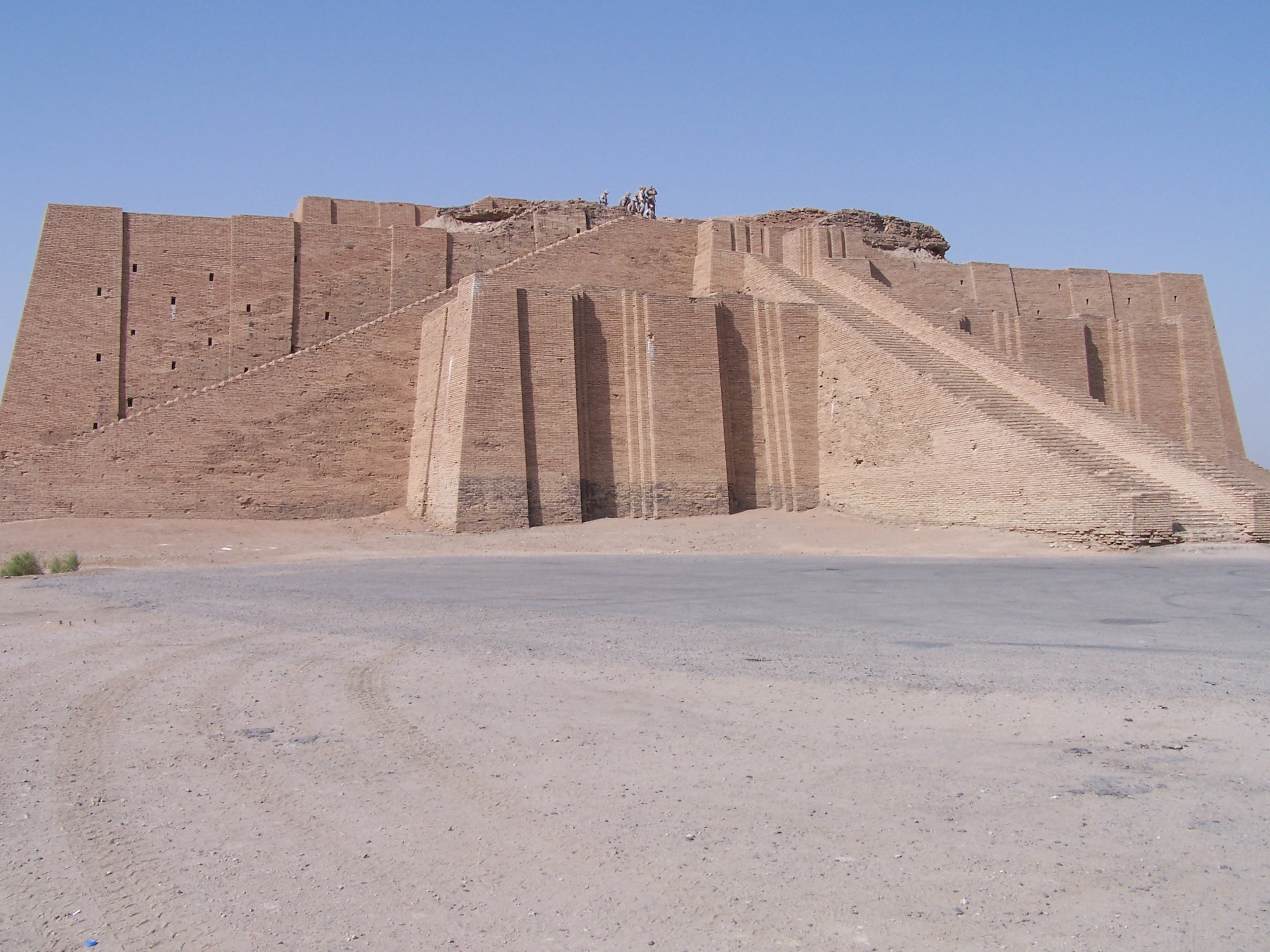
Ziggurats, stepped pyramids across Mesopotamia, were usually built to honor gods or to serve as temples of different kinds. Certainly the people who were taken from Jerusalem to Babylon in the exile would have seen such buildings, tall against the horizon, as well as other imposing architecture in Babylonian cities. Even prior to the exile, those who traveled and then returned to Jerusalem or traders coming to the city would have shared stories of the architecture in surrounding areas. People may have wondered or worried about their own buildings, but also knew that they had built in accordance with their tradition, which was influenced by God's communication to Moses and the very different nature of their religion, which worshipped one God alone.
In the story, the people are building such a tower. They are building it either intend to reach heaven and control God or make a name for themselves by causing other people to seem them as being as powerful as gods. Their tower will speak to their unrivaled power and all will fear them and, consequently, do their will. God keeps this plan from happening by scattering the people and confounding their language.
In such circumstances, the Tower of Babel story would have been a comforting one. Remember what happened when people thought they could build powerful towers and reach God? What did they think would happen? Did they think they would be able to control God? Don't they know the Lord's power? And look what happened! It didn't go so well for them, now, did it?
The story, full of human pride and self-confidence, shows how the Lord does and will confound plans that attempt to control the Divine. Making a name for one's self either means taking the credit personally, which the people in the story intended to do, or giving credit to one's Maker, which the hearers of the story would have known was the right action.
The Tower of Babel story makes a second important point. This point is discerned not from the words of the story, but from its location in Genesis. The Tower story is in Genesis 11. Genesis 6-10 deal with the story of Noah and the flood. Then we have Babel. Chapter 11 concludes with the lineage of Noah's son, Shem, which goes right up to Abraham. Chapter 12 of Genesis begins the story of Abram, a man whom God counted as righteous, even when Abram/Abraham made egregious mistakes.
The location of the Babel story illustrates how some people never learn to honor God, since they would have been in the generations to have reflected on the flood, but didn't. Thus, the Lord thwarts their work and scatters them. Then God blesses Abram as well as those who bless Abram. The Babel story is situated as a reminder to Jewish (and then to Christian) listeners and readers that God keeps God's promises and that God extends blessing generously, even to those who are kind to God's people. Furthermore, God gave Abram the name Abraham, meaning "father of many". It was not a name that Abram could make for himself or give himself.
What does this have to do with us today?
I would be remiss and very negligent in my duties as a pastor if I did not acknowledge that in the past 24 hours, 30 people died in mass shootings in the United States- in the incidents in El Paso, Texas and in Dayton, Ohio. More than 70 other people were injured physically. This does not count the mental and emotional pain causes to people who were witnesses to the shootings, the pain of the families of the victims (dead and survivors), and the stress and danger to police and first responders, as well as the strain on their families who worry always about this kind of situation.
If I talk about guns or gun control, some people will say it is too soon, that the Second Amendment is what it is, or that guns don't have anything to do with this. If I don't talk about guns or gun control, some people will say that I am too afraid to be honest and that I softpedaled my role as a preacher and a prophet. So I am in a tight spot, but I am ultimately answerable to God and I want to share with you what the Spirit has laid on my heart in the last 24 hours.
The bricks and bitumen that built the Tower of Babel were not to blame. They were useful tools and they could be used however people saw fit. Certainly they could be used as weapons, but their main intention was as tools. Once the people corporately decided to build a tower to make a name for themselves, to reach to the heavens and control God, they have changed the bricks from tools into weapons. The bricks and the bitumen become false idols that give the people imagined power that is not theirs to claim.
Similarly, in our own time, our guns- as tools or toys- have exactly the role that we give them. If they are used or collected as things that feed our families, are enjoyable to shoot, or maybe used defensively in a rare, if not ever, situation, then they have an appropriate location and are no more than the bricks and bitumen were meant to be at Babel.
However, if our conversation around our guns (and I say our because we have guns at my house) becomes about the power they give us, the fear we have about someone taking them away, or the way they could be used to make a name for ourselves, the guns have become idols. We are giving them inappropriate power and use in our thoughts, words, and deeds. Idols are objects, people, or ideas that take up time, talent, and treasure that is rightly devoted to God.
In parts of our country, and around the world, but specifically in the United States, our conversation around guns has become idolatrous. The answer is not necessarily to get rid of the guns, but to have much sharper and brighter lines about how we talk about guns. How often are guns used to solve a problem in popular entertainment? How often do we casually say or hear, "I could shoot him" or "I could shoot myself"? How often do we talk about a leader or a candidate, falsely, with regard to what he or she might do with our guns or the tools for our guns? How often do we grow silent during a conversation about gun ownership because we have mixed feelings, but we know stronger voices will shout us down? What are the corners of our culture where the forces that oppose God foment conversation about how guns will permit a person or persons to make a name for themselves?
If we live in a culture (if!) with these symptoms, then guns- like brick and bitumen- have become weapons that we use to make a name for ourselves, rather than tools and toys. If we are genuinely intent on keeping the first commandment, You Shall Have No Other Gods Before Me, if we genuinely intend to fear, love, and trust God above all else- then we cannot permit guns to become or to remain idols.
And we as followers of Jesus must be willing to embrace the joy of our salvation, we must be willing to walk the way of the cross, we must be willing embrace the Spirit that is greater than our fear and have real. honest conversations about guns in our homes, in our community, and in our world. If we do not, then the word for us- the word of our freedom in Christ to care for our neighbor- has been sown on rocky ground.
The story of the Tower of Babel reminds us how quickly we can go wrong, how quickly we make idols of tools and then weaponize them that we may have control and make a name for ourselves.
We have a name. We are children of the living God, the God who kept and keeps promises to Abraham, Isaac, Jacob, Mary, Martha, and John of Patmos (the writer of Revelation who warned about lukewarm faith). We are brothers and sisters in Jesus Christ. The power we need for living comes through our baptism, God's gift of faith, and Christ's renewal of our inner selves in holy communion. We cannot and must not embrace items or stories about anything else as sources of power- not our family names, not our heritage, not our denomination or political party, not any item we own, including our guns.
If we want to show the world, if we want God to show the world through us, the truth of God's power and might- then we must stand up for Jesus and be willing to have the hard conversations that will tear the towers and idols of our culture. It is only this way, rooted in good soil, that our light will shine and others will see it and give glory to our Holy Parent in heaven.


