Sunday, February 17, 2013

No Next Time


Luke 10:25-37


            The parable of the Good Samaritan is a summer story. I do not mean that it happens in the summer, though it might, but that we usually get it in the summer. Well, into the Pentecost season, we hear this familiar parable. However, now we are hearing it where it comes in the gospel- at the start of Jesus’ journey to Jerusalem. He and the disciples have just left a Samaritan village, where they were not well-received, and they are now on the journey that will end where? (At the cross)

            Why are they traveling to Jerusalem? Is it so that they can be near the temple for Passover? Is it so that Jesus can confront the religious authorities and bring about revolution as the Messiah? The journey begin far off, but with each encounter and each parable- Jesus and the men and women traveling with him get closer to Jerusalem and the events of betrayal and crucifixion.

            Here’s a question, though, for the start of their journey. Is what happens in Jerusalem inevitable? Does Jesus have to be crucified? Does the purpose of his time in the flesh on earth culminate in the events of one dark Friday? If we believe that people have free will, given to us by God, then Jesus does not have to end up crucified. People could choose to recognize the Messiah, they could heed to urging of the Holy Spirit, they could be open to God’s work in the world. But in anger and fear, in rigidity to their expectations, in a desire to control God, many people will stand and say, “Crucify him! Crucify him!”

            Were there enough people to resist that? Maybe, but where were they? Many people who are in that Jerusalem courtyard believe they are good people. They believe they are people doing the right thing. Yet, when we look at it (and perhaps when others on the periphery looked at the crowd), we think they are very wrong. How could they think they were right to crucify Jesus?

            Where did they go wrong? Is it possible that the events in that courtyard start on the road to Jericho? Does denying Jesus in a story where well-intentioned people pass by a man dying in a ditch after having been robbed and beaten? The people who pass by have good reasons, you know. In the story, there are two people who pass by. Ostensibly, the priest and the Levite have very particular reasons for not stopping. If they touch blood or a dead body, they will be ritually unclean for a certain amount of time and, therefore, unable to perform their religious duties. It could have been a trap, set by the robbers, to gain additional victims from those who stop to render aid. The men may have been in a great hurry and trusted that any one of many others on a busy road would stop to help.

            Jesus offers these two examples because those listening to his story would have understood the religious reasons, but also known that carrying for others is supposed to trump religious minutiae. Then Jesus drops his bombshell for big effect, a Samaritan- one who is outside the laws of Moses and, thus, presumably outside the affections of God- is the one who does the right thing. A Samaritan is the one who genuinely has good reason not to stop and help a Jew, but who abandons all else, offers aid, and promises to return. (Speaking of, can you think of someone else unexpected who abandons their position, offers gracious aid, and promises to return?)

            One can always find a reason not to help. It’s just this time- when I’m so busy, when I’m not sure what to say, when things are tight, when I don’t want people to know how I feel about this, when I’m afraid… There are always good reasons for not acting this time (or ever), but are they good enough?

            The trouble with thinking that your reasons are good or that you’ve done enough is that the world keeps moving, the powers that oppose God keep working, and eventually… not stopping for someone, not speaking up, not heeding the Spirit’s urging… leads to standing in a courtyard with a crowd who are yelling, “Crucify him! Crucify him!” We wonder, “How did we get here?” and we tell ourselves it happened because Jesus came to die.

            But if he didn’t. If his death is the result of people’s actions, when did it start? It started when people wanted to pinpoint who deserves care, who deserves neighbor love… and who can be left in the ditch. It starts when people want to point out who “deserves help” and who made their own bed. It starts when there is a line drawn between people for any reason- for race, color, creed, habit, affection, or location.

            The Levite and the priest probably told themselves that they would stop next time. Next time. There’s always a next time. That’s one of the problems that Lent brings before us. Putting off caring for your neighbor, speaking up against injustice, making God a priority brings us right to the foot of the cross. In Lent, there is no next time. There is now.

            Now is the time. Now is when you stop. Now is when you call. Now is when you write. Now is when you reach out, stand up, speak to, lift high… There are no good reasons not to do so.

            The Lenten reminder that there is no next time is rooted in what we know is coming- not the death, but the resurrection. This is the season in which we reflect on what it means to be people whose decisions are not final. We like to think that the world hinges on what we do. Yet, all of history is in God’s own hands. “Crucify him” was not the last word, resurrection is. There is no next time because we are not waiting to receive God’s grace. It has already been poured out for us and on us. If we have already received, why should we wait to give?

            Recognizing Jesus as the one who saves the world does not wait for Easter. It doesn’t wait until we have more time, a better physique, or more money. It doesn’t wait until we are confronted with a clean-cut, sanitary, comfortable moral decision. Recognizing Jesus as the one who saves and is alive in us and in our neighbor… happens right now… with people all around us… all kinds of bodies, all kinds of needs, all kinds of grace.

            The road of the decision to crucify starts when people give small reasons for ignoring the needs of people in front of them and promise, “Next time.” God never says, “Next time” to us. Thus, it’s not a response that we should give to God.


Amen. 

Tuesday, December 18, 2012

Born that We No More May Die


I’m having trouble sleeping these days. Part of it is the late stage of being pregnant, but the other part is the pictures that keep running through my mind.

Not a picture of my friend
The first is picture of a friend of mine, her significant other and their baby, a baby who was stillborn last week, just before full-term. In the picture, she is clutching the baby, wrapped up, close to her chest and her SO is leaned over them both, his head touching hers and his eyes on the baby. It is a nativity to behold. 

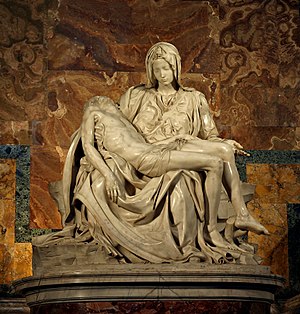
The second image is the Pietà, Michaelangelo’s to be specific. I keep thinking of this image in connection with the violent deaths of the children of Sandy Hook, Connecticut. It is likely that most of those parents were not able to cradle the bodies of their babies- stopped from doing so because of the cause of death and the condition of the bodies. Thus, I think of that image of Mary cradling the grown Jesus and remembering in her mind how she held him so many times before. I know those parents are remembering every moment they held their children. The other thoughts that are probably running through their minds are too hard for me to imagine. Not impossible to imagine, but too hard for me to consider and still let go of my own toddler and refuse to live in fear.

These images are not only interfering with my sleep, but they are marching into the forefront of my mind as I try to prepare for Christmas. One of the things that I wrestle with all the time, theologically and personally, is the connection between Christmas and Easter. More specifically, the connection between Christmas and Good Friday. I do not accept that Jesus was born, destined for the cross. I am not resigned to the idea that betrayal and crucifixion were inevitable. My faith is anchored, beyond the veil, in the trust that God is bigger than all things, was revealing that power before Jesus, and that the Messiah came into the world to be the clear sign of that power and a clear revelation of God’s expectations of creation.

Death, violent or otherwise, was never a part of God’s intentions for creation. With our scientific minds (and I love science), we understand a cycle of birth, decay, and death. Yet, our faith teaches that this is not preordained. We are not born to die. We are born for life. We are gifted with faith for abundant life. Somehow, in some way, the Christmas story is the heart of this truth- that God came into the world in an expected way, so that we might believe and live. When death tries to trump that truth, life wins. Love wins. Joseph does not stone Mary. The childhood illnesses that could have claimed Jesus’ life do not succeed. The devil’s temptations do not stand. The threats of detractors do not hold water. The cross and tomb are not the final word. Incarnation leads to not to crucifixion, but to resurrection. Life wins.

In this season of grieving, personal and public, for my friends, for people I do not know, for our world, I do believe that life wins. The story of God’s entrance into the world as one of us is not the beginning of that theme, but the powerful plot twist that no one expected and that surprises us still.

Every death, every stillbirth, every child, every 110-year-old, is a death that is too soon when it precedes God’s final renewal of heaven and earth. Yet these deaths are not the final word. That Word is God’s. The Word that has always been with God, indeed the Word that is God, is life. Life.

There comes a point where I don’t have anything else to say and so I have to stop talking. The grief is too real. The pain is too sharp. The explanations are weak or non-existent.

And still hope flickers.

And still we say, “Come, Lord Jesus.”

And still Life shines through the darkness. And the darkness cannot overcome it.


Sunday, December 16, 2012

Dressed for Joy (Sermon 12/16)


Isaiah 61:1-11


How many of you know the adage, “Wear clean underwear, because you never know when you’ll be in an accident”? While I do not want to know how many of you follow that rule, I suspect many of you think about what you wear each day. Am I dressed or ready for the car to break down? Am I dressed or ready if I had to sit for a while and wait? Am I dressed and ready for walking around the store, getting gas, watching a toddler, changing a tire, having lunch with a friend?

This is a question I ask myself all the time. Especially as the number of clothes I have that fit begins to dwindle, I ask myself, “Is this what I want to be wearing for a hospital visit? For an emergency call? For pastoral authority in the office?” Sometimes I’m not dressed, or I don’t feel like I am, for what I need to do.

On Friday, after the initial shock of the news out of Connecticut, I was thinking about opening the church into the evening for prayers. When I decided to do that, I was wearing jeans and a sweater. A fine outfit for sitting in the office and writing a sermon, not what I wanted to be wearing when we were opening the church and I was talking with the people who came in and out all day. “I’m not dressed for this”- I kept thinking. What I really meant was- I’m not ready. I’m not prepared for this.

This is not the first time this has happened. Someone here once told me- it doesn’t matter what you’re wearing, just show up. Good advice, but I know I’m not the only one to whom this happens. How many of you felt overwhelmed this week- either by the season, by events, or by memories? How many of you have had a call during the day or in the night- for which you weren’t dressed, for which you weren’t ready?

Thus, in considering that the third Sunday in Advent is Joy Sunday, I don’t feel dressed for it. If we had colored candles, this would be the pink one (the others being blue or purple). Joy Sunday! And that’s what the task that the prophet Isaiah delivers to Israel and that is also communicated to us, as our task, through Jesus. It is our task to seek joy, to be found by joy, to communicate joy.

Isaiah says the role of the prophet, which is now the mantle that goes over all of Israel and extends to all who live by faith is this: The spirit of the Lord God is upon me, because the Lord has anointed me; he has sent me to bring good news to the oppressed, to bind up the brokenhearted, to proclaim liberty to the captives, and release to the prisoners; to proclaim the year of the Lord's favor, and the day of vengeance of our God; to comfort all who mourn; to provide for those who mourn in Zion --- to give them a garland instead of ashes, the oil of gladness instead of mourning, the mantle of praise instead of a faint spirit.  (61:1-3)

Do you feel dressed to do that? To declare the year of the Lord’s favor? To bring good news to the oppressed and to comfort all who mourn? Do you feel ready to proclaim joy?

Joy is not happiness. It is one of the fruits of the Spirit (love, joy, peace, patience, kindness, goodness, faithfulness)- not something we can produce ourselves, but something that God brings forth in us. Joy has the twinge of the fight, of how far it took to get there, it is hard earned and treasured. Joy is the light that shines in the darkness and shines that focused beam, making us aware of how dark things can be. How can we be ready for joy? How can we be ready to proclaim it? How do we dress for this?

The only way to be dressed for joy is to be clothed in Christ.  To be clothed in the experience of weeping at the death of a friend, to know betrayal, to have eaten good-bye meals, to have people turn away from grace, to feel forsaken… and to still taste resurrection, to still hope in return and restoration, to trust in the possibility of peace, to rest in the light of Love. 

The only way to be dressed for joy is to be clothed in Christ, clothing which comes with all of these experiences, the accessories of faith, if you will- the very real experiences of this very real life.  Joy is not the absence of suffering, but the presence of God.

            I cannot tell you why bad things happen. I cannot tell you that we will live to see the good that God will bring from some of the tragedies of our lifetimes. I cannot undo the exile of the Israelites and I cannot redo Friday with a different outcome.

            God is not the “why” of tragedy and devastation. God is the how- the how we get through it. God is the where- consoling to the grieving, receiving the dying, walking with the confused and afraid. God is the who- the One who made all things and loves all creation. God is the when- a mystery to us, but a promise of renewal and bringer of unexpected joy. God is the what- the what we shall wear, the what we shall say, the what we shall turn to.

            When there is no “why”, there is a Holy Who/Where/How/When/What that clothes us in grace, that dresses us in mercy, that accessorizes us with joy. We come as we are to God’s dressing room- the baptismal font, Holy Communion, a conversation with a friend, a time of prayer- and we are draped in Christ.

            What do you wear to do that proclaiming, to be a priest of the Lord, a minister proclaiming God’s favor (as Isaiah says you are)?

            (Make the sign of the cross). You wear the sign of the cross and…

There! You’re dressed for proclamation. You are wearing the promise of the Holy Spirit, the mark of Christ crucified and risen, the symbol of hope for the whole world. You will never be more ready to bear joy. You will not find anything that fits you better. There’s never been a more graceful fit, a closer fit, a more beautiful shape. The cross is the clothing we’ve got… its emptiness, its inability to be the final word, its attempt to stop the Word of Life… it is how God dresses us to go out into the world. The sign of the cross is our clothing for grieving and for rejoicing, for sorrow and for joy. The sign of the cross is our Christmas sweater, our Easter suit, our Epiphany workout clothes, our Pentecost learning outfit, our clothing for waiting, for hoping, for proclaiming.

            It is Advent and we wait. We wait for a great deal, including joy. But we’re dressed for it, when it comes. Saved and clothed in righteousness by Christ’s own faithfulness, we are dressed to heal, to share hope, to be a part of the work of the kingdom. In the midst of tragedy and hope, we are dressed, in the cross, to seek and to be found by joy. Amen.


Sunday, December 9, 2012

Advent Ache (Sermon 12/9)


Joel 2:12-13, 28-29


            Here’s the funny thing about Christmas- the holy days, not the holiday- it’s the shortest church season we have. Even if Lent starts early, Epiphany is still longer than 12 days. Lent is forty days. The Easter season is fifty days. The season of Pentecost or Ordinary Time goes on past twenty weeks. Advent is four weeks. Christmas, as church season, is short.

            Many of us get tired of seeing the Christmas things all around us long before we show up to mark the birth of the Savior and our true expectation of God’s completion of that good work in Christ’s return. Christmas can get old before it gets here and yet we’re uncertain what to do with Advent. (How many have Advent wreaths in their homes?)

            Frankly, I’m feeling very Advent. I go into Safeway and I hear, “It’s the most wonderful time of the year…” Yet all I can think about is the number of suicides that have been in the news this week.

I enter Fred Meyer and hear: “I really can’t stay (Baby, it’s cold outside). I gotta go ‘way (But, baby, it’s cold outside).” Yet, I think about the people who call the church office every week asking for food assistance, for gifts for children, for rental help.
           
            I wait to get my oil changed and I hear, “Santa Baby, slip a sable under the tree… for me… been awful good girl.” I think about the people who use the Listening Post downtown and the volunteers there who hear powerful and overwhelming stories, every day of the year- not just in this season.

            I turn on the car radio and I hear, “’Come,’ they told me, Pa-rum-pa-pum-pum.” I think of the drums of war, the drums of greed, the drums of fiscal concern that are beating all around.

            I have an Advent ache and the Christmas music can’t drown it out. The short Christmas season is never long enough to overcome all of these less cheery realities that are currently part of this life.
So then I sit in my office and I turn to the reading for this week- four short verses from the prophet Joel. Thinking about Joel’s time frame, one might expect that the book would be full of rejoicing, but it’s not. Joel is writing to the Judeans who have returned to Jerusalem after the exile. There may be a few people who can still dimly remember earlier days, but most of the exiles are younger and have never seen the city. The temple ruins, the place the market once stood, the homes haunted by memories of what was before Babylon swept in and carried it all away… the most intense longing for Jerusalem did not prepare them for the return.

            And in those first days and first weeks of trying to reclaim, resettle, restore, no one wants to say how disappointing it all is. How it is not what they expected. How the triumphant return has not only fallen flat, but flat out sucks. They are expecting Christmas- actually, they are longing for the Messiah- but they are in a very Advent time.

            And, honestly, it is an Advent time for God. The people did not return thanking God. They didn’t speed over the hills and valleys, with their hearts in their throats in anticipation of worshiping in what was left of the temple. Some of them chose to stay in Babylon, to adapt to life there-including the religious practices of the new location. God’s waiting, too- waiting for people to heed the call of the prophets, to sing the songs of praise, to stop taking favor for granted, but to put it to use for making the world a better place.

            It’s the Advent ache. Things are not what we would hope for. We are not always what God would hope for. The longing of this season allows us to sit in silence with that and to express our longing for God’s answer to the problem, to the gap, to the divide. The longing of the season allows us to sit with God’s own longing hope for creation. The response to that hope came at the first Christmas…and comes again in all kinds of ways.            

            Our Advents hymns express this longing, especially some of the ones that are worked into our liturgy.

Consider: Come, thou long expected Jesus- “born to set thy people free- from our fears and sins release us- set our hearts at liberty…” (Charles Wesley) The verses of this song express our hope in all that Christ’s advent will bring- freedom, peace, rest.

Consider: O come, O come, Emmanuel- written as early as the 8th century (or maybe a little earlier). Based on the old “O antiphons” or verses that reflection Advent anticipation. The verses in Latin form an acrostic, a word out of the first letter of each verse, the word Erocras meaning, “I will be tomorrow”. The longing for Christ in the song is answered, mysteriously, by a response that Christ is coming.

Consider: Ososo,  or “Come now, O Prince of Peace”. This is a Korean hymn, written in 1988 for a world conference focused on attaining peace and reunification for the Korean peninsula. “Come now, Lord Jesus, reconcile all nations” has a very different feel when you are considering people who are separated from family members, from resources, from peace.

            These are songs of Advent, songs of longing, songs that say, “Things are not what we hoped for.” The answer we get, to our singing and our sighing, is “Return to the Lord, your God, for he is gracious and merciful, slow to anger, and abounding in steadfast love, and relents from punishing.” Return to the Lord… gracious and merciful… steadfast love… slow to anger…

            Christmas is a short season, in part because we live in an Advent world. A world that has received God’s body in its midst and still remains broken. A world that has seen (and still sees) miracles like no other. A world that has been gifted the outpouring of the Holy Spirit… and still cries for reconciliation, for peace, for grace. It’s not a sin to not be ready for Christmas. It’s a reality. It’s a real expression of where we are, who we are, and what we are asking God to do in the world. It is honest to look at the paper, the city, the news, the world, and say, “This is not what we hoped for.” It echoes what God also is saying to us.

            Advent means God has not let our hope die. Advent is a season for waiting in the Lord, for returning to the Lord, for hoping in the Lord. It is not yet time for “Good Christian friends, rejoice, with heart and soul and voice...” It is the season of “Come, now, O God of love, make us one body. Come, O Lord Jesus, reconcile your people.”


Amen. 

Tuesday, December 4, 2012

Advent Lions (Sermon 12/2)


Daniel 6:6-27

            Talk to me about the war on Christmas. How many of you are having a hard time finding Christmas decorations? How many of your family members have met you in back alleys to exchange cards, hoping to be undetected? Other than the icy roads, who was worried about coming here today? Has anyone been so deluged by Happy Holidays, Happy Hanukkah, or Kwanzaa commercialism that they just felt unable to get a word in edgewise for the Christmas holiday? Anyone?

            It is hard for me to listen to rhetoric about the “war on Christmas” and think about religious persecution around the world that happens today, both to Christians and non-Christians. It’s hard for me to listen to rants about the “war on Christmas” and to read about Daniel at the same time. Here is a story about real persecution and real faith. A story about a young Jewish exile, likely born in Babylon, never having seen Jerusalem… he serves under four kings, the first two of which change his name- not calling him by his Hebrew name Daniel, but by the Greek name- Belteshazzar. Daniel serves at the pleasure of the king and does not hold back from the obviousness of his true devotion to the one God.

            Daniel maintains a strict diet (see Daniel 1), interprets dreams (Daniel 3-5), and finally refuses to cave to pressure from jealous rivals and does not stop worshipping God (Daniel 6). This story is almost intimidating in Daniel’s faithfulness. He has no guarantee that God will prevent the lions from destroying him. God didn’t prevent the exile into Babylon. Daniel’s only comfort is in trusting in God’s faithfulness above all else- above the desertion of exile, above the power of King Darius, above the ferocious nature of the lions.

            When I think of what it means to live faithfully, under those kind of conditions, the much-discussed “war on Christmas” becomes unimpressive indeed. As we enter the season of Advent today, we are called to ponder what are the lions that face us? What is the exile we experience?

            We know that Christmas, the holy day (as opposed to the holiday), is not for another 22 days, beginning the evening of 24 December. Believing that God-with-us, Emmanuel, has already been born into world once, is present with us still, and yet will come again, what are we waiting for? The exile we experience is the space between what we believe is true and what we observe around us.

            We believe in the Prince of Peace and yet we do not see peace. We believe in the Spirit of Consolation and still we see many who are not consoled, grieving, anguished. We believe in the Creator of all that is seen and unseen and yet we see many who struggle- some because of their own decisions, some because of the actions of others. We believe a light shines in the darkness and the darkness has not overcome it, yet the darkness still seems very, very deep (and not just because it’s winter in Alaska).

            The lions that slink around us in Advent are both obvious and subtle. There are showy lions of commercialism, decadence, and acquisition. Their roars tempt us to place our hope in things that are shiny and promising now. Then there are the subtle, hungry lions of hopelessness, frustration, depression, and isolation. Their sneak attacks undercut our ability to stand false brightness of the holiday and leave us unprepared for the holy day. The war on Christmas isn’t some outside entity, but a struggle that happens within us and around us to undercut our waiting hope- emphasized this time of year, but lived out every day of the year.

            Our Advent exile- our time apart, waiting in hope- gives us the opportunity to fight off these lions, to dare to be a Daniel and to pray beyond the falseness of their promises. In this season of waiting, we are presented with the chance to exercise our faithfulness, our hope in God, our expectation of holiness, our trust in the promise of Emmanuel, God-with-us. And, like Daniel, our faithfulness only stands in the light- the undimmed light- of the One God who is the gifter, sustainer, and perfecter, who is Faithfulness itself. 

Tuesday, November 27, 2012

Mind the Gap

This post originally appeared here as "Second-Class Baptism" on 22 November 2012. 


         In the fall of 2005, I was an exchange student from Yale Divinity School to Westcott House, a member of the Cambridge Theological Federation in Cambridge, England. It was quite an awakening for this Lutheran. Despite knowledge of some of the rifts in the Episcopal Church (USA), I had very little awareness or comprehension of the major theological divides in the Church of England. In the wake of the recent decision (11/20/12) by the General Synod of the Church of England not to ordain women as bishops, I have recalled learning about those divides, specifically through a speech I heard that semester. 

            During my time in Cambridge, I went to an event sponsored by Women and the Church (WATCH) to hear speakers arguing for the ordination of women as bishops. One speaker, whose name is lost to my memory, gave a carefully constructed and passionate speech about baptism and vocation within the church. She noted that if we do not believe women are qualified and gifted by God for leadership at any and all levels, why do we bother to baptize them? I have never forgotten that sentence, which was so stunning that the room was silent for several seconds afterwards.

            Even with disparate understandings and beliefs about baptism, most Christians agree that the washing rite reveals God’s claim on an individual and, simultaneously, a welcome of that individual into the corporate work of the church on earth. What happens to that second part when we baptize someone, but tell her that because of her sex organs- the Church will interpret how God is using her? What does it mean to pour the water, make the sign of the cross, and say, “But because of your sex, you’re only fit to carry the cross of Christ this far, in this way, and with these provisions?”

            Furthermore, when the Church places provisos for leadership based on sex, gender identity, sexual orientation, race, or other biological circumstance, we presume a kind of certainty and zeal in speaking for God that should make us pause. Throughout history, people have been quick to use the name of God as the seal of approval on whatever preferred course of action was believed to need pursuing. This often occurred through the same kind of biblical gymnastics that still occur today- a little limbo under the inconvenient verses, a vault over the stories that are contradictory, a lovely ribbon-dancing floorshow with the few verses that, out of context, support exactly the argument one is trying to make.

            If the Church of England was honest about its history, its theology, and its current struggle to remain relevant in today’s society, perhaps the voting would have gone differently. Perhaps if the space were made for lament over the rifts in the modern church and, in the next breath, prayers for the future were offered, maybe the voting would have gone differently. Maybe if we could point out that shortly after Peter and Andrew left their nets, they were joined by Mary of Magdala, Joanna, and Susanna in following Jesus- we might be able to have the conversation that nothing about the image of ministry or mission in the Bible at all resembles the way most churches and denominations are structured today. Maybe then things would go differently. 

            The main conversation that must happen, though, is the one around God’s ability to equip, regardless of biology. Either we believe that the Holy Spirit blows where She wills or we don’t. Either we believe that God is more powerful that human weakness (present in all) or we don’t. Either we believe that Jesus broke down social and gender barriers in community and communion or we don’t. Either we wrestle with our human limitations in comprehending the expansive nature of God’s mercy, call, and creative purposes or we get used to our efforts failing as God says, “Oh, no, you don’t.”


          The failure of the General Synod to pass, by just six votes, a measure allowing for the ordination of women as bishops is not a sign of failure on the part of either side. It is a sign that there is a gap between the understanding of the gift of baptism and the Church’s willingness to allow all people to live into that gift. That space creates an unholy chasm into which many gifts will fall and go unused because of the pain in this construction: “You are a child of God, but here’s exactly what that looks like.” When a significant church body, like the Church of England, says to women, “Your skills are useful this far and no further,”- what most women and girls hear is this: “God loves you as you are, but would love you more if you were a man.” If that is the case, why, and into what, are we baptizing women? As they say on the London tube (subway), “Mind the gap, please.” 

Sunday, November 18, 2012

Hemmed in Thanksgiving (Sermon 11/18)


Isaiah 6:1-8

            There are many details in this story that can be distracting. Who was King Uzziah? What exactly does a seraph look like?  Why is Isaiah’s call to be a prophet happening six chapters in, instead of in chapter 1? All of these are good questions, but not ultimately what this short passage is about.

            Isaiah is in the holy of holies, inside the innermost part of the temple. He is a having a vision or an experience, where the shapes on the Ark of the Covenant are slowly transformed until they are no longer carvings, but are revealing to him the activity that happens around the throne of God.

            When Isaiah says, “Woe is me…” This is not a Charlie Brown-kick-the-dirt kind of grousing. It’s a gulp of terror. To see God, in Hebrew Scriptures, is to know that you are about to die. No one sees the face of God and lives. Isaiah has nothing to offer; yet what happens next isn’t based on what he can bring. It’s based on what God can do and how Isaiah responds.

            God’s attendants come and purify Isaiah, giving him a real experience of forgiveness and grace in the presence of God… mercy when he expected to die, absolution without a sacrifice or offering, righteousness on God’s terms (not human definitions). Thus, Isaiah is so moved that when God converses with the heavenly host: Who will go for us? Whom shall I send?- Isaiah pipes up, “I’ll go! Send me!”- even before he knows what he will be asked to do or say.

            Isaiah is so grateful for his life and for grace, that he’s willing to undertake a task from God- the details of which he does not know, but if he thought for a minute about prophetic history, he’d probably offer someone else’s name instead. Isaiah realizes that God does not abandon unclean people, but makes them holy, makes them ready, and invites them into the work that needs to be done. He says, “Send me”, not because he is an amazing prophet, but because he recognizes the grace in being involved in God’s work in the world.

            How much of God does Isaiah see? Certainly not God’s face or even God’s hands- these are not visible. Isaiah only gets a view of God’s feet: “The hem of God’s robe fills the temple.” Only God’s feet… but it is enough. This experience, God’s feet and hem, an encounter with forgiveness, is enough to move Isaiah to gratitude and to action.

            In the coming week, most of us will be considering the things for which we are grateful. We will listen to others around us say for what they are thankful. Almost in the same breath, as we speak of gratitude, we will think of new things that we want or perceive that we need. What if we stopped and just thought about the hem of God’s robe? What if we became absorbed, like Isaiah, in a vision of God’s activity in the world, in our communities, in our lives? And what would happen if we realized that all we are grateful for, all that we are able to perceive is just the hem of God’s robe?

            It’s not the whole picture. It’s not even half. The grace that we are able to comprehend is just the tip of the iceberg. And yet it is enough. It is enough for us to know just this much and to not die. Let this be your Thanksgiving thought: all that you can think of to list as blessings in your life barely begins to list all that God has done for you.

            So it is for all people and all creation. Having received more, and costlier, grace than we can comprehend through Christ, may God’s Spirit move our thanksgiving beyond “thank you” to “Here I am. Send me” – a thanksgiving response to the grace of in being involved in God’s work in the world.

Amen. 

The Way of the Cross Can Have Rhinestones (Sermon)

This is a sermon about Jesus, adversaries, and Dolly Parton.  When Jesus says to Peter, “Get behind me, Satan”, I imagine the other disciple...